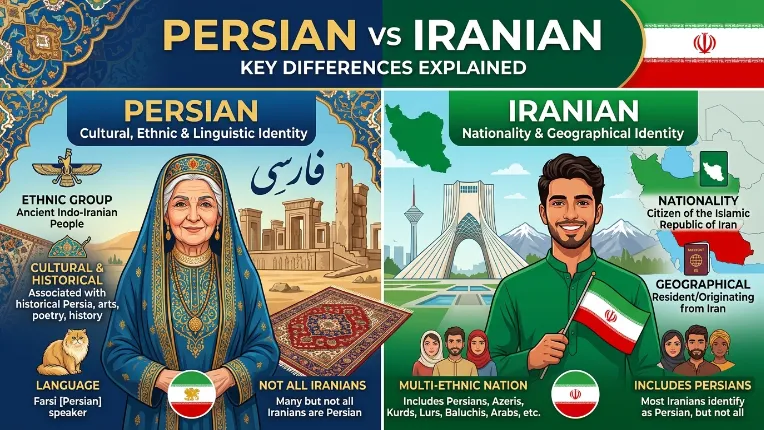
The difference between Persian and Iranian is that Persian refers mainly to an ethnic group, language, and culture, while Iranian refers to anyone who belongs to or comes from the country of Iran.
A student named Daniel once visited the Middle East for a cultural exchange program. While meeting people from Iran, he heard some people call themselves Persian and others say they were Iranian. Daniel became curious and wondered what the real difference between Persian and Iranian was. Many people around the world face the same confusion because the two terms are often used interchangeably.
The difference between Persian and Iranian mainly relates to culture, ethnicity, and nationality. Persian refers to a specific ethnic and cultural group with a long historical heritage, while Iranian refers to anyone who belongs to the country of Iran regardless of ethnic background. Understanding the difference between Persian and Iranian helps people appreciate the rich diversity within Iran. Knowing the difference between Persian and Iranian is also important in history, culture, language, and international identity.
Key Difference Between Persian and Iranian
The main difference between Persian and Iranian lies in ethnicity versus nationality.
- Persian refers to an ethnic group, language, and culture.
- Iranian refers to a citizen or resident of the country of Iran.
Why It Is Important to Know the Difference
Understanding the difference between Persian and Iranian is important for cultural awareness and accurate communication. Iran is a diverse country with several ethnic groups including Persians, Kurds, Azeris, Arabs, Baluchis, and others. When people assume that all Iranians are Persian, they overlook this cultural diversity.
Recognizing the difference between Persian and Iranian also helps in academic fields like history, anthropology, and international relations. Persian culture has influenced art, poetry, architecture, and language for thousands of years. Meanwhile, the term Iranian represents the modern national identity of people living in Iran today. Understanding this distinction helps people respect both cultural heritage and national identity.
Pronunciation (US & UK)
| Term | US Pronunciation | UK Pronunciation |
| Persian | /ˈpɜːrʒən/ | /ˈpɜːʒən/ |
| Iranian | /ɪˈreɪniən/ | /ɪˈreɪniən/ |
Linking Hook:
Now that we understand the basic concept, let’s explore the detailed difference between Persian and Iranian.
Difference Between Persian and Iranian
1. Meaning
Persian refers to a specific ethnic and cultural group, while Iranian refers to nationality.
Examples:
- A Persian person belongs to the Persian ethnic group.
- An Iranian citizen may belong to any ethnic group in Iran.
2. Cultural Identity
Persian represents a cultural identity with ancient traditions. Iranian represents a national identity.
Examples:
- Persian culture includes classical poetry and traditional art.
- Iranian identity includes all cultural groups within the country.
3. Language
Persian refers to the Persian language (also called Farsi). Iranian may refer to speakers of different languages.
Examples:
- Persian language is widely spoken in Iran.
- Some Iranians speak Kurdish or Azeri instead of Persian.
4. Historical Background
Persian history dates back thousands of years to ancient empires. Iranian identity developed later as a national identity.
Examples:
- The Persian Empire existed in ancient times.
- The modern nation-state of Iran developed in the 20th century.
5. Geographic Meaning
Persian originally referred to people from the region of Persia. Iranian refers to people from the country of Iran.
Examples:
- Ancient Persia included parts of modern Iran.
- Today, Iranian refers to citizens of Iran.
6. Ethnic Diversity
Persian is one ethnic group among many. Iranian includes all ethnic groups in the country.
Examples:
- Persians form a large ethnic group in Iran.
- Kurds, Azeris, and Arabs are also Iranian citizens.
7. Use in Global Context
Persian is often used in cultural or historical discussions. Iranian is used in political and national contexts.
Examples:
- Persian art and Persian carpets are famous worldwide.
- Iranian politics refers to the government of Iran.
8. Historical Terminology
The name Persia was widely used internationally until the 20th century. Iran became the official name in 1935.
Examples:
- Western countries historically called the region Persia.
- The government later asked other nations to use the name Iran.
9. Cultural Representation
Persian identity emphasizes heritage and traditions. Iranian identity represents modern national unity.
Examples:
- Persian poetry reflects ancient cultural values.
- Iranian national celebrations unite different ethnic groups.
10. Global Perception
Persian often carries a cultural or artistic association. Iranian is associated with nationality and modern identity.
Examples:
- Persian cuisine is recognized globally.
- Iranian passports identify citizens of Iran.
Nature and Behaviour of Both
Persian:
- Cultural and ethnic identity
- Associated with language, literature, and traditions
- Rooted in ancient history
Iranian:
- National identity
- Represents all citizens of Iran
- Includes multiple ethnic groups
Why Are People Confused About Their Use?
People often confuse the difference between Persian and Iranian because the two terms are closely related. Since Persia was the historical name for Iran, many people assume that Persian and Iranian mean the same thing. Additionally, Persians form a large portion of Iran’s population, which adds to the misunderstanding.
Difference and Similarity Table
| Feature | Persian | Iranian | Similarity |
| Meaning | Ethnic group | National identity | Both connected to Iran |
| Language | Persian (Farsi) | Multiple languages | Cultural heritage |
| History | Ancient cultural identity | Modern nationality | Shared history |
| Use | Cultural context | Political/national context | Related terms |
| Scope | Specific group | Entire population | Iranian society |
Which Is Better in What Situation?
Persian is better used when discussing culture, language, literature, or historical traditions. For example, it is correct to say Persian poetry, Persian carpets, or Persian cuisine because these expressions highlight the cultural heritage of the Persian people.
Iranian is better used when referring to nationality, citizenship, or modern political identity. For example, people say Iranian government, Iranian economy, or Iranian citizens when discussing topics related to the country as a whole.
Metaphors and Similes
- Persian as a “cultural treasure.”
Example: Persian culture is like a treasure chest filled with centuries of art and poetry. - Iranian as a “national umbrella.”
Example: The Iranian identity acts like an umbrella that includes many different ethnic groups.
Connotative Meaning
Persian
- Positive: elegance, heritage, artistic tradition
- Neutral: ethnic or cultural description
Example: Persian literature is admired for its beauty.
Iranian
- Positive: national pride and unity
- Neutral: nationality
Example: Iranian citizens celebrate their national identity.
Idioms or Proverbs Related to Culture
- “A nation’s culture lives in its language.”
Example: Persian language reflects centuries of cultural history. - “Unity in diversity.”
Example: Iran represents unity in diversity with many ethnic groups. - “History shapes identity.”
Example: Persian history strongly influences Iranian identity today.
Works in Literature Related to Persian Culture
- Shahnameh – Epic poem by Ferdowsi (1010), Persian literature
- Rubaiyat of Omar Khayyam – Poetry collection by Omar Khayyam (12th century)
Movies Related to Iranian Culture
- A Separation – 2011, Iran
- Children of Heaven – 1997, Iran
- The Salesman – 2016, Iran
Frequently Asked Questions
1. What is the main difference between Persian and Iranian?
Persian refers to an ethnic group and culture, while Iranian refers to nationality.
2. Are all Iranians Persian?
No. Iran has many ethnic groups, including Persians, Kurds, Azeris, and others.
3. Do Persians live only in Iran?
No. Persian communities also exist in countries like Afghanistan and Tajikistan.
4. Why was Persia renamed Iran?
In 1935, the Iranian government asked other countries to use the name Iran officially.
5. Is the Persian language the same as Iranian?
Persian (Farsi) is a language spoken by many Iranians, but not all Iranians speak it as their first language.
How Both Are Useful for Society
Persian culture has contributed greatly to world civilization through literature, art, science, and architecture. Iranian national identity unites different ethnic communities within one country and promotes social cooperation. Together, these identities preserve history while supporting modern society.
Final Words
Persian and Iranian are closely connected terms, but they represent different ideas. Persian highlights culture and ethnicity, while Iranian highlights nationality and citizenship.
Conclusion
The difference between Persian and Iranian lies mainly in the distinction between cultural identity and national identity. Persian refers to an ethnic group with a rich cultural heritage, language, and historical traditions that date back thousands of years. Iranian, on the other hand, refers to anyone who belongs to the modern country of Iran regardless of ethnic background. While many Iranians are Persian, the country is home to many other ethnic groups as well. Understanding the difference between Persian and Iranian helps people appreciate both the diversity within Iran and the cultural legacy of Persian civilization. Recognizing these distinctions promotes better cultural awareness and respectful communication in global discussions.
Difference Between Contractors and Subcontractors:Complete Guide

I’m Nathan Brooks, an independent writer passionate about vocabulary clarity and usage differences. On Hubdifference.com, I create easy-to-understand comparisons covering American and British English variations. I focus on simple language, practical tips, and reader-friendly explanations. Helping people write with clarity and confidence is what drives my work.