One-line snippet: Agriculture is the large-scale cultivation of crops and livestock, while horticulture focuses on small-scale, intensive plant cultivation like fruits, vegetables, and ornamental plants.
Many students, farmers, and even general readers often get confused when they hear the terms agriculture and horticulture. At first glance, both seem related to farming and plants, so people assume they are the same thing. But in reality, there is a clear and important difference between them.
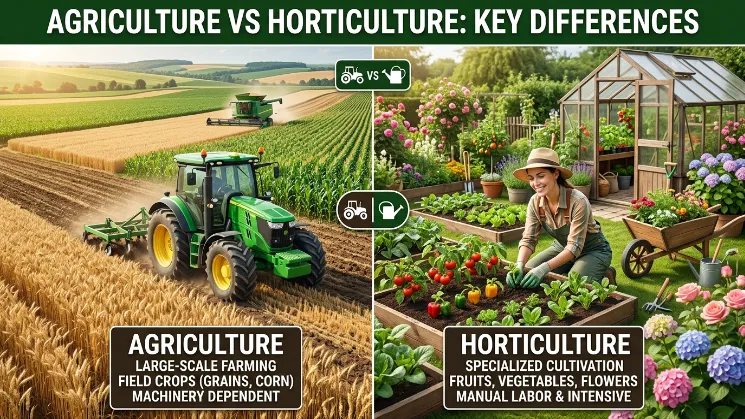
Imagine you are driving through vast fields of wheat stretching for miles that is agriculture. Now picture a well-maintained garden filled with colorful flowers, fruits, and vegetables that is horticulture. Both involve growing plants, but their purpose, scale, and methods are completely different.
Understanding this difference is not just useful for exams; it also helps in career choices, farming practices, and even business opportunities in the agriculture sector. In this article, we will break down both terms in the simplest way so you never confuse them again.
What is Agriculture?
Agriculture is the broad science and practice of cultivating land, growing crops, and raising animals for food, fiber, fuel, and other human needs. It is one of the oldest human activities and forms the backbone of the global economy.
Simple Meaning
Agriculture means large-scale farming of crops and livestock to meet mass food demand.
Key Features of Agriculture
- Involves large fields and farmland
- Focuses on staple crops like wheat, rice, maize, and sugarcane
- Includes animal farming (cattle, poultry, etc.)
- Uses machinery and modern technology
- Production is mainly for commercial purposes
Real-World Meaning
Agriculture is what feeds entire countries. From bread to rice and milk, most daily food products come from agricultural activities.
What is Horticulture?
Horticulture is a branch of agriculture that focuses on the cultivation of garden plants, fruits, vegetables, flowers, and ornamental plants. It is usually done on a smaller and more controlled scale compared to agriculture.
Simple Meaning
Horticulture means growing fruits, vegetables, and decorative plants in gardens or small farms.
Key Features of Horticulture
- Done on smaller land areas like gardens or orchards
- Focuses on high-value crops like fruits and vegetables
- Includes flowers and decorative plants
- Requires more care and attention
- Often involves scientific and controlled growing techniques
Real-World Meaning
Horticulture is what gives us apples, mangoes, tomatoes, roses, and plants used for decoration and landscaping.
🔥 Comparison Table: Agriculture vs Horticulture
| Feature | Agriculture | Horticulture |
|---|---|---|
| Meaning | Large-scale cultivation of crops and livestock | Small-scale cultivation of fruits, vegetables, and ornamental plants |
| Usage | Produces staple food and raw materials | Produces fruits, vegetables, and decorative plants |
| Context | Broad farming system | Specialized branch of agriculture |
| Social Perception | Seen as mass food production system | Seen as advanced, scientific gardening and farming |
| Examples | Wheat, rice, maize, sugarcane, dairy farming | Mango, apple, tomato, rose, nursery plants |
Key Differences Between Agriculture and Horticulture
1. Scale of Production
Agriculture is done on a large scale using vast fields, while horticulture is carried out on smaller plots like gardens, orchards, and greenhouses.
2. Type of Crops
Agriculture mainly deals with staple crops like wheat and rice. Horticulture focuses on fruits, vegetables, flowers, and ornamental plants.
3. Level of Technology
Agriculture uses heavy machinery like tractors and harvesters. Horticulture uses more precision tools and controlled techniques like drip irrigation and greenhouses.
4. Purpose
Agriculture aims to produce food in bulk for the population. Horticulture aims to produce high-quality, often high-value products.
5. Labor and Care
Agriculture is less labor-intensive per plant due to large-scale farming. Horticulture requires more individual attention and care for each plant.
6. Profit Structure
Agriculture generally gives lower profit per unit but high total output. Horticulture gives higher profit per unit but lower total volume.
Real-Life Examples
To understand better, let’s look at real-world examples:
- A farmer growing wheat across 50 acres is practicing agriculture
- A gardener growing roses and vegetables in a greenhouse is practicing horticulture
- A dairy farm producing milk is part of agriculture
- An orchard producing mangoes and apples is part of horticulture
In many countries, both systems work together to ensure food security and economic growth.
Why People Confuse Agriculture and Horticulture
There are several reasons why these two terms are often misunderstood:
1. Both involve plants
Since both deal with plant cultivation, people assume they are the same field.
2. Overlapping practices
Some crops like vegetables can be grown in both agriculture and horticulture settings.
3. Academic definitions
In textbooks, horticulture is often described as a branch of agriculture, which adds to the confusion.
4. Language similarity
Both words are used in farming and agricultural studies, making them appear closely related.
Common Misconceptions
Myth 1: Agriculture and horticulture are the same
Fact: Horticulture is actually a specialized branch of agriculture.
Myth 2: Horticulture is only gardening
Fact: It includes commercial production of fruits, vegetables, and flowers.
Myth 3: Agriculture is outdated
Fact: Modern agriculture uses advanced technology like AI-based farming and precision irrigation.
Myth 4: Horticulture is less important
Fact: Horticulture plays a major role in nutrition, export, and landscaping industries.
FAQ Section
1. What is the main difference between agriculture and horticulture?
Agriculture focuses on large-scale crop and livestock production, while horticulture focuses on fruits, vegetables, and ornamental plants.
2. Is horticulture a part of agriculture?
Yes, horticulture is considered a specialized branch of agriculture that deals with intensive plant cultivation.
3. Which is more profitable, agriculture or horticulture?
Horticulture is often more profitable per unit because it deals with high-value crops like fruits and flowers.
4. Can horticulture be done at home?
Yes, horticulture can be practiced in home gardens, terraces, and small greenhouses.
5. What are examples of agriculture crops?
Common examples include wheat, rice, maize, sugarcane, and cotton.
6. What are examples of horticulture crops?
Examples include mango, apple, tomato, rose, and ornamental plants.
Conclusion
The difference between agriculture and horticulture is simple yet very important. Agriculture is a broad system focused on large-scale food production, while horticulture is a specialized field dealing with fruits, vegetables, and decorative plants on a smaller scale. Both are essential for human survival and economic development.
In short, agriculture feeds the world, while horticulture adds nutrition, beauty, and variety to it.

I’m Ethan Caldwell, a language enthusiast who enjoys simplifying confusing English word pairs for everyday readers. At Hubdifference.com, I write clear and practical comparisons that help users choose the right word with confidence. My goal is to remove confusion and make English learning simple, useful, and accessible. I believe the right words create better communication.