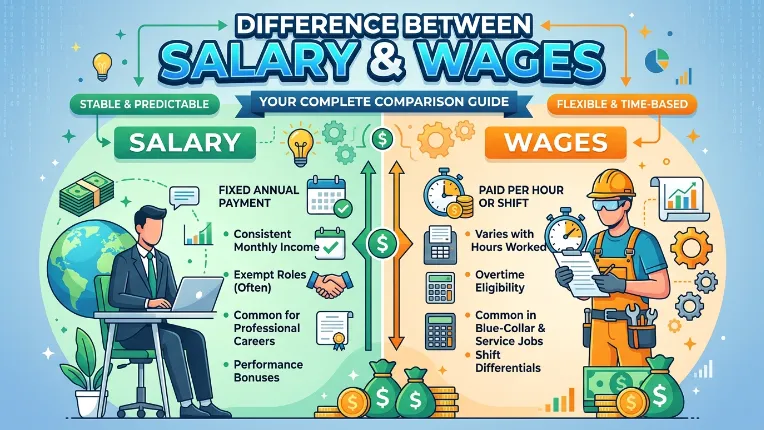
The difference between salary and wages is that salary is a fixed payment given regularly for professional work, while wages are payments made based on hours worked or tasks completed.
Imagine two workers in the same company. One receives a fixed amount at the end of every month. The other gets paid based on the number of hours worked each week. Both people earn money for their work, yet their payment systems are different. This common workplace situation helps explain the difference between salary and wages.
The difference between salary and wages mainly depends on the payment method and type of job. Salaries are usually fixed monthly or yearly payments. Wages are usually calculated hourly or daily. Understanding the difference between salary and wages helps employees, employers, and students learn how compensation systems work. When people understand the difference between salary and wages, they can better manage employment contracts, financial planning, and workplace expectations.
Key Difference Between the Both
The main difference between salary and wages lies in how employees are paid.
- Salary is a fixed payment given regularly, often monthly or annually.
- Wages are payments based on the number of hours or days worked.
Why Is Their Difference Necessary to Know?
Understanding the difference between salary and wages is important for both workers and employers. It helps people understand employment contracts and payment structures. Employees who receive salaries often have stable monthly income. Workers who earn wages may have income that changes depending on hours worked.
For businesses, the difference between salary and wages helps determine how to manage payroll and labor costs. In society, this knowledge supports fair employment practices and financial planning. Knowing the difference between salary and wages also helps job seekers understand what type of compensation best suits their needs.
Pronunciation
| Word | US Pronunciation | UK Pronunciation |
| Salary | /ˈsæləri/ | /ˈsæləri/ |
| Wages | /ˈweɪdʒɪz/ | /ˈweɪdʒɪz/ |
Linking Hook:
To understand payment systems better, let us explore the detailed difference between salary and wages.
Difference Between Salary and Wages.
1. Payment Structure
Salary: Fixed payment amount.
Examples:
- A manager receiving a monthly salary.
- An engineer paid an annual salary.
Wages: Payment based on time worked.
Examples:
- A factory worker paid hourly.
- A construction worker paid daily.
2. Job Type
Salary: Common in professional jobs.
Examples:
- Teachers receiving monthly salaries.
- Office managers paid annual salaries.
Wages: Common in manual or hourly jobs.
Examples:
- Restaurant workers paid hourly wages.
- Laborers receiving daily wages.
3. Payment Frequency
Salary: Usually paid monthly or biweekly.
Examples:
- Monthly payment to office staff.
- Biweekly salary in corporate jobs.
Wages: Often paid weekly or daily.
Examples:
- Weekly pay for hourly workers.
- Daily payment for temporary labor.
4. Income Stability
Salary: Income remains consistent.
Examples:
- Fixed monthly payment for employees.
- Annual salary divided into monthly paychecks.
Wages: Income varies depending on hours worked.
Examples:
- Workers earning more during overtime.
- Lower pay during fewer working hours.
5. Overtime Payment
Salary: Overtime may not always be paid.
Examples:
- Managers working extra hours without extra pay.
- Office workers completing tasks after hours.
Wages: Overtime usually paid at higher rates.
Examples:
- Factory workers receiving overtime wages.
- Construction workers paid extra for longer shifts.
6. Work Schedule
Salary: Usually fixed work schedules.
Examples:
- Office employees working regular hours.
- Corporate workers with fixed schedules.
Wages: Work hours may vary.
Examples:
- Part-time workers with flexible hours.
- Seasonal workers working different shifts.
7. Employment Status
Salary: Often associated with permanent employment.
Examples:
- Company executives receiving salaries.
- Full-time office staff paid salaries.
Wages: Often linked to temporary or hourly work.
Examples:
- Casual labor workers earning wages.
- Seasonal agricultural workers.
8. Benefits
Salary: Often includes benefits.
Examples:
- Health insurance for salaried employees.
- Paid leave for office workers.
Wages: Benefits may be limited.
Examples:
- Hourly workers without paid leave.
- Temporary workers with fewer benefits.
9. Calculation Method
Salary: Calculated annually or monthly.
Examples:
- Annual salary divided into monthly payments.
- Fixed yearly income for professionals.
Wages: Calculated by hours or days worked.
Examples:
- Hourly rate multiplied by hours worked.
- Daily wages for construction workers.
10. Financial Planning
Salary: Easier for budgeting.
Examples:
- Employees planning monthly expenses.
- Salaried workers managing savings.
Wages: Income may fluctuate.
Examples:
- Workers earning more during busy seasons.
- Lower income during fewer work hours.
Nature and Behaviour
Salary:
Salary represents a stable and predictable income system. Employees receive fixed payments regardless of slight changes in working hours. It is common in professional and managerial jobs.
Wages:
Wages represent a flexible payment system. Workers are paid according to the number of hours or days worked. This system is common in manual, part-time, or temporary jobs.
Why People Are Confused About Their Use?
People often confuse salary and wages because both terms refer to money earned from work. In everyday conversation, some people use them interchangeably. However, their payment methods and employment structures are different.
Difference and Similarity Table
| Aspect | Salary | Wages | Similarity |
| Payment type | Fixed amount | Hourly or daily pay | Both are income |
| Job type | Professional jobs | Manual or hourly jobs | Both pay employees |
| Stability | Stable income | Variable income | Both depend on work |
| Payment schedule | Monthly or biweekly | Weekly or daily | Both involve payroll |
| Benefits | Often included | Sometimes limited | Both support workers |
Which Is Better in What Situation?
Salary:
Salary is better for people who want stable income and long-term employment. It allows easier financial planning because the amount stays consistent. Professionals and office workers usually prefer salary-based jobs.
Wages:
Wages are better for jobs where working hours change frequently. They allow workers to earn more through overtime or extra shifts. Many part-time workers and temporary laborers benefit from wage-based payment systems.
Metaphors and Similes
Salary (Positive / Neutral)
Meaning: stability or steady income.
Examples:
- “A steady salary is like a reliable stream.”
- “His job provided a salary that supported his family.”
Wages (Neutral)
Meaning: reward for labor.
Examples:
- “Hard work brings its wages.”
- “Effort is the wages of success.”
Idioms or Proverbs
- Earn your wages – work hard enough to deserve pay.
Example: The team really earned their wages during the busy season. - Fair wages for fair work – payment should match effort.
Example: Workers demanded fair wages for fair work.
Works in Literature
- “Das Kapital” – Economics, Karl Marx, 1867
- “The Wealth of Nations” – Economics, Adam Smith, 1776
Movies Related to Work and Employment
- “Modern Times” – 1936, USA
- “The Pursuit of Happyness” – 2006, USA
Frequently Asked Questions
1. Is salary higher than wages?
Not always. Some hourly jobs may pay more depending on overtime.
2. Are wages paid hourly?
Yes. Wages are often calculated based on hours or days worked.
3. Do salaried employees get overtime?
Some salaried employees may not receive overtime pay.
4. Are wages common in part-time jobs?
Yes. Part-time and temporary jobs often use wage systems.
5. Which payment system is more stable?
Salary is generally more stable because the income is fixed.
How Both Are Useful for Surroundings
Salary and wages are essential parts of economic systems. They help businesses pay employees and support families through earned income. Both systems create job opportunities and support economic growth in society.
Conclusion
Understanding the difference between salary and wages helps people understand how employees are paid. Salary refers to a fixed payment usually given monthly or annually. Wages are payments calculated based on hours or days worked. Both systems have advantages depending on the type of job and work schedule. Salaries provide stability and predictable income, while wages offer flexibility and overtime opportunities. Recognizing the difference between salary and wages allows workers and employers to make better employment and financial decisions.

I’m Ethan Caldwell, a language enthusiast who enjoys simplifying confusing English word pairs for everyday readers. At Hubdifference.com, I write clear and practical comparisons that help users choose the right word with confidence. My goal is to remove confusion and make English learning simple, useful, and accessible. I believe the right words create better communication.