The difference between rifle and carbine is that a rifle is longer and more accurate at range, while a carbine is shorter, lighter, and easier to maneuver.
In military films, video games, and news reports, you may have noticed soldiers using different types of long guns—some large and full-length, others shorter and more compact. These are often rifles and carbines, and although they look similar, their design purpose is different.
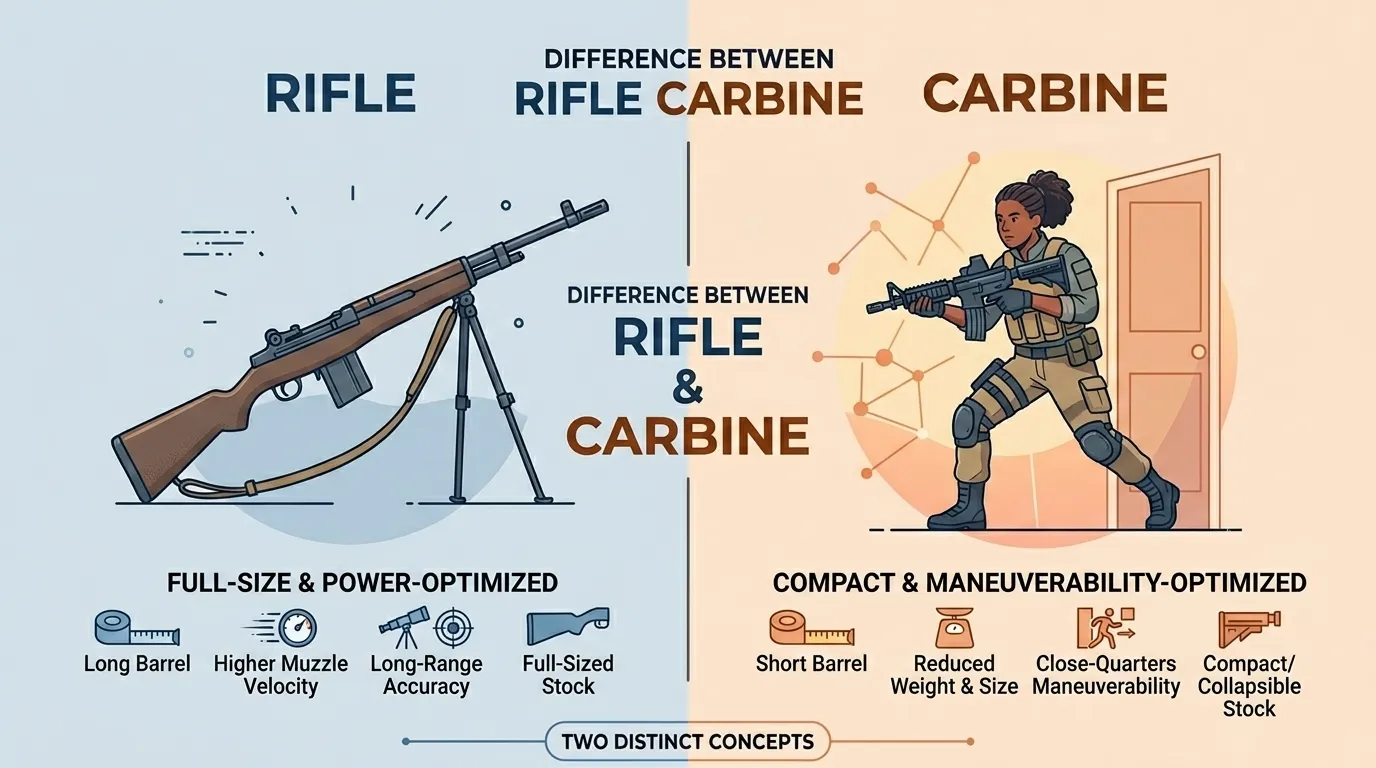
The difference between rifle and carbine becomes clear when you look at size, range, and handling. A rifle is built for precision and long-distance shooting, making it ideal for open-field combat. A carbine, however, is a shorter version designed for mobility, especially in close-quarters environments like urban warfare or tight spaces. Understanding the difference between rifle and carbine helps in military studies, firearms education, and defense-related knowledge.
KEY DIFFERENCE OVERVIEW
The difference between rifle and carbine mainly lies in size, barrel length, and intended use. Rifles prioritize accuracy and range, while carbines prioritize speed, compactness, and maneuverability.
IMPORTANCE OF UNDERSTANDING THE DIFFERENCE
Understanding the difference between rifle and carbine is important because:
- It helps in defense and military education
- It improves understanding of weapon design
- It clarifies tactical usage in different environments
- It supports accurate interpretation in news and media
For example, a sniper team may use rifles for long-distance targeting, while infantry in urban areas may prefer carbines.
PRONUNCIATION SECTION
Rifle
- US: /ˈraɪ.fəl/
- UK: /ˈraɪ.fəl/
- Phonetic: RYE-fuhl
Carbine
- US: /ˈkɑːr.baɪn/
- UK: /ˈkɑː.baɪn/
- Phonetic: KAR-bine
Key Differences Between Rifle and Carbine
1. Size Difference
A rifle is longer with a full-length barrel, while a carbine is shorter and more compact.
Example 1: Infantry rifle used in open battlefield.
Example 2: Short carbine used in tight indoor operations.
2. Barrel Length Difference
Rifles have longer barrels for better accuracy; carbines have shorter barrels for mobility.
Example 1: Long-range precision shooting with a rifle.
Example 2: Quick aiming in close combat with a carbine.
3. Weight Difference
Rifles are generally heavier, while carbines are lighter.
Example 1: Soldier carrying a full rifle over long distance.
Example 2: Lightweight carbine for fast movement.
4. Range Difference
Rifles are designed for long-range shooting; carbines are more effective at short to medium range.
Example 1: Sniper support rifle.
Example 2: Urban combat carbine.
5. Accuracy Difference
Rifles offer higher accuracy due to longer barrels; carbines are slightly less accurate at long distances.
Example 1: Target shooting at 500 meters.
Example 2: Engagement within 100–200 meters.
6. Handling Difference
Carbines are easier to handle in tight spaces; rifles require more space to maneuver.
Example 1: Moving inside buildings.
Example 2: Firing from open terrain.
7. Purpose Difference
Rifles are used for precision and long-distance combat; carbines are used for mobility and close combat.
Example 1: Defensive sniping.
Example 2: Patrol in urban areas.
8. Tactical Use Difference
Rifles are used in planned, long-range engagements; carbines are used in fast-moving situations.
Example 1: Battlefield positioning.
Example 2: Rapid response units.
9. Recoil Difference
Rifles may have stronger recoil due to higher power; carbines are easier to control in quick bursts.
Example 1: Controlled long shots.
Example 2: Rapid firing in close combat.
10. Mobility Difference
Carbines are designed for high mobility; rifles are less flexible but more stable.
Example 1: Running through tight spaces.
Example 2: Fixed position shooting.
INDIVIDUAL ANALYSIS
Nature of Rifle
A rifle is a long-barreled firearm designed for accuracy, stability, and long-range shooting. It is commonly used in military operations, hunting, and precision shooting. Its design focuses on maximizing bullet velocity and stability over distance.
Nature of Carbine
A carbine is a shortened version of a rifle designed for portability and ease of use in confined environments. It sacrifices some range and accuracy in exchange for faster handling and maneuverability, making it ideal for close combat situations.
CONFUSION REASON
The difference between rifle and carbine is confusing because:
- Both look structurally similar
- Both fire similar ammunition in many cases
- Modern carbines are based on rifle platforms
- Media often uses the terms interchangeably
However, the key distinction is barrel length and intended tactical use.
COMPARISON TABLE
| Feature | Rifle | Carbine |
|---|---|---|
| Size | Long | Short |
| Barrel | Longer | Shorter |
| Range | Long-range | Short to medium range |
| Weight | Heavier | Lighter |
| Accuracy | Higher | Moderate |
| Mobility | Lower | Higher |
| Similarity | Both are firearms | Both are firearms |
| Key Difference | Precision & range | Compact & mobility |
WHICH IS BETTER & WHEN?
Rifle is better when:
- Long-distance accuracy is required
- Open battlefield combat is expected
- Precision shooting is important
Carbine is better when:
- Fighting in urban or tight spaces
- Speed and mobility are needed
- Quick response is required
Neither is superior overall—it depends on the mission.
LANGUAGE & LITERARY USE
Metaphors
- Rifle = “long vision of precision”
- Carbine = “swift tool of movement”
Connotative Meaning
- Rifle → precision, power, distance
- Carbine → speed, agility, control
IDIOMS / PROVERBS
No direct idioms, but commonly used phrase:
- “Shortened rifle platform” (used in military description)
LITERATURE USE
- Common in military manuals and defense studies
- Used in tactical training guides
- Featured in firearms engineering textbooks
MOVIE / CULTURE REFERENCES
- Black Hawk Down shows use of both rifles and carbines in military combat scenarios
- War documentaries often demonstrate differences in weapon types for tactical purposes
FAQ SECTION
1. What is the difference between rifle and carbine?
A rifle is longer and designed for long-range accuracy, while a carbine is shorter and more mobile.
2. Is a carbine weaker than a rifle?
Not necessarily weaker, but usually less effective at long range.
3. Can a carbine use rifle ammo?
Yes, many carbines use the same ammunition as rifles.
4. Why are carbines used?
They are used for mobility and close-quarters combat.
5. Which is more accurate?
Rifles are generally more accurate than carbines.
6. Are carbines modern weapons?
Yes, modern militaries widely use carbines.
7. Is AR-15 a rifle or carbine?
It can be both depending on barrel length configuration.
8. Which is better for beginners?
Carbines are often easier to handle due to shorter size.
REAL-WORLD IMPORTANCE
The difference between rifle and carbine is important in military strategy, law enforcement, and defense training. It helps determine weapon choice based on environment, distance, and mission type, ensuring effectiveness and safety in operations.
FINAL SUMMARY
The difference between rifle and carbine lies in size, range, and purpose. A rifle is built for long-range accuracy and stability, while a carbine is designed for compact handling and quick movement in close-quarters situations.
CONCLUSION
Understanding the difference between rifle and carbine is essential in military science and defense studies. A rifle is a full-length firearm optimized for accuracy and long-distance engagement, making it suitable for open battlefield scenarios. A carbine, on the other hand, is a shorter and lighter version designed for speed, mobility, and close-range combat.
Although both weapons may share similar mechanics and ammunition types, their role in tactical situations is very different. Rifles prioritize precision and stability, while carbines prioritize maneuverability and quick response. Knowing this difference helps in better understanding modern firearms, military strategies, and real-world defense operations. It also clears confusion often caused by their similar appearance.

I’m Ethan Caldwell, a language enthusiast who enjoys simplifying confusing English word pairs for everyday readers. At Hubdifference.com, I write clear and practical comparisons that help users choose the right word with confidence. My goal is to remove confusion and make English learning simple, useful, and accessible. I believe the right words create better communication.