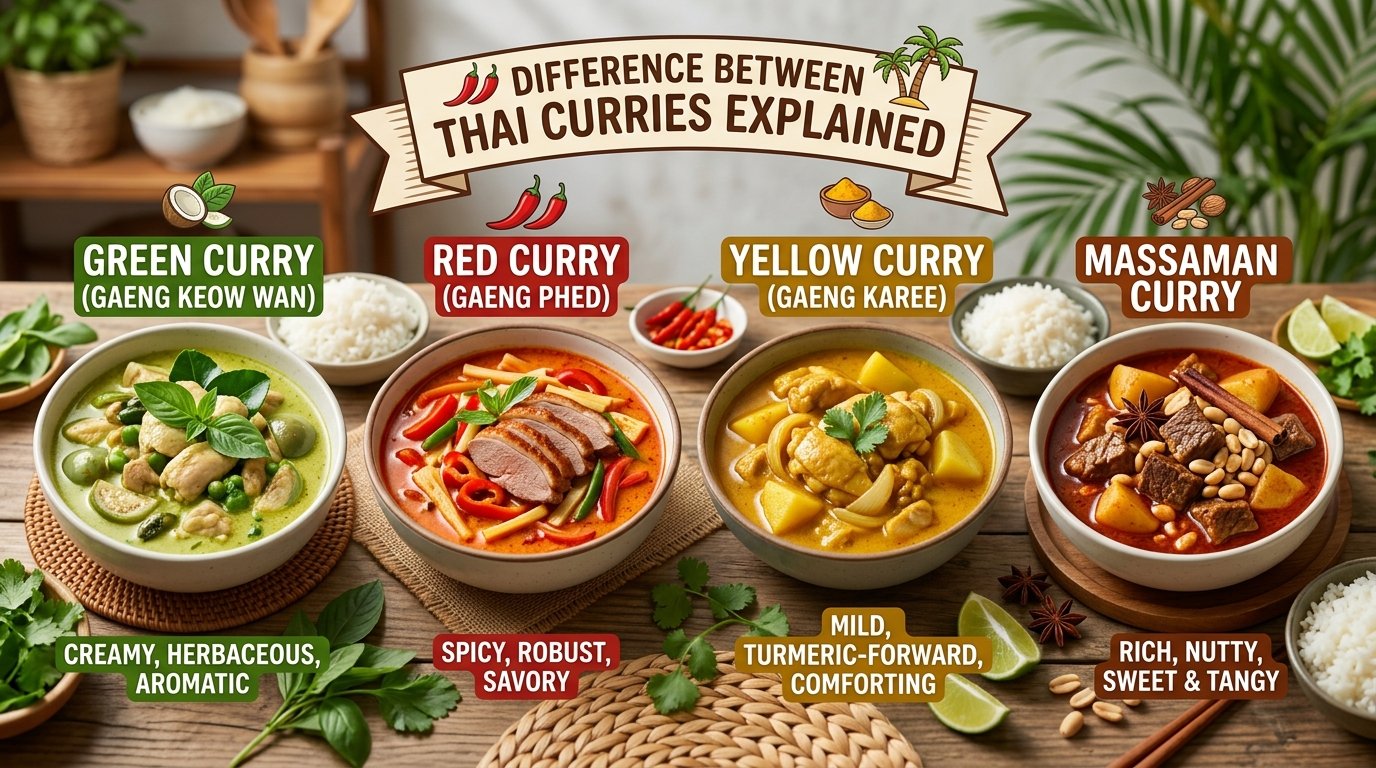
Thai curries differ mainly in color, ingredients, spice level, and base paste, such as green being spicy and red being richer and milder.
KEY DIFFERENCE OVERVIEW
The difference between Thai curries is based on the type of chili paste, coconut milk balance, herbs, and spice intensity used in each variety. Thai cuisine mainly includes green, red, yellow, Massaman, and Panang curries, and each has a distinct flavor profile. While all Thai curries share a coconut milk base, their taste, color, and heat level vary significantly.
IMPORTANCE OF UNDERSTANDING THE DIFFERENCE
Understanding the difference between Thai curries helps you:
- Choose the right curry based on spice tolerance
- Understand Thai restaurant menus easily
- Appreciate authentic Thai cooking styles
- Match curries with suitable rice or noodles
For example, green curry is ideal for spice lovers, while Massaman curry is better for mild and rich flavors.
PRONUNCIATION SECTION
Thai
- US: /taɪ/
- UK: /taɪ/
- Phonetic: TIE
Curry
- US: /ˈkʌr.i/
- UK: /ˈkʌr.i/
- Phonetic: KUR-ee
Key Differences Between Thai Curries
1. Color Difference
Thai curries differ mainly by color due to different chili types.
Example: Green curry uses green chilies, red curry uses red chilies.
2. Spice Level Difference
Green curry is the spiciest, red is medium, and yellow is mild.
Example: Green curry burns more than yellow curry.
3. Base Paste Difference
Each curry uses a different spice paste mix.
Example: Green curry paste includes fresh green chilies and herbs.
4. Ingredient Difference
Herbs and spices vary in each curry style.
Example: Panang uses peanuts, while Massaman uses cinnamon and cardamom.
5. Flavor Profile Difference
Green curry is fresh and sharp, red is balanced, yellow is mild and sweet.
Example: Red curry tastes richer than green curry.
6. Coconut Milk Ratio Difference
Some curries are creamier than others.
Example: Massaman curry uses more coconut milk than green curry.
7. Cultural Origin Difference
Different curries have influences from different regions.
Example: Massaman curry has Persian and Indian influence.
8. Texture Difference
Some curries are thick, others are more liquid.
Example: Panang curry is thick, green curry is more soupy.
9. Protein Pairing Difference
Different curries pair better with different proteins.
Example: Massaman with beef, green curry with chicken or seafood.
10. Aroma Difference
Herbs create distinct smells in each curry.
Example: Basil-heavy green curry vs nutty Panang curry.
INDIVIDUAL ANALYSIS
Nature of Thai Curries
Thai curries are a group of coconut-based dishes made using fresh herbs, spices, and chili pastes. They vary widely in heat, sweetness, and texture, making them one of the most diverse elements of Thai cuisine.
CONFUSION REASON
The difference between Thai curries is confusing because:
- All use coconut milk as a base
- Many share similar ingredients
- Color differences are subtle to beginners
- Restaurants sometimes simplify names
However, each curry has a unique spice paste and flavor identity.
COMPARISON TABLE
| Feature | Green Curry | Red Curry | Yellow Curry | Massaman Curry |
|---|---|---|---|---|
| Color | Green | Red | Yellow | Brownish |
| Spice Level | Very hot | Medium | Mild | Very mild |
| Flavor | Fresh & herbal | Rich & balanced | Mild & sweet | Sweet & nutty |
| Base | Green chili paste | Red chili paste | Turmeric base | Spiced curry paste |
| Similarity | All use coconut milk | All use coconut milk | All use coconut milk | All use coconut milk |
| Key Difference | Spiciest | Balanced heat | Mildest | Richest flavor |
WHICH IS BEST & WHEN?
Green Curry is best when:
- You like strong spice
- You enjoy fresh herbal taste
Red Curry is best when:
- You want balanced heat
- You prefer classic Thai flavor
Yellow Curry is best when:
- You prefer mild food
- You like light sweetness
Massaman Curry is best when:
- You like rich, slow-cooked flavor
- You prefer less spice
LANGUAGE & LITERARY USE
Metaphors
- Green curry = “fire of Thai cuisine”
- Massaman curry = “slow, warm comfort bowl”
Connotative Meaning
- Green → heat, intensity
- Red → balance, richness
- Yellow → mild comfort
- Massaman → depth, warmth
IDIOMS / PROVERBS
No direct idioms, but culinary saying:
- “Thai curry is a balance of hot, sweet, sour, and salty”
LITERATURE USE
- Common in Southeast Asian culinary studies
- Featured in food anthropology research
- Used in global cuisine textbooks
MOVIE / CULTURE REFERENCES
- The Hundred-Foot Journey shows cultural fusion of Asian and European cuisine influences
- Thai food culture is often featured in travel documentaries about Southeast Asia
FAQ SECTION
1. What is the difference between Thai curries?
They differ in spice level, color, ingredients, and flavor.
2. Which Thai curry is the spiciest?
Green curry is usually the hottest.
3. Which Thai curry is mild?
Yellow and Massaman curries are the mildest.
4. Do all Thai curries use coconut milk?
Yes, most traditional Thai curries use coconut milk.
5. What makes red curry different?
It uses red chili paste and has a balanced spice level.
6. Is Massaman curry Thai or Indian?
It is Thai with Persian and Indian influences.
7. Which curry is the sweetest?
Yellow curry is slightly sweeter and milder.
8. Can I mix Thai curries?
They are usually cooked separately for authentic flavor.
REAL-WORLD IMPORTANCE
The difference between Thai curries helps food lovers choose dishes based on taste preference and spice tolerance. It also improves cultural understanding of Thai cuisine and enhances dining experiences in global restaurants.
FINAL SUMMARY
The difference between Thai curries lies in their spice level, color, ingredients, and flavor profile. Each curry—green, red, yellow, Massaman, and Panang—offers a unique taste experience, making Thai cuisine rich and diverse.
CONCLUSION
Understanding the difference between Thai curries helps you appreciate the diversity of Thai cuisine. Each curry has its own identity shaped by different chilies, herbs, and spices. Green curry is bold and spicy, red curry is balanced, yellow curry is mild, and Massaman curry is rich and comforting.
Although they all share a coconut milk base, their taste and aroma vary greatly. This makes Thai curries unique and globally loved. Once you understand these differences, choosing the right curry becomes easier and more enjoyable. Whether you prefer heat, sweetness, or richness, Thai cuisine offers something for every palate.

I’m Nathan Brooks, an independent writer passionate about vocabulary clarity and usage differences. On Hubdifference.com, I create easy-to-understand comparisons covering American and British English variations. I focus on simple language, practical tips, and reader-friendly explanations. Helping people write with clarity and confidence is what drives my work.