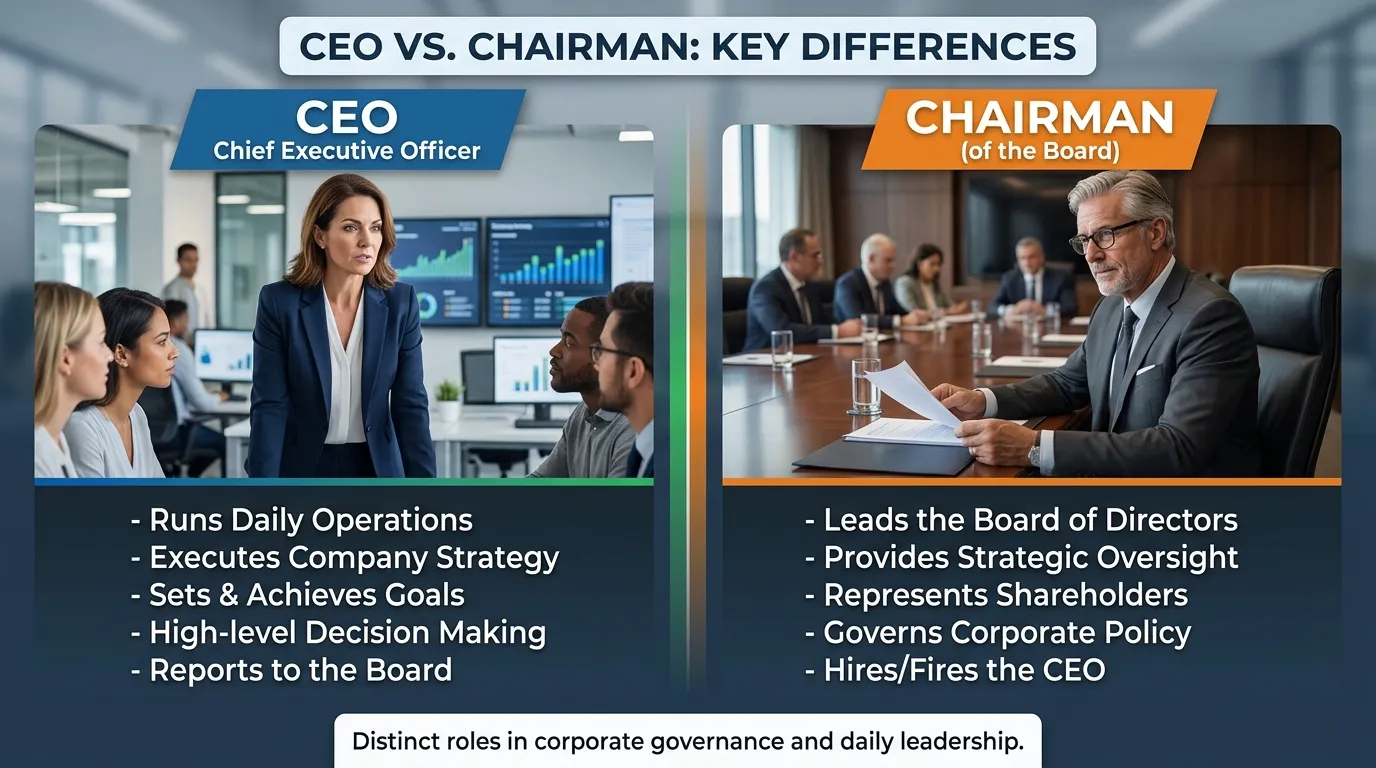
A CEO runs a company’s daily operations, while a chairman leads the board of directors and oversees the company’s long-term direction.
Jake had just started a new job at a business magazine in Chicago. During a meeting, he called the chairman the CEO of a company. Everyone quickly corrected him. Jake realized he did not fully understand the roles.
Many people make the same mistake. A CEO is the top executive who manages the company every day. A chairman leads the board that watches over the company and helps guide its future. Think of it like a ship. One person steers it through the waves, while the other helps choose the destination. Understanding the difference between CEO and chairman can help you follow business news and company decisions more clearly. The roles seem close, but they are not the same.
The Key Difference
The CEO manages the company’s daily work. The chairman leads the board that supervises the company and supports long-term goals.
One role focuses on running the business. The other focuses on governing it.
Why Does This Difference Matter?
Knowing the difference between CEO and chairman helps you understand who is responsible for what. If sales fall, the CEO often handles the response. If the company needs a new direction, the board and chairman may become more involved.
People who confuse these roles may misunderstand business news, company reports, or leadership changes. Knowing the distinction makes company decisions easier to follow and understand.
Now let’s look at these two positions one point at a time so their duties and authority become much easier to recognize.
10 Differences Between CEO and Chairman
1. Basic Definition
A CEO is the highest-ranking executive in a company. This person manages employees, operations, and business activities. A chairman leads the board of directors. The board represents shareholders and oversees leadership.
Example 1: Tim Cook serves as CEO of Apple.
Example 2: Jamie Dimon serves as CEO of JPMorgan Chase.
2. Origin or Source
The CEO position comes from company management. The role exists to run the business. The chairman position comes from the board structure. Shareholders elect directors, and directors often select a chairman.
Example 1: Apple has both management and board leadership.
Example 2: Microsoft follows a similar structure.
3. How It Is Made or Done
A CEO is usually hired or appointed by the board. Experience, leadership skills, and business success often influence the choice. A chairman is commonly chosen by board members after joining the board.
Example 1: Satya Nadella was selected to lead Microsoft.
Example 2: Bob Iger returned to lead Disney.
4. Variety or Range
CEO roles can vary by company size. A startup CEO may do many jobs. A large-company CEO may oversee thousands of workers. Chairman roles also vary. Some chairmen are active, while others mainly guide board meetings.
Example 1: A startup founder may act as CEO.
Example 2: A chairman at a large public company may focus on governance.
5. Flavor, Feel, or Output Quality
The CEO role feels fast-paced and action-focused. Decisions often affect daily work. The chairman role feels broader and more strategic. It focuses on oversight and long-term thinking.
Example 1: A CEO may approve a major hiring plan.
Example 2: A chairman may discuss future board priorities.
6. Primary Use Cases
A CEO handles operations, budgeting, staffing, and execution. A chairman organizes board meetings, supports governance, and monitors leadership performance.
Example 1: A CEO launches a new product line.
Example 2: A chairman leads a board discussion about company goals.
7. Effect or Impact
The CEO’s actions directly affect business performance and company culture. The chairman’s actions influence accountability and corporate governance.
Example 1: A CEO may improve profits through better management.
Example 2: A chairman may strengthen oversight practices.
8. Specificity and Precision
CEO is a very specific executive role. It usually refers to one top manager. Chairman is specific too, but it belongs to the board side of the organization rather than management.
Example 1: Companies normally have one CEO.
Example 2: Boards normally have one chairman.
9. Can They Replace Each Other?
Sometimes one person holds both positions. However, the responsibilities remain different. In many companies, the roles stay separate to improve checks and balances.
Example 1: Some founders serve as both CEO and chairman.
Example 2: Many public companies separate the roles.
10. Long-Term Result
A successful CEO can help a company grow, innovate, and compete. A successful chairman can help maintain stability, accountability, and strong governance over many years.
Example 1: Long-term CEO leadership can expand markets.
Example 2: Long-term board leadership can improve oversight quality.
Nature and Character
A CEO is action-oriented. The role demands quick decisions, leadership, and constant attention to business performance. CEOs often work closely with managers and employees across the company.
A chairman is oversight-oriented. The role focuses on guidance, accountability, and governance. Chairmen spend more time evaluating strategy and ensuring leadership serves shareholder interests.
Why Do People Mix Them Up?
Many people see both titles at the top of a company and assume they mean the same thing. News reports often mention both leaders together. Some companies also allow one person to hold both positions. Corporate structures can differ between businesses as well.
A common mistake happens when someone reads a company announcement and assumes the chairman is running daily operations.
Comparison Table
| Feature | CEO | Chairman |
|---|---|---|
| Definition | Top executive manager | Leader of the board |
| Origin | Management structure | Board governance structure |
| Process / How Made | Appointed or hired by board | Chosen by directors |
| Variety / Duration | Varies by company size | Varies by board involvement |
| Output / Quality | Business execution | Strategic oversight |
| Main Use | Daily operations | Board leadership |
| Impact | Direct business results | Governance quality |
| Use Case / Setup | Leads employees and executives | Leads directors and meetings |
| Interchangeable? | Sometimes combined | Sometimes combined |
| Long-Term Result | Growth and performance | Stability and accountability |
| Key Similarity | Both provide leadership | Both support company success |
| Key Difference | Runs company daily | Oversees leadership through board |
Which Is Better and When?
A CEO is better when a company needs strong execution and operational leadership. For example, launching a new product often requires CEO direction and management skills.
A chairman is better when governance and oversight matter most. For example, reviewing executive performance or guiding board strategy fits the chairman’s role. Neither position is always better because they serve different purposes.
Quick Decision Checklist
Choose CEO if:
☑ You want daily business leadership
☑ You manage employees directly
☑ You execute company strategy
☑ You oversee operations and budgets
Choose Chairman if:
☑ You lead board meetings
☑ You oversee executive leadership
☑ You focus on governance
☑ You guide long-term board strategy
Metaphors and Similes
A CEO is the engine that keeps the company moving forward every day.
A chairman is the compass that helps keep the company pointed in the right direction.
Together, they work like a captain and a lighthouse, each helping the journey in a different way.
[used in: intro]
Connotative Meaning
CEO often carries a positive image of leadership, ambition, and business success. For example, people may admire a CEO who grows a company. It can also have a negative image when people see CEOs as overly powerful. In a neutral sense, it simply means the chief executive.
Chairman often suggests guidance and experience. For example, investors may trust an experienced chairman. Some people may view the role as distant from daily work. In a neutral sense, it means the person leading the board.
Idioms and Expressions
“Runs the show” often fits a CEO. Example: The CEO runs the show during product launches.
“Keeps the ship steady” often fits a chairman. Example: The chairman keeps the ship steady during leadership changes.
[coined expression] “Boardroom compass.” Example: The chairman became the boardroom compass during a difficult year.
Frequently Asked Questions
Q1: What is the main difference between CEO and chairman?
The CEO manages the company’s daily operations. The chairman leads the board of directors. This difference exists because companies need both management and oversight to function effectively.
Q2: Can CEO be used instead of chairman?
No. The titles describe different responsibilities. A CEO manages the business directly, while a chairman oversees governance through the board. One title cannot automatically replace the other.
Q3: Which one is better :CEO or chairman?
Neither role is better overall. The CEO is stronger for daily leadership and execution. The chairman is stronger for oversight and long-term governance. Their value depends on the situation.
Q4: Which one should a beginner start with?
Most people start on the management path before reaching executive positions. Becoming a chairman usually requires significant board experience because the role focuses on governance and oversight.
Q5: Why do people mix up CEO and chairman?
People often see both titles at the top of company leadership. Confusion increases when one person holds both positions. News stories also tend to mention them together without explaining the distinction.
Real-World Importance
Understanding the difference between CEO and chairman helps when reading business news, investing in companies, or studying corporate leadership. It matters when a company announces a new CEO, elects a new chairman, or changes its governance structure. Knowing who does what makes company decisions easier to interpret and evaluate.
Conclusion
Remember Jake from the business magazine? He now knows exactly who manages a company and who oversees its leadership. That simple understanding helped him avoid future mistakes.
The difference between CEO and chairman comes down to responsibility. The CEO handles daily business activities, employee leadership, and execution. The chairman leads the board, supports governance, and focuses on long-term oversight. One role drives the company forward, while the other helps keep it on the right path. Like an engine and a compass, both roles matter, but they serve different purposes.
Once you understand their unique jobs, business news and company leadership become much easier to follow.

I’m Sophia Turner, a content writer who loves making English simple and easy to understand. At Hubdifference.com, I write clear comparisons of commonly confused words, spelling variations, and everyday language differences. I focus on practical examples so readers can quickly learn and use the right words. My aim is to help learners write with clarity, confidence, and accuracy.