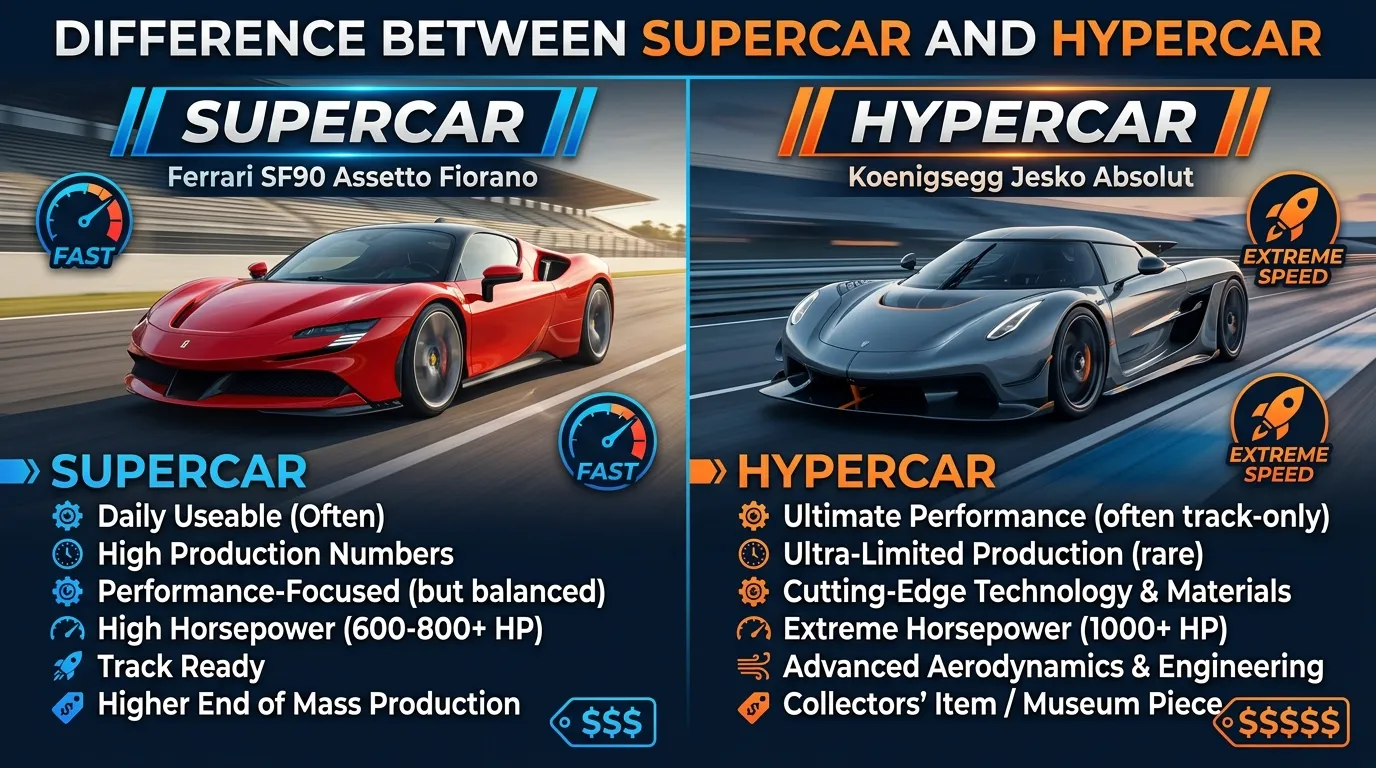
A supercar is a high-performance sports car, while a hypercar is an even more powerful, exclusive, and advanced version built in very limited numbers.
Ali loved fast cars and often watched car videos online. One day, he saw a Lamborghini Huracán and called it a hypercar. His friend quickly corrected him and explained that it was actually a supercar. Ali was surprised because both cars looked incredibly fast and expensive.
The difference between supercar and hypercar confuses many car enthusiasts and beginners. Both types of vehicles offer amazing speed, stunning designs, and advanced technology. However, the difference between supercar and hypercar goes beyond appearance. A supercar delivers exceptional performance, while a hypercar pushes the limits of engineering and exclusivity. Understanding the difference between supercar and hypercar helps buyers, students, and car fans appreciate what makes these machines unique. So, what truly separates them?
Key Difference
The biggest difference is performance and exclusivity. A supercar offers very high speed and luxury. A hypercar takes those qualities much further with extreme performance, advanced technology, and very limited production numbers.
Why Is This Difference Important to Know?
Understanding the difference between supercar and hypercar helps car enthusiasts make informed decisions when discussing, buying, or studying high-performance vehicles. It also helps people understand automotive innovation. Knowing the distinction makes conversations about luxury cars more accurate and helps readers appreciate the engineering behind these remarkable machines.
Linking Hook
Now that you know the basic difference, let’s explore ten important points that clearly show how supercars and hypercars differ in design, performance, technology, and long-term value.
10 Points of Difference
1. Basic Definition and Meaning
A supercar is a high-performance sports car designed for speed and style. A hypercar is the highest level of performance car, offering extreme speed, advanced engineering, and rarity.
Example 1: Ferrari 296 GTB is considered a supercar.
Example 2: Bugatti Chiron is considered a hypercar.
2. Origin / Main Components
Supercars focus on powerful engines, lightweight materials, and sporty handling. Hypercars use these features plus cutting-edge technology, hybrid systems, and aerospace-inspired materials.
Example 1: McLaren 570S uses lightweight construction.
Example 2: Koenigsegg Jesko uses advanced carbon-fiber engineering.
3. Process — How They Are Built
Supercars are often produced in larger numbers. Hypercars are usually handcrafted and built in very limited quantities with special attention to detail.
Example 1: Audi R8 was produced in relatively higher numbers.
Example 2: Pagani Huayra was built in limited production.
4. Time Involved / Production Duration
Supercar production generally continues for several years with many units sold. Hypercars often have shorter production runs and fewer vehicles manufactured.
Example 1: Lamborghini Huracán remained in production for years.
Example 2: Aston Martin Valkyrie had a highly limited production run.
5. Performance and Driving Feel
Supercars deliver thrilling acceleration and handling. Hypercars provide even greater speed, sharper aerodynamics, and near-racing-car performance.
Example 1: Ferrari F8 Tributo offers outstanding performance.
Example 2: Rimac Nevera delivers extreme acceleration.
6. Primary Use Cases
Supercars are often driven on roads and occasionally on race tracks. Hypercars are usually collector vehicles, showcase models, and engineering masterpieces.
Example 1: Porsche 911 Turbo S is commonly road-driven.
Example 2: Mercedes-AMG One serves as a technological showcase.
7. Effect or Impact
Supercars inspire excitement and luxury. Hypercars often influence future automotive technologies and become symbols of innovation.
Example 1: Lexus LFA gained fame for performance.
Example 2: McLaren P1 influenced hybrid performance technology.
8. Degree of Exclusivity
Supercars are exclusive but still accessible to many wealthy buyers. Hypercars are much rarer and often limited to a few hundred units worldwide.
Example 1: Ferrari Roma has broader availability.
Example 2: Bugatti Bolide is extremely rare.
9. Can They Replace Each Other?
Both provide excitement and speed, but they serve different purposes. A supercar offers everyday usability, while a hypercar focuses on ultimate performance and exclusivity.
Example 1: McLaren Artura suits regular driving.
Example 2: Koenigsegg Regera targets collectors and enthusiasts.
10. Long-Term Results / Lasting Impact
Supercars often retain strong value and popularity. Hypercars frequently become collectible investments due to rarity and historical importance.
Example 1: Ferrari Enzo became highly desirable.
Example 2: Bugatti Veyron became a landmark vehicle.
Nature and Behaviour
Supercars feel sporty, exciting, and practical enough for occasional daily driving. They balance performance, luxury, and usability.
Hypercars feel extreme, rare, and groundbreaking. They are designed to push engineering limits and showcase the best technology available.
Why Do People Confuse Them?
People confuse supercars and hypercars because both are fast, expensive, and visually striking. Manufacturers also use marketing terms differently. Someone may see a powerful sports car and assume it is a hypercar, even when it lacks the rarity and technology that define the category.
Comparison Table
| Feature | Supercar | Hypercar |
|---|---|---|
| Definition | High-performance sports car | Ultimate performance vehicle |
| Production | Higher numbers | Very limited numbers |
| Technology | Advanced | Cutting-edge |
| Speed | Extremely fast | Even faster |
| Price | Very expensive | Extremely expensive |
| Exclusivity | Exclusive | Ultra-exclusive |
| Main Use | Road and track | Showcase and collection |
| Impact | Performance focus | Innovation focus |
| Interchangeable? | Not fully | Not fully |
| Long-Term Result | Strong value | Collector status |
| Similarity | Fast and luxurious | Fast and luxurious |
Which Is Better and When?
A supercar is better if you want thrilling performance with greater practicality. For example, a Porsche 911 Turbo S can be enjoyed regularly while still delivering incredible speed.
A hypercar is better if you want the ultimate automotive experience, rarity, and cutting-edge technology. Vehicles like the Bugatti Chiron represent the peak of automotive engineering.
Quick Decision Guide
Choose Supercar if:
☑ You want regular road use
☑ You need more practicality
☑ You prefer lower ownership costs
☑ You enjoy weekend driving
Choose Hypercar if:
☑ You want maximum exclusivity
☑ You seek ultimate performance
☑ You collect rare vehicles
☑ You want advanced technology
Metaphors and Similes
A supercar is like a world-class athlete fast, skilled, and impressive. A hypercar is like an Olympic champion breaking records. Comparing them is like comparing a lightning bolt to a thunderstorm; both are powerful, but one is more extreme.
Connotative Meaning
Supercar often carries positive meanings of excitement, luxury, and prestige. Example: Owning a supercar may symbolize success. Negatively, it may suggest extravagance.
Hypercar often suggests innovation, rarity, and engineering excellence. Example: A hypercar may represent the future of automotive technology. Negatively, some people see it as excessive spending. Neutrally, both terms describe high-performance vehicles.
Idioms and Proverbs
“Go the extra mile” fits hypercars because they push beyond normal limits. Example: The engineers went the extra mile designing the vehicle.
“Built like a dream” suits supercars. Example: The Ferrari looked built like a dream.
[Coined expression] “Beyond fast, beyond ordinary.” Example: Reviewers used it to describe a hypercar.
FAQ Section
Q1: What is the main difference between supercar and hypercar?
A supercar offers exceptional performance and luxury, while a hypercar takes performance, technology, rarity, and exclusivity to a much higher level.
Q2: Can a supercar be used instead of a hypercar?
For most driving situations, yes. However, hypercars provide greater performance, exclusivity, and technological innovation than supercars.
Q3: Which is better—supercar or hypercar?
It depends on your needs. Supercars offer more practicality. Hypercars provide ultimate performance and exclusivity.
Q4: How long do supercars and hypercars last?
With proper maintenance, both can last for decades. Hypercars may also gain collector value due to their rarity.
Q5: Why do people mix up supercars and hypercars?
Both look similar, cost a lot, and deliver incredible speed. The differences mainly involve rarity, technology, and performance levels.
Real-World Importance
Knowing the difference between supercar and hypercar helps car enthusiasts, buyers, collectors, and students understand automotive classifications. It also improves discussions about vehicle performance, engineering, luxury markets, and investment potential.
Conclusion
The difference between supercar and hypercar comes down to performance, rarity, technology, and exclusivity. Supercars deliver thrilling speed and luxury, while hypercars represent the absolute peak of automotive engineering. Supercars are often more practical and widely available. Hypercars are rarer, more advanced, and built in limited numbers. Both are remarkable vehicles, but they serve different purposes in the automotive world. By understanding these differences, you can better appreciate the innovation and craftsmanship behind the world’s fastest and most exciting cars.

I’m Ethan Caldwell, a language enthusiast who enjoys simplifying confusing English word pairs for everyday readers. At Hubdifference.com, I write clear and practical comparisons that help users choose the right word with confidence. My goal is to remove confusion and make English learning simple, useful, and accessible. I believe the right words create better communication.