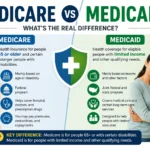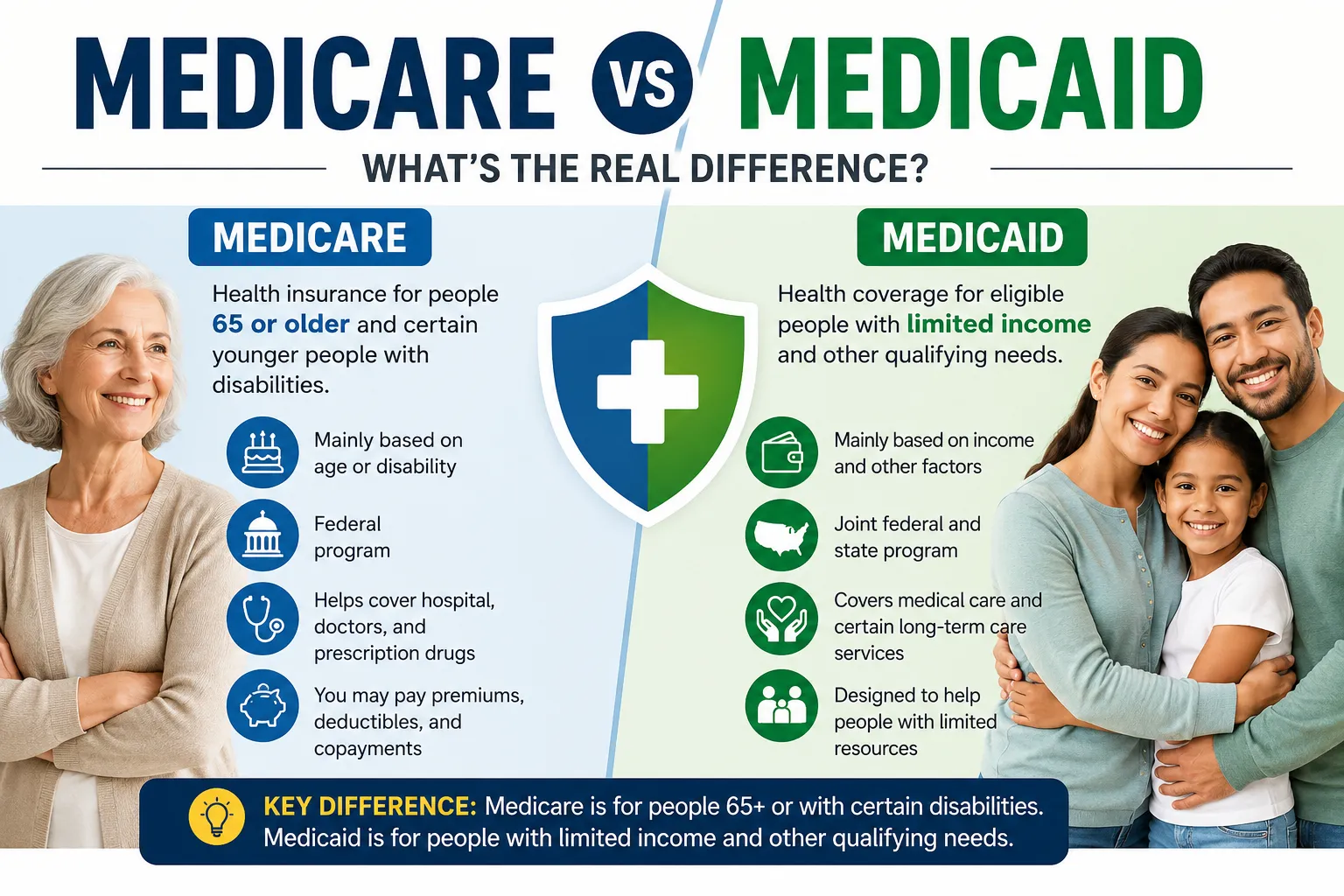
Medicare is mainly for people 65+ and certain younger people with disabilities, while Medicaid helps eligible people with limited income and other qualifying needs.
Many people hear Medicare and Medicaid and think they are the same government health program. They are not. The names sound almost identical, but they serve different groups of people.
Imagine Sarah, a 68-year-old woman who recently retired in Florida. She knew she needed health coverage, so she searched for Medicaid. Her neighbor told her she probably meant Medicare. Sarah became confused because both programs help pay medical bills.
This is why understanding the difference between Medicare and Medicaid matters. Medicare is a federal health insurance program mainly linked to age or certain disabilities. Medicaid is a joint federal and state program for eligible people with limited income and other qualifying conditions. Once you understand the difference between Medicare and Medicaid, the two names become much easier to remember. So, what exactly separates them?
Key Difference
The main difference is who qualifies. Medicare is mainly based on age, disability, or certain medical conditions, while Medicaid is generally based on income and other state eligibility rules.
Medicare is run at the federal level. Medicaid is jointly funded by the federal government and states, with states managing their programs under federal rules.
Keep reading — we break down all 10 differences in plain, simple terms below.
Why Is This Difference Important to Know?
Knowing the difference between Medicare and Medicaid can help you choose the right coverage and understand your medical costs. It matters when you turn 65, have a disability, have limited income, need long-term care, or help a family member apply for benefits.
It can also prevent a costly mistake: assuming that having one program automatically means you qualify for the other.
Before We Compare the Details
Medicare and Medicaid can both help pay for health care, but they work in different ways. Their eligibility rules, funding, benefits, and costs are not the same.
If you also want to understand another common health insurance term, check out our guide: Difference Between Medicare and Medicare Advantage.
10 Points of Difference
1. Basic Definition and Meaning
Medicare is a federal health insurance program mainly for people age 65 and older, plus certain younger people with disabilities or specific conditions. Medicaid is a joint federal-state program that helps eligible people with limited income and other qualifying needs.
Example 1: Robert turns 65 and becomes eligible for Medicare.
Example 2: Maria has limited income and qualifies for Medicaid under her state’s rules.
2. Origin and Main Source
Medicare and Medicaid were both created in 1965, but they have different structures. Medicare is a federal program. Medicaid is funded by both the federal government and individual states, and states administer their programs within federal guidelines.
Example 1: Medicare rules are largely set at the federal level.
Example 2: Texas and California can have different Medicaid rules and programs.
3. How the Programs Work
Medicare generally provides health coverage through different parts. Part A helps with hospital insurance, Part B covers medical insurance, and Part D provides prescription drug coverage. Medicare Advantage, also called Part C, is another way to receive Medicare coverage.
Medicaid works differently. Each state runs its program under federal requirements and decides many details about eligibility and covered services.
Example 1: James uses Medicare Part B for covered doctor services.
Example 2: Linda receives Medicaid through her state Medicaid program.
4. Age and Eligibility
Age is a major factor for Medicare. Most people become eligible around age 65, although younger people may qualify because of certain disabilities or conditions.
Medicaid does not simply depend on age. Eligibility can include income, resources, family status, disability, pregnancy, age, and state rules.
Example 1: David qualifies for Medicare after reaching 65.
Example 2: Emma qualifies for Medicaid while raising children and meeting her state’s income rules.
5. Coverage and Benefits
Medicare covers many medically necessary health services, but it does not cover every type of care. Medicaid can cover services that Medicare does not normally cover, including some long-term care and personal care services.
Example 1: Medicare helps pay for covered hospital treatment.
Example 2: Medicaid may help cover nursing home or personal care services for an eligible person.
6. Primary Use Cases
Medicare is commonly used by older adults and certain younger people with disabilities. Medicaid serves many groups, including eligible low-income adults, children, pregnant women, older adults, and people with disabilities.
Example 1: A 72-year-old retiree uses Medicare for regular medical care.
Example 2: A low-income pregnant woman may qualify for Medicaid.
7. Effect on Medical Costs
Medicare can cover a large part of eligible medical costs, but people may still have premiums, deductibles, and other out-of-pocket costs depending on their coverage.
Medicaid can help reduce costs for eligible people, and in some cases can help pay Medicare premiums and cost-sharing.
Example 1: A Medicare beneficiary may pay a share of a covered service.
Example 2: Medicaid may help an eligible person pay certain Medicare costs.
8. Degree of Specificity or Precision
Medicare eligibility is more consistent across the country because it is a federal program. Medicaid can be more complex because states have different eligibility rules, benefits, and programs within federal requirements.
Example 1: Medicare eligibility for age 65 is generally a federal rule.
Example 2: Medicaid eligibility can differ between Ohio and New York.
9. Can They Replace Each Other?
Medicare and Medicaid are not direct replacements for each other. A person can sometimes qualify for both. People with both are often called dually eligible.
When someone has both, Medicare generally pays first for Medicare-covered services, while Medicaid may help with certain remaining costs and services.
Example 1: A 70-year-old with Medicare may also qualify for Medicaid because of limited income.
Example 2: A dual-eligible person may receive Medicaid help with certain Medicare costs.
10. Long-Term Results and Lasting Impact
Medicare provides ongoing health insurance for people who meet its eligibility requirements. Medicaid can provide important long-term support, especially for eligible people who need services that Medicare does not normally cover.
This can be especially important for people who need long-term care.
Example 1: A retired person may continue using Medicare for many years.
Example 2: An eligible older adult may receive Medicaid support for long-term services.
Nature and Behaviour
Medicare is a federal health insurance program. Its main purpose is to provide health coverage for older adults and certain younger people with disabilities or specific conditions. Its structure is more consistent across the United States.
Medicaid is more flexible from state to state. It is designed to help eligible people who meet financial and other requirements. States administer their programs within broad federal rules, so benefits and eligibility can vary.
Why Do People Confuse Them?
People confuse Medicare and Medicaid for several reasons. First, their names sound almost identical. Second, both are government health programs. Third, both can help pay medical expenses.
There is another important reason: some people can have both programs at the same time. For example, an older adult with Medicare may also qualify for Medicaid because of limited income.
Comparison Table
| Feature | Medicare | Medicaid |
|---|---|---|
| Definition | Federal health insurance program | Joint federal-state health coverage program |
| Main Eligibility | Mainly age 65+ or certain disabilities/conditions | Income and other state eligibility rules |
| Administration | Federal | State, under federal requirements |
| Funding | Federal Medicare trust funds and other sources | Federal and state funding |
| Main Users | Older adults and certain younger disabled people | Eligible low-income adults, children, pregnant women, seniors, and people with disabilities |
| Coverage | Hospital, medical, drug and other Medicare benefits | Medical care plus certain additional services |
| Long-Term Care | Limited compared with Medicaid | Can cover certain long-term services |
| State Differences | Generally more uniform | Rules and benefits vary by state |
| Interchangeable? | No | No |
| Can You Have Both? | Yes | Yes |
| Key Difference | Mainly based on age/disability | Mainly based on income and other eligibility rules |
📌 Save this for later — bookmark this page or share it with someone who always mixes up Medicare and Medicaid.
Which Is Better and When?
Neither program is simply “better.” Medicare is usually the relevant program for people who qualify because of age or certain disabilities. For example, a person turning 65 may enroll in Medicare.
Medicaid can be better suited to someone who meets their state’s financial and other eligibility rules. It may also provide benefits Medicare does not normally cover, such as certain long-term care services.
Quick Decision Guide
Choose Medicare if:
- You are 65 or older
- You qualify through certain disabilities
- You meet Medicare’s eligibility requirements
- You need federal Medicare health coverage
Choose Medicaid if:
- You meet your state’s income requirements
- You meet other state eligibility rules
- You need help with medical costs
- You may need certain long-term care services
Still unsure? Drop your question in the comments , we answer every single one.
Metaphors and Similes
Medicare is like a national health coverage umbrella designed mainly around age and certain disabilities.
Medicaid is like a state-supported safety net for people who meet income and other eligibility rules.
Together, they are like two doors leading to health coverage, but each door has different rules for entry.
Connotative Meaning
Medicare often has a neutral or reassuring meaning because it is linked with health coverage for older adults. Positive: “Medicare helped cover his medical care.” Neutral: “She enrolled in Medicare.” Negative feelings may arise when someone worries about premiums or uncovered costs.
Medicaid often suggests support for people with limited income. Positive: “Medicaid helped her family get care.” Neutral: “He applied for Medicaid.” Some people may wrongly connect the word with poor-quality care, even though the program itself provides many important health services.
Idioms and Proverbs
There are no standard English idioms that specifically mean Medicare or Medicaid. However, common expressions can describe their role.
“A safety net” — “Medicaid can act as a safety net for eligible people who need help with health costs.”
“Cover the bases” — “Having both Medicare and Medicaid can help cover more health care needs.”
[Coined expression] “Know your coverage door.” — “Before applying, know your coverage door: Medicare and Medicaid have different rules.”
FAQ
1. What is the main difference between Medicare and Medicaid?
Medicare is mainly for people 65 and older and certain younger people with disabilities or specific conditions. Medicaid helps eligible people based on income and other state requirements.
2. Can Medicare be used instead of Medicaid?
Not always. The programs serve different groups and have different benefits. Some people qualify for only one, while others can qualify for both. Medicaid may cover services Medicare does not normally cover.
3. Which is better — Medicare or Medicaid?
Neither is always better. Medicare is generally designed around age or certain disabilities. Medicaid is designed for eligible people who meet income and other requirements. The right program depends on your personal situation and state rules.
4. How long does Medicare or Medicaid last?
Coverage can continue as long as you remain eligible and follow program rules. Medicare eligibility can continue after enrollment, while Medicaid eligibility is reviewed under state rules and can change when circumstances change.
5. Why do people mix up Medicare and Medicaid?
Their names sound very similar, and both are government health programs. They can also cover some of the same health services, and some people qualify for both at the same time.
Related Reading
You might also like:
→ Difference Between Medicare and Medicare Advantage /difference-between-medicare-and-medicare-advantage
→ Difference Between Health Insurance and Medicaid /difference-between-health-insurance-and-medicaid
Real-World Importance
Knowing the difference between Medicare and Medicaid can help when applying for health coverage, planning retirement, comparing medical costs, or helping an older family member. It is also useful when someone needs long-term care or may qualify for both programs.
Understanding the rules can help you ask better questions and avoid choosing the wrong coverage path.
Conclusion
The difference between Medicare and Medicaid is mainly about eligibility and program structure. Medicare is a federal health insurance program mainly for people 65 and older and certain younger people with disabilities or specific conditions. Medicaid is a joint federal and state program for eligible people who meet income and other requirements.
Medicare and Medicaid are not the same, but one person can qualify for both. When that happens, the programs can work together, with Medicare generally paying first for Medicare-covered services and Medicaid helping with certain remaining costs and benefits.
Now that you know the difference, you’ll never mix them up again.

I’m Ayesha Sadiqah, and I’m passionate about answering one simple question: “What’s the difference?” Through clear comparison guides, I help readers understand commonly confused words, products, concepts, and everyday topics. My goal is to make complex ideas easy to understand with accurate, practical, and reader-friendly explanations.