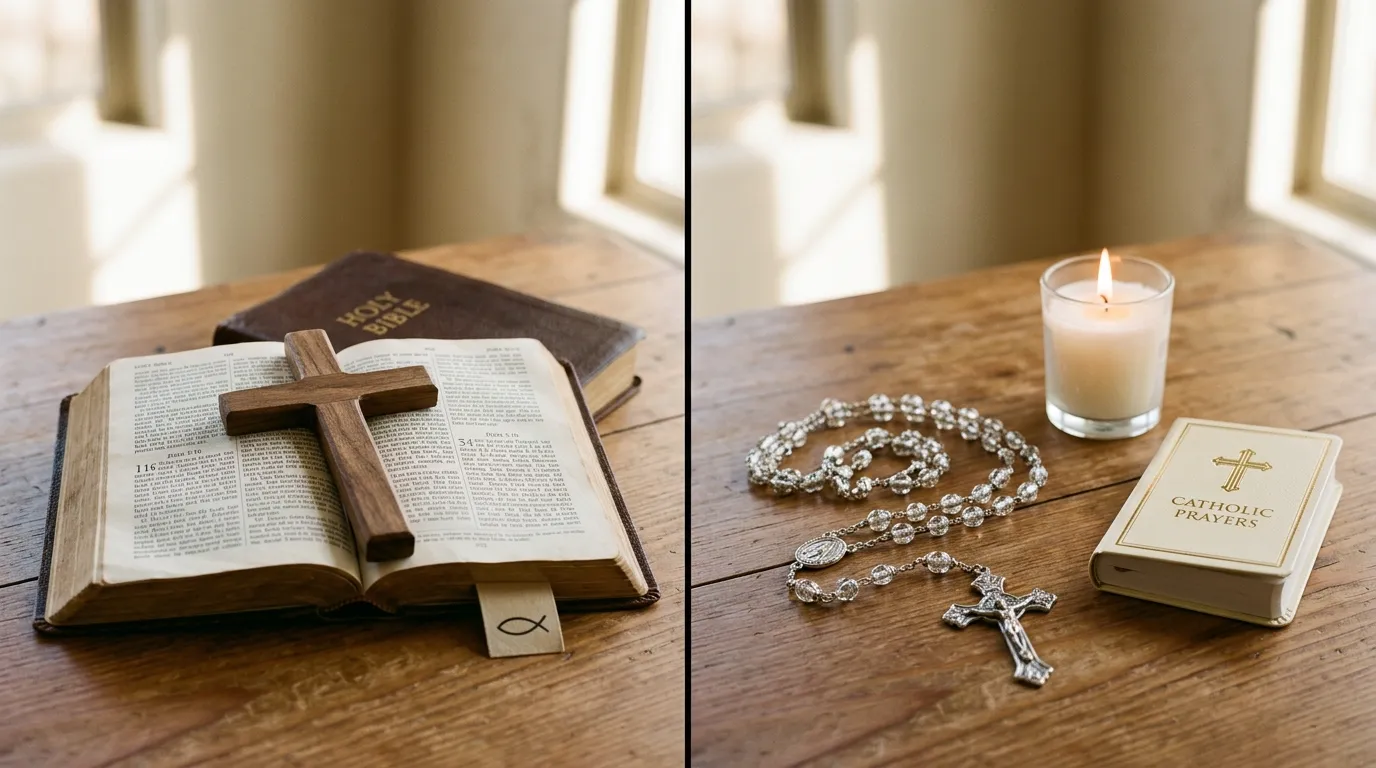
Catholicism is one branch of Christianity, so all Catholics are Christians, but not all Christians are Catholic.
Quick Snippet Table
| Feature | Catholic | Christian |
| Meaning | A member of the Catholic Church | A person who follows Jesus Christ |
| Type | One Christian tradition | A broad religious group |
| Main Authority | Bible and Church Tradition | Varies by Christian tradition |
| Leadership | Pope and Catholic bishops | Varies by denomination |
| Worship | Catholic Mass and sacraments | Varies by church |
| Key Difference | A specific Christian tradition | The wider faith that includes Catholicism |
Many people use Catholic and Christian as if they are two separate religions. They are not. This is one of the most common misunderstandings about Christianity.
Last Sunday, Daniel visited a church with his friend Mark. Daniel called himself Christian, while Mark said he was Catholic. Daniel wondered, “If you’re Catholic, does that mean you’re not Christian?” Mark explained that Catholics are Christians, but Catholicism is one particular tradition within Christianity.
That simple conversation shows why the difference between Catholic and Christian can be confusing. A Christian is someone who follows Jesus Christ. A Catholic is a Christian who belongs to the Catholic Church. Understanding the difference between Catholic and Christian becomes much easier when you see one as a broad term and the other as a specific tradition. So, what really separates them?
Key Difference
The most important point is simple: Christianity is the wider faith, while Catholicism is one major tradition within Christianity.
Catholics believe in Jesus Christ and are therefore Christians. Other Christians belong to traditions such as Protestantism or Eastern Orthodoxy.
Keep reading, because the 10 differences below explain this clearly with simple examples.
Why Is This Difference Important to Know?
Understanding the difference between Catholic and Christian helps prevent a common mistake: treating Catholicism and Christianity as completely separate religions. It also helps when reading about churches, beliefs, worship, the Bible, and Christian history.
This difference matters in school, religious discussions, family conversations, travel, and everyday life. It also helps people speak about religious traditions with greater accuracy and respect.
Before We Compare the Details
The word “Christian” describes people who follow Jesus Christ, while “Catholic” identifies people within a particular Christian church and tradition. That means the two words overlap, but they are not equal in scope.
If you also want to understand another common religious comparison, check out our guide: Difference Between Catholic and Protestant.
10 Points of Difference
1. Basic Definition and Meaning
Christian is the broad term. It generally refers to a person who follows Jesus Christ and identifies with Christianity. Catholic is a more specific term for a Christian who belongs to the Catholic Church.
So, Catholic describes a particular Christian identity, while Christian can describe people from many different churches and traditions.
Example 1: Maria is Christian because she follows Jesus and belongs to a Baptist church.
Example 2: John is Catholic because he follows Jesus and belongs to the Catholic Church.
2. Origin and Main Tradition
Christianity began with the life, teachings, death, and resurrection of Jesus Christ in the first century. Catholicism developed as the tradition of the Catholic Church, which traces its history back to the early Christian community.
Over time, Christianity developed different traditions and denominations. Catholicism became one of the largest Christian traditions.
Example 1: Early Christians gathered around the teachings of Jesus and his apostles.
Example 2: The Catholic Church developed a long tradition of bishops, councils, and Church teaching.
3. Authority and Teaching
Catholic teaching looks to both the Bible and Sacred Tradition, interpreted through the teaching authority of the Catholic Church. Other Christian traditions may place different levels of authority on church tradition.
For example, many Protestant churches emphasize the Bible as their highest authority. Catholicism gives an important role to Scripture, Tradition, and the Church’s teaching authority.
Example 1: A Catholic may study the Bible together with Catholic Church teaching.
Example 2: A Protestant Christian may rely strongly on the Bible when forming a belief.
4. Church Leadership
Catholics have a defined worldwide leadership structure. The Pope is the bishop of Rome and serves as the chief pastor of the Catholic Church. Catholic bishops lead dioceses around the world.
Christian leadership varies greatly outside Catholicism. Some churches have bishops, while others have pastors, elders, or other leaders.
Example 1: A Catholic parish is led by a priest under the authority of a bishop.
Example 2: A Baptist church may be led by a pastor and local church leaders.
5. Worship and Religious Practice
Catholic worship centers on the Mass, which includes Scripture readings, prayers, and the Eucharist. Catholics also observe seven sacraments, including Baptism and the Eucharist.
Other Christian churches may worship through sermons, songs, prayers, Bible readings, and communion. The exact form depends on the denomination.
Example 1: A Catholic family attends Sunday Mass at a parish.
Example 2: A Protestant family attends a Sunday service with worship music and a sermon.
6. Primary Use of the Terms
The word Christian is useful when speaking about the whole Christian faith or people who follow Jesus across different traditions. The word Catholic is useful when you need to identify the Catholic tradition specifically.
This distinction makes conversations clearer. Saying someone is Christian gives broad information. Saying someone is Catholic gives more specific information about their church tradition.
Example 1: “Christian communities exist around the world” includes Catholics and many other Christians.
Example 2: “Catholic churches celebrate Mass” refers specifically to Catholic worship.
7. Beliefs and Doctrines
Catholics share the central Christian belief that Jesus Christ is the Son of God and Savior. They also accept specific Catholic teachings about the Church, sacraments, Mary, the saints, and other matters.
Other Christians share core beliefs about Jesus but may disagree with Catholics on some doctrines.
Example 1: Catholics honor Mary as the mother of Jesus and give her a special place in Christian devotion.
Example 2: Many Protestant Christians honor Mary but generally give her a different role in worship and devotion.
8. Degree of Specificity
Christian is a broad identity. It can describe Catholics, Protestants, Eastern Orthodox Christians, and several other Christian groups.
Catholic is more specific. It identifies a person connected with the Catholic Church and its beliefs, worship, sacraments, and traditions.
Example 1: Saying “Sarah is Christian” does not tell you which Christian tradition she follows.
Example 2: Saying “Sarah is Catholic” gives you more specific information about her Christian tradition.
9. Can They Replace Each Other?
The words cannot always replace each other. You can correctly say that a Catholic is Christian, but calling every Christian Catholic would be incorrect.
This is because Christianity includes many traditions. Catholicism is one of them.
Example 1: “Peter is Christian” can be true if Peter is Catholic.
Example 2: “Peter is Catholic” would be incorrect if Peter belongs to a Methodist church.
10. Long-Term Historical Impact
Christianity has shaped art, literature, education, culture, philosophy, and history across many centuries. Catholicism has played a major role within that wider Christian story.
Catholic institutions have also had a long historical influence through churches, schools, universities, hospitals, missions, and charitable organizations.
Example 1: Christian ideas influenced European art and literature for centuries.
Example 2: Catholic universities and schools have contributed to education in many countries.
Nature and Behaviour
Christian is a broad identity. It focuses on a person’s relationship with Jesus Christ and their connection to Christianity. The exact beliefs and practices can differ greatly among Christian traditions.
Catholic is a specific Christian identity. It connects a person with the Catholic Church, its teachings, sacraments, worship, traditions, and worldwide structure.
Why Do People Confuse Them?
People often confuse the terms because Catholicism is Christianity, but the word Catholic sounds like a separate category. The word Christian is also used differently in everyday speech.
Some people use “Christian” to mean Protestant Christian, especially in certain communities. This can make the distinction even more confusing.
For example, someone might say, “I’m Catholic, not Christian,” when they really mean, “I’m Catholic, not Protestant.” Technically, Catholics are Christians.
Comparison Table
| Feature | Catholic | Christian |
| Definition | Member of the Catholic Church | Person who follows Jesus Christ |
| Origin | Catholic tradition within early Christianity | Began with Jesus and the early Christian community |
| Authority | Bible, Tradition, and Church teaching | Varies by Christian tradition |
| Leadership | Pope, bishops, and priests | Varies by denomination |
| Worship | Mass and Catholic forms of worship | Varies by church |
| Main Use | Identifies a specific Christian tradition | Describes the wider faith |
| Beliefs | Catholic doctrines and Christian beliefs | Core Christian beliefs, with denominational differences |
| Specificity | Specific | Broad |
| Interchangeable? | Catholic is Christian | Not every Christian is Catholic |
| Long-Term Result | Major Christian tradition with global influence | Broad religious tradition with global influence |
| Similarity | Follows Jesus Christ | Follows Jesus Christ |
| Key Difference | A specific branch/tradition | The wider category |
📌 Save this for later: bookmark this page or share it with someone who always mixes up Catholic and Christian.
Which Is Better and When?
Neither term is “better.” They answer different questions. Use Christian when you are talking about people who follow Jesus Christ in general. For example, Catholics, Protestants, and Eastern Orthodox believers can all be described as Christians.
Use Catholic when you need to identify the Catholic tradition specifically. For example, saying someone attends a Catholic parish gives more detail than simply saying they are Christian.
Quick Decision Guide
Choose “Christian” if:
☑ You mean followers of Jesus in general
☑ You are discussing Christianity as a whole
☑ The person’s denomination is unknown
☑ You mean the wider Christian faith
Choose “Catholic” if:
☑ You mean the Catholic Church
☑ You are discussing Catholic beliefs
☑ You mean Catholic worship or Mass
☑ You are identifying a specific tradition
Still unsure? Drop your question in the comments, we answer every single one.
Metaphors and Similes
Christianity is a large tree, with many branches growing from its Christian tradition.
Catholicism is one major branch of that tree, with its own teachings, worship, and history.
They are like a country and one of its regions: the region belongs to the country, but the country contains more than that one region.
Connotative Meaning
Christian usually has a broad and neutral meaning. Positive: “She is a committed Christian.” Neutral: “He studies Christian history.” In some conversations, the word may be used narrowly to mean a Protestant Christian.
Catholic usually has a specific meaning connected with the Catholic Church. Positive: “She is proud of her Catholic heritage.” Neutral: “He attends a Catholic church.” Some people may use the word in debates about doctrine, but its basic meaning is simply a Catholic Christian identity.
Idioms and Proverbs
There are no common English idioms that specifically mean “Catholic” or “Christian.” However, several Christian expressions are widely used.
“Walk by faith”: “The Christian group encouraged members to walk by faith.”
“Love thy neighbor”: “The church taught children to love thy neighbor.”
“A house of God”: “The Catholic parish was described as a house of God.”
[Coined expression] “One faith, many traditions”: “The phrase reminds readers that Christianity includes different traditions.”
FAQ
1. What is the main difference between Catholic and Christian?
Christian is the broad term for people who follow Jesus Christ. Catholic refers specifically to Christians who belong to the Catholic Church. Therefore, Catholicism is part of Christianity, not a separate religion from Christianity.
2. Can Catholic be used instead of Christian?
Sometimes, but only when the person is Catholic. Every Catholic is Christian, but not every Christian is Catholic. A Protestant or Eastern Orthodox believer is Christian but belongs to a different Christian tradition.
3. Which is better, Catholic or Christian?
Neither word is better because they describe different levels of identity. Christian is broader, while Catholic is more specific. A Catholic can accurately describe themselves as both Catholic and Christian.
4. How long has Catholic Christianity existed?
Catholicism traces its history to the early Christian community and the apostles. Christianity itself began in the first century with Jesus and his followers. The Catholic Church developed its distinct structure and traditions over many centuries.
5. Why do people mix up Catholic and Christian?
People mix them up because Catholicism is one form of Christianity, while “Christian” is the wider term. Some people also use Christian in everyday speech to mean Protestant, which can create further confusion.
Related Reading
You might also like:
→ Difference Between Catholic and Protestant — /difference-between-catholic-and-protestant
→ Difference Between Christian and Protestant — /difference-between-christian-and-protestant
Real-World Importance
Knowing the difference between Catholic and Christian helps in religious studies, school discussions, travel, family conversations, and reading about world history. It also helps people describe churches and beliefs correctly.
Most importantly, this distinction prevents a common misunderstanding: Catholicism is not outside Christianity. It is one of Christianity’s major traditions.
Conclusion
The difference between Catholic and Christian is mainly about scope. Christian is the broad term for people who follow Jesus Christ. Catholic is a specific Christian identity connected with the Catholic Church.
Catholics believe in Jesus and are therefore Christians. Christianity also includes many other traditions, such as Protestant and Eastern Orthodox Christianity. These groups share important beliefs but can differ in church structure, worship, and doctrine.
The easiest way to remember it is this: Catholic is Christian, but Christian does not always mean Catholic. Think of Christianity as the larger category and Catholicism as one major tradition within it.
Now you know the difference, you can use both terms with confidence and avoid one of the most common misunderstandings about Christian identity.
Difference Between Medicare and Medicaid: Complete Guide

I’m Ethan Caldwell, a language enthusiast who enjoys simplifying confusing English word pairs for everyday readers. At Hubdifference.com, I write clear and practical comparisons that help users choose the right word with confidence. My goal is to remove confusion and make English learning simple, useful, and accessible. I believe the right words create better communication.