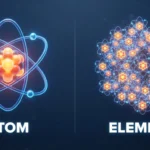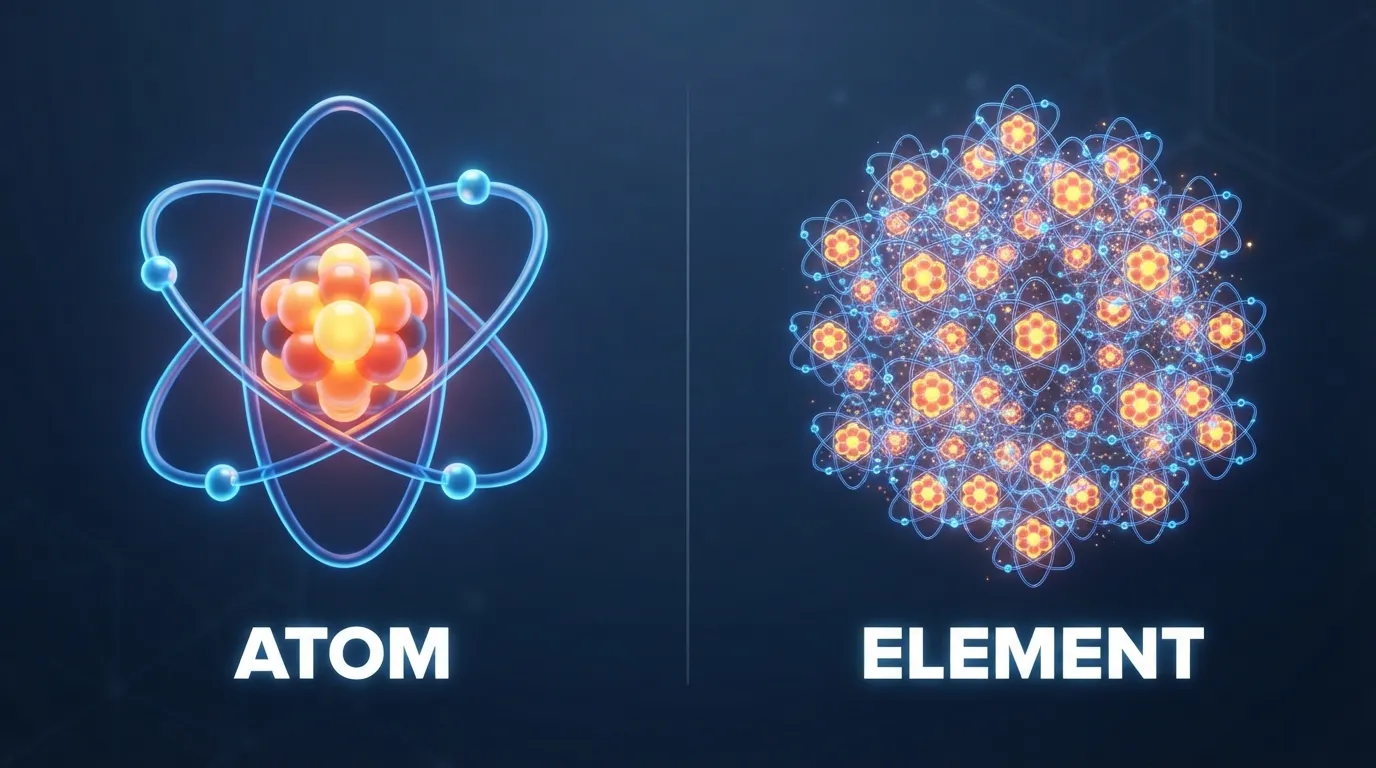
An atom is the smallest unit of matter that still holds the properties of a substance, while an element is a pure substance made entirely of one type of atom.
Most students think atom and element are just two words for the same tiny thing. They’re not, and mixing them up costs marks on almost every chemistry test.
I once tutored a student named Farah who wrote “gold is an atom” on her exam. Her teacher circled it in red. She was crushed, because she genuinely thought she understood the topic.
So what actually separates these two ideas, and why does it trip up so many learners? Let’s clear up the difference between atom and element once and for all.
An atom is a single, individual particle. An element is the bigger category that groups together atoms of the same kind. Every element is built from atoms, but not every atom you talk about belongs to a labeled element in casual speech. Understanding the difference between atom and element is the first real step toward understanding chemistry itself.
Key Difference
An atom is one tiny particle, the basic building block of everything around us. An element is a substance made of only one kind of atom, nothing mixed in. Keep reading, we break down all 10 differences in plain, simple terms below.
Why Is This Difference Important to Know?
Getting the difference between atom and element wrong leads to confusion in chemistry class, lab work, and even everyday science news. Students who understand this distinction find the periodic table far easier to read. Professionals in medicine, engineering, and materials science rely on this exact vocabulary daily. Even outside school, knowing this helps you follow science articles without getting lost in jargon.
Ten Differences Between Atom and Element
If you also want to understand how atoms bond together, check out our guide: Covalent vs Ionic Bonds Explained. Now let’s walk through the ten clearest differences between atoms and elements, one at a time.
1. Basic Definition and Meaning
An atom is the smallest particle of matter that keeps the identity of a substance. An element is a pure substance made of only one type of atom. For example, one single carbon atom is a particle, but a lump of pure carbon is the element carbon. Another example: a single oxygen atom exists inside water, but oxygen gas by itself is the element oxygen.
2. Origin and Main Components
Atoms are made of protons, neutrons, and electrons packed into a tiny structure. Elements are built purely from repeating identical atoms with no other atom type mixed in. Hydrogen, for instance, is an element made only of hydrogen atoms. Iron is an element made only of iron atoms, nothing else joins in.
3. How Each One Is Formed or Identified
Atoms form through nuclear processes like fusion inside stars, where protons and neutrons combine. Elements are identified on the periodic table based on how many protons their atoms contain. Carbon is defined by having exactly six protons in every atom. Gold is defined by having exactly seventy nine protons in every atom.
4. Scale and Size Involved
A single atom is almost impossible to see, even under most microscopes. An element can exist as a visible chunk, like a gold bar or a helium filled balloon. One atom of neon is invisible to the naked eye. A tank of neon gas, however, is easily seen glowing in a sign.
5. Physical Presence and Output Quality
An atom by itself usually cannot be handled directly in daily life. An element can be touched, weighed, and used in real objects. A single silver atom cannot be worn as jewelry. A block of silver, the element, absolutely can be shaped into a ring.
6. Primary Use Cases
Atoms are studied mainly in physics and theoretical chemistry to explain structure and behavior. Elements are used practically in industry, medicine, cooking, and construction. Scientists study individual uranium atoms to understand radioactivity. Engineers use the element aluminum to build airplane parts.
7. Effect or Impact on Matter
A single atom rarely changes anything on its own in the visible world. A collection of atoms forming an element can create entire materials and reactions. One sodium atom does very little alone. Many sodium atoms together, as the element sodium, react violently with water.
8. Degree of Specificity or Precision
Talking about an atom is very specific, referring to one exact particle. Talking about an element is broader, referring to any and every atom of that type combined. Saying “this one carbon atom” points to a single particle. Saying “carbon” as an element covers every carbon atom that exists anywhere.
9. Can They Replace Each Other in Language?
Sometimes people use atom and element loosely in casual talk, but they are not truly interchangeable. Saying “oxygen atom” and “oxygen element” mean two different scales of the same idea. You would never say “I bought an atom of gold” at a jewelry store. You would say “I bought the element gold,” referring to the whole substance.
10. Long Term Results and Lasting Impact
Individual atoms remain stable or unstable based on their nuclear makeup, sometimes lasting forever, sometimes decaying. Elements, as categories, remain permanently defined on the periodic table regardless of how many atoms exist. A single unstable atom of radon eventually decays into another element. The element radon itself stays listed on the periodic table no matter how many atoms decay.
Nature and Behaviour
An atom behaves like a single puzzle piece, quiet and easy to overlook on its own, yet packed with structure inside its nucleus and electron shells.
An element behaves like the finished picture made from thousands of identical puzzle pieces, visible, usable, and often reactive when combined with other elements.
Why Do People Confuse Them?
People confuse atom and element mainly because both terms describe matter at a microscopic level. Textbooks sometimes use the words back to back without pausing to define each clearly. Students also hear phrases like “oxygen atom” and “oxygen element” used loosely in casual speech. A common real life mistake happens when a student labels a diagram, writing “element” under a single dot meant to represent one atom.
Comparison Table
| Feature | Atom | Element |
|---|---|---|
| Definition | Smallest unit of matter | Pure substance of one atom type |
| Origin | Formed by protons, neutrons, electrons | Defined by atomic number |
| Process | Built through nuclear structure | Classified on periodic table |
| Duration | Can be stable or radioactive | Permanently defined category |
| Output | Usually invisible alone | Can be a visible material |
| Main Use | Studied in physics research | Used in industry and daily life |
| Impact | Minimal effect alone | Can react and form compounds |
| Interchangeable? | No, refers to one particle | No, refers to a whole substance |
| Long Term Result | May decay over time | Stays fixed on periodic table |
| Similarity | Both describe matter’s building blocks | Both describe matter’s building blocks |
| Key Difference | Single particle | Collection of identical atoms |
📌 Save this for later, bookmark this page or share it with someone who always mixes up atom and element.
Which Is Better and When?
Neither one is “better,” they simply answer different questions. Use atom when you’re discussing structure, particles, protons, or nuclear behavior in a science lesson. Use element when you’re discussing a substance you can see, weigh, or use, like naming what a ring or a gas tank is made of.
Quick Decision Guide
Choose atom if: ☑ You’re discussing a single particle ☑ You need to explain protons or electrons ☑ You’re studying nuclear physics ☑ You’re describing something too small to see
Choose element if: ☑ You’re naming a pure substance ☑ You’re reading the periodic table ☑ You’re describing something you can touch ☑ You’re talking about a material used in daily life
Still unsure? Drop your question in the comments, we answer every single one.
Metaphors and Similes
An atom is like a single brick, small and simple by itself. An element is like a finished brick wall, built entirely from identical bricks stacked together. Comparing them is like comparing one drop of rain to an entire rainstorm.
Connotative Meaning
Atom carries a positive connotation in physics, symbolizing power and precision, as in “splitting the atom.” It carries a slightly negative connotation in phrases about nuclear danger, like “atomic threat.” Neutrally, it simply means the smallest particle, as in a chemistry textbook.
Element carries a positive connotation when describing something essential, as in “the key element of success.” It carries a neutral connotation in pure science, simply naming a substance like oxygen. Rarely, it carries a negative tone in phrases like “exposed to the elements,” meaning harsh weather.
Idioms and Proverbs
“Splitting the atom” describes tackling something extremely difficult, as in “Solving this puzzle felt like splitting the atom.” “In her element” describes someone comfortable and skilled, as in “She was in her element during the science fair.” “Down to the atom” is a coined expression meaning extremely precise, as in “He checked the measurements down to the atom.”
FAQ
What is the main difference between atom and element?
An atom is one single particle of matter, while an element is a full substance made of many identical atoms grouped together under one name.
Can atom be used instead of element?
Not accurately. An atom refers to one particle, while an element refers to the entire substance, so swapping the words changes the meaning of a sentence.
Which is better, atom or element?
Neither is better, they serve different purposes. Atoms explain structure and particles, while elements explain visible substances and materials.
How long does an atom or element last?
Elements stay permanently defined on the periodic table. Individual atoms may last forever or decay quickly, depending on whether they are stable or radioactive.
Why do people mix up atom and element?
Both terms describe matter at a tiny scale, and textbooks often use them close together without clear definitions, which leads to confusion for students.
You might also like: → Covalent vs Ionic Bonds Explained, wordiums.com/covalent-vs-ionic-bonds → Compound vs Mixture: What’s the Difference, wordiums.com/compound-vs-mixture
Real World Importance
Knowing the difference between atom and element helps students pass chemistry exams with confidence. It also helps professionals in medicine, cooking, and manufacturing describe materials accurately. Even in casual reading, like a news article about gold prices or nuclear energy, this knowledge keeps you from misunderstanding the science.
Conclusion
An atom is the smallest building block of matter, while an element is the pure substance formed when countless identical atoms come together. The difference between atom and element comes down to scale, one is a single particle, the other is the whole substance built from it. Once you see it this way, the periodic table starts making a lot more sense.
Now that you know the difference, you’ll never mix them up again.
See More: What Is the Difference Between Deed and Title?

I’m Ayesha Sadiqah, and I’m passionate about answering one simple question: “What’s the difference?” Through clear comparison guides, I help readers understand commonly confused words, products, concepts, and everyday topics. My goal is to make complex ideas easy to understand with accurate, practical, and reader-friendly explanations.