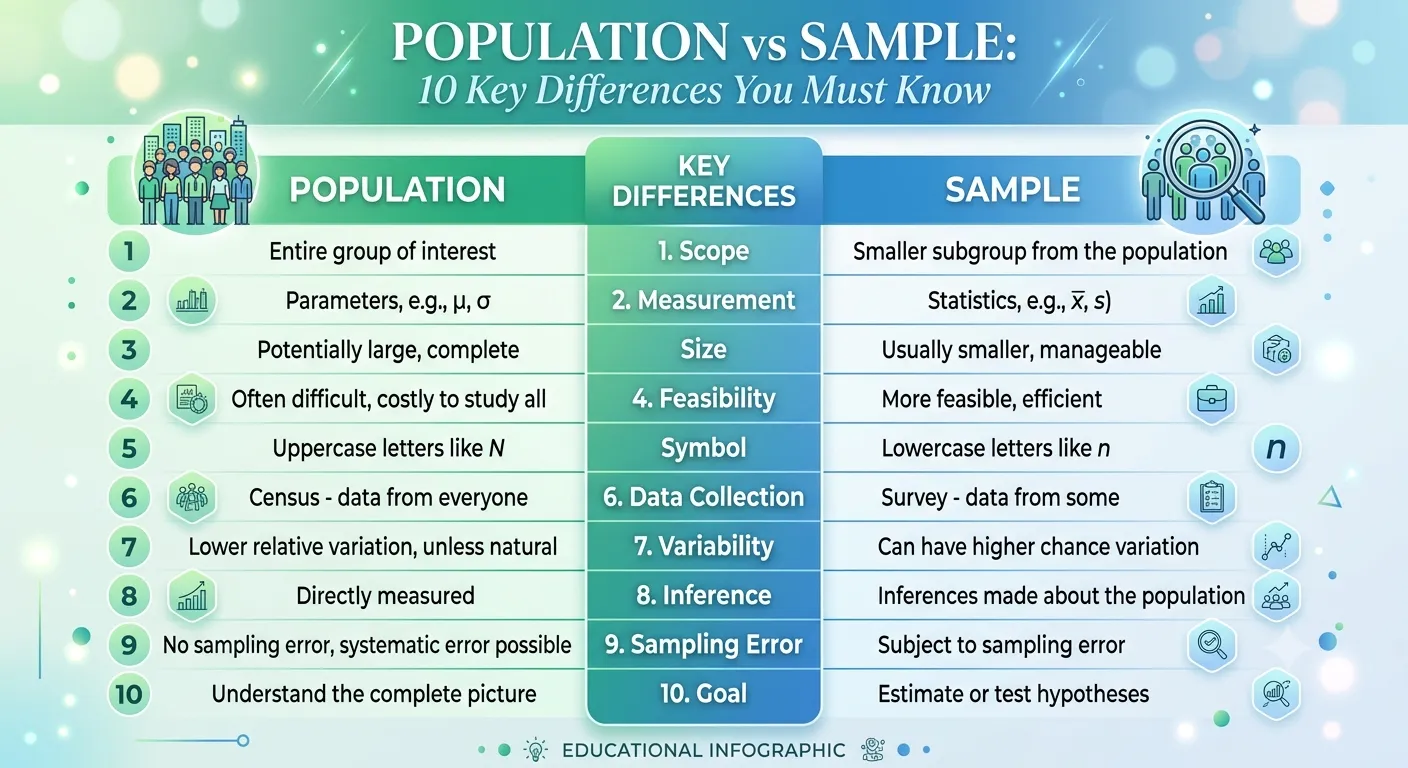
A population is every single member of a group you want to study, while a sample is a smaller, chosen portion of that group used to make conclusions about the whole thing.
Most students copy the wrong formula because they mix up these two words. It is one of the most common mistakes in statistics, and it changes your entire answer.
Meet Sarah. She was analyzing survey results for her college project. She used the population formula on data that was actually a sample, and her final numbers were completely wrong. Her professor caught it in seconds.
So what really separates a population from a sample, and why does getting it right matter so much?
In statistics, understanding the difference between population and sample is the first skill you need before doing any real data analysis. A population includes every possible unit you care about. A sample is a smaller group pulled from that population. Once you understand the difference between population and sample clearly, formulas, symbols, and research design all start to make sense. This guide breaks down the difference between population and sample in plain, simple English, with real examples you will actually remember.
Key Difference
A population covers every single member of a defined group, with no one left out. A sample is only a portion of that group, chosen to represent the whole. Researchers use samples because studying an entire population is often too slow, too expensive, or simply impossible.
Keep reading, we break down all 10 differences in plain, simple terms below.
Why Is This Difference Important To Know?
Getting this wrong can ruin an entire research project. Using the wrong formula, wrong symbol, or wrong sample size leads to false conclusions that businesses, doctors, and governments might actually act on.
Whether you are a student writing a report, a data analyst building a model, or a business owner reading a market survey, knowing the difference between population and sample helps you trust the numbers in front of you and avoid costly mistakes.
What This Means For Your Research
If you are also curious about choosing the right group for your study, check out our guide: How to Calculate the Right Sample Size for Any Study. Understanding these two terms is the foundation everything else in statistics is built on.
10 Points of Difference
1. Basic Definition and Meaning
A population is the complete set of individuals or items you want to study. A sample is a smaller subset pulled from that population. For example, all registered voters in Pakistan form a population, while 2,000 voters surveyed for an opinion poll form a sample. Another example: every student enrolled at a university is the population, while one class of 40 students is the sample.
2. Origin and Source
A population comes directly from the full group you are studying, with no selection involved. A sample comes from a deliberate selection process applied to that population. For instance, all smartphones made by a factory in one year is the population, while 500 phones pulled off the line for quality testing is the sample. A census counts an entire population, while an exit poll samples only certain voters.
3. Process: How It Is Formed
Studying a population means collecting data from every single unit, often through a census. Building a sample involves a sampling method such as random selection, stratified sampling, or convenience sampling. A national census team visits every household in the country, while a research firm might randomly call 1,000 households for a phone survey.
4. Time Involved
Collecting data from a full population usually takes far longer, sometimes months or years, especially for large groups. Collecting a sample is much faster since fewer units need to be measured. A country’s census can take a full year to complete, while a customer satisfaction sample survey might be finished in a single afternoon.
5. Output Quality and Precision
Population data gives you the true, exact value, called a parameter. Sample data gives you an estimate, called a statistic, which carries some margin of error. Exit poll results are estimates and can be slightly off from the final election count, while the actual vote count reflects the true population result.
6. Primary Use Cases
Populations are used when complete accuracy is required, such as national censuses or full financial audits. Samples are used for quicker studies like customer surveys, medical trials, or product testing. A hospital testing a new drug on 300 volunteers is using a sample, while tracking every patient in the country’s health system would involve the population.
7. Effect or Impact
Population studies remove sampling error completely since every unit is counted. Sample studies always carry some risk of sampling error, meaning the results might not perfectly match the real population. A factory checking every single product avoids missing defects, while checking only a batch might let a few defective items slip through.
8. Degree of Specificity
A population gives specific, fixed numbers that apply to the whole group with certainty. A sample gives numbers that come with confidence intervals and margins of error attached. Government reports based on full population data are stated as exact figures, while survey based news reports often include phrases like plus or minus three percent.
9. Can They Replace Each Other?
A sample can never fully replace a population when total accuracy is legally or medically required, such as counting election votes. A population is often unnecessary when a well designed sample can answer the research question just as reliably. Courts require full vote counts, not samples, but a taste test company is happy using a sample of 50 people instead of surveying everyone.
10. Long Term Results and Lasting Impact
Population studies build permanent, official records used for laws, funding, and long term planning. Sample studies guide faster decisions but usually need to be repeated over time to confirm trends. Census data shapes government budgets for a decade, while a monthly customer survey sample only guides short term business changes.
Nature and Behaviour
A population behaves like the full picture, complete and unchanging once collected. It demands patience, resources, and total commitment to gather.
A sample behaves like a quick snapshot. It moves fast, saves money, and works well when chosen carefully, but it always carries a small shadow of uncertainty behind it.
Why Do People Confuse Them?
Many people confuse these terms because both involve collecting data from groups of people or items. Textbooks sometimes use both words loosely in casual writing. Beginners often assume more data automatically means a full population, when it might still just be a large sample. A common real life mistake: a student surveys 500 people and calls it the population, when it is really just a large sample of a bigger group.
Comparison Table
| Feature | Population | Sample |
| Definition | Entire group being studied | Smaller portion of the group |
| Origin | Complete group, no selection | Chosen through a sampling method |
| Process | Census or full count | Random or targeted selection |
| Duration | Longer, often months or years | Shorter, days or weeks |
| Output | Parameter, exact value | Statistic, estimated value |
| Main Use | Full audits, national census | Surveys, trials, quick studies |
| Impact | No sampling error | Some sampling error possible |
| Interchangeable | Rarely, when full accuracy is required | Yes, for most everyday research |
| Long Term Result | Official permanent records | Guides short term decisions |
| Similarity | Both describe a group being studied | Both describe a group being studied |
| Key Difference | Includes every single unit | Includes only a portion of units |
📌 Save this for later, bookmark this page or share it with someone who always mixes up population and sample.
Which Is Better and When?
A population is better when you need complete, guaranteed accuracy, such as a national census or a legal vote count, where missing even one unit could cause serious problems.
A sample is better when speed and cost matter more than perfect precision, such as testing customer opinions on a new product before a full launch.
Quick Decision Guide
Choose Population if: ☑ You need 100 percent accurate results ☑ The group is small enough to study fully ☑ Legal or medical rules require complete data ☑ You are conducting an official census
Choose Sample if: ☑ The full group is too large to study ☑ You need faster results ☑ Your budget or time is limited ☑ A small margin of error is acceptable
Still unsure? Drop your question in the comments, we answer every single one.
Metaphors and Similes
A population is like an entire ocean, vast and complete. A sample is like a single glass of water scooped from that ocean. Choosing a sample is like tasting one spoon of soup to judge the whole pot.
Connotative Meaning
Population can feel positive, suggesting thoroughness and trustworthiness, as in official government data. It can feel negative when it implies an overwhelming, unmanageable task, like surveying an entire country. Neutrally, it simply means the full group under study, such as the population of a small town.
Sample can feel positive, suggesting efficiency and smart planning, as in a well designed clinical trial. It can feel negative when it implies incomplete or unreliable results, as in a poorly chosen internet poll. Neutrally, it simply means a portion selected for testing, such as a paint color sample.
Idioms and Proverbs
“The whole nine yards” reflects the completeness of a population, as in, they surveyed the whole nine yards of registered voters. “A drop in the ocean” reflects how small a sample can feel compared to the population, as in, our survey was just a drop in the ocean. [Coined expression] “Tasting the batch” can describe sampling, as in, we tasted the batch before approving the whole shipment.
FAQ
Q1: What is the main difference between population and sample? A population includes every member of a group, while a sample includes only a chosen portion of that group used to represent it.
Q2: Can a sample be used instead of a population? Yes, in most everyday research a well chosen sample works fine. However, situations needing total accuracy, like elections, require the full population.
Q3: Which is better, population or sample? Neither is always better. Population offers full accuracy, while sample offers speed and lower cost. The right choice depends on your goal.
Q4: How long does population or sample data collection take? Population data collection often takes months or years due to its size. Sample data collection is usually much faster, sometimes just days.
Q5: Why do people mix up population and sample? Both involve studying groups of people or items, and beginners often assume any large group of data automatically counts as the full population.
You might also like: → How to Calculate the Right Sample Size for Any Study, /sample-size-calculator-guide → Types of Sampling Methods Every Beginner Should Know, /sampling-methods-explained
Real World Importance
Understanding population and sample helps in daily life more than people realize. Doctors rely on sample based drug trials before approving medicine for the entire population. Businesses use customer samples to predict what millions of shoppers might want. Governments use full population census data to decide how public funds get distributed across cities and towns.
Conclusion
A population includes every single member of a group, while a sample includes only a chosen portion used to represent that group. Populations offer complete accuracy but take more time and resources. Samples offer speed and lower cost but carry a small margin of error. Knowing the difference between population and sample helps you choose the right method for any research project, big or small.
Now that you know the difference, you will never mix them up again. The next time you read a survey, a census report, or a research paper, you will instantly know exactly which one you are looking at.
See More: Furlough vs Layoff: What’s the Real Difference?

I’m Ayesha Sadiqah, and I’m passionate about answering one simple question: “What’s the difference?” Through clear comparison guides, I help readers understand commonly confused words, products, concepts, and everyday topics. My goal is to make complex ideas easy to understand with accurate, practical, and reader-friendly explanations.