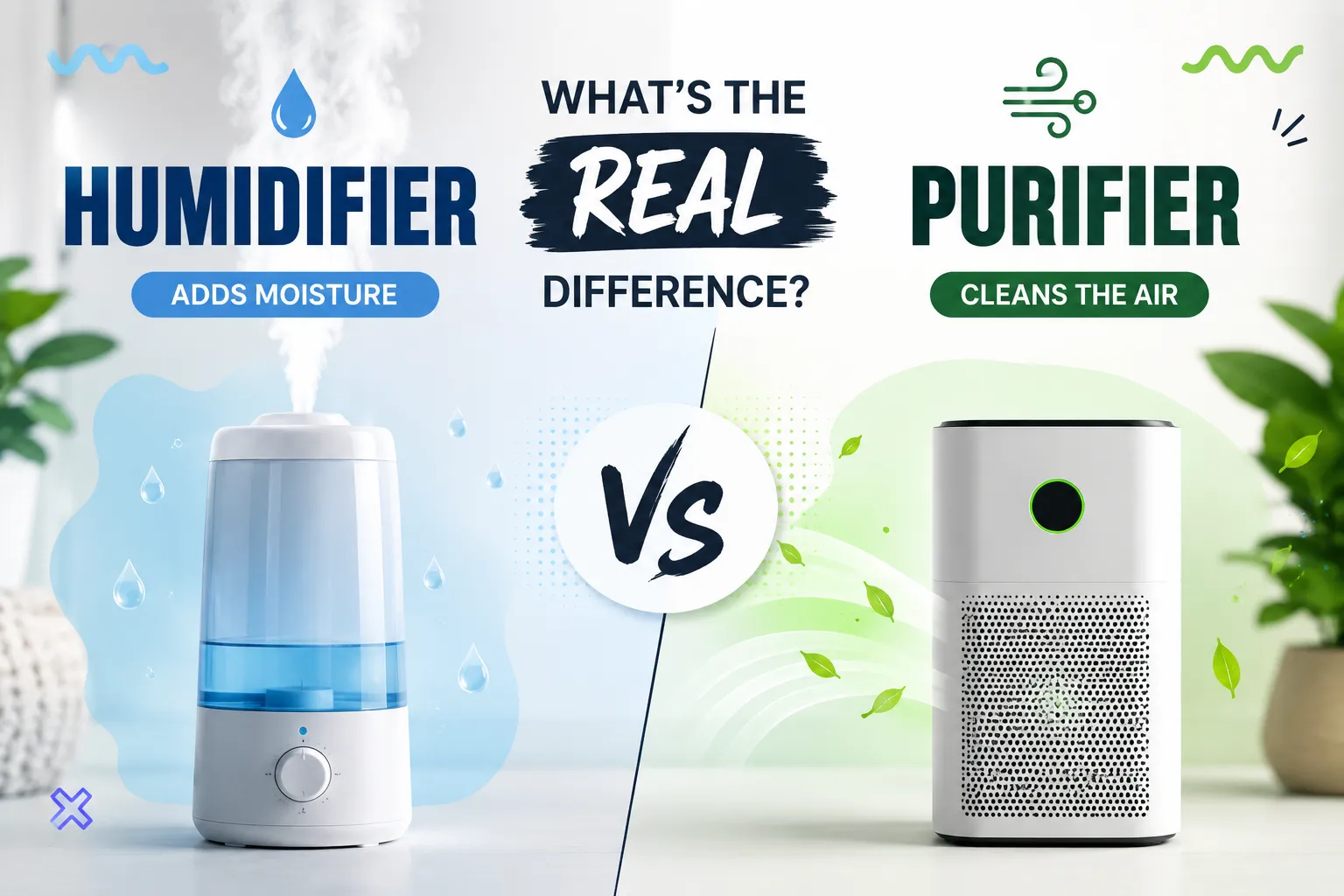
A humidifier adds moisture to dry air, while a purifier removes particles and pollutants from the air you breathe.
Most people use these like synonyms. They’re not, and the difference actually matters for your health, your home, and your wallet.
My neighbor Sana bought a humidifier last winter, convinced it would fix her constant sneezing and stuffy nose. Her symptoms got worse within a week. She had actually needed a purifier the whole time, since dust and pet dander, not dry air, were the real problem.
So how do you know which one your home actually needs? The difference between humidifier and purifier comes down to what each machine physically does to the air around you, and getting it wrong can waste money or worsen your symptoms.
A humidifier releases water vapor into a room. A purifier pulls air through filters that trap dust, smoke, and allergens. Understanding the difference between humidifier and purifier is the first step to breathing easier at home.
Key Difference
A humidifier changes how much moisture is in your air. A purifier changes how clean that air actually is. One adds something to the room, the other removes something from it. Keep reading, we break down all 10 differences in plain, simple terms below.
Why Is This Difference Important to Know?
Buying the wrong machine means spending money without solving your actual problem. Someone with allergies needs a purifier, not added moisture. Someone with cracked skin and nosebleeds from dry winter air needs a humidifier, not filtered air. Knowing the difference between humidifier and purifier helps parents, allergy sufferers, and anyone managing a respiratory condition make the right choice the first time.
Let’s Break It Down Further
If you also want to understand indoor air quality more broadly, check out our guide: Air Quality Index Explained in Plain English. Now let’s walk through the ten clearest differences between humidifiers and purifiers, one at a time.
Ten Points of Difference Between Humidifier and Purifier
1. Basic Definition and Meaning
A humidifier is a device that adds water vapor or steam into the air to raise humidity levels. A purifier is a device that filters air to remove dust, smoke, and allergens. For example, a bedroom humidifier releases a fine mist overnight. A living room purifier quietly pulls smoke particles out of the air after cooking.
2. Origin and Main Components
Humidifiers rely on a water tank, a wick or disk, and sometimes a small heating element to create vapor. Purifiers rely on internal filters, most often a HEPA filter, along with a fan that pushes air through them. A cool mist humidifier uses a spinning disk to fling water into droplets. A HEPA purifier uses a pleated filter to trap particles as small as 0.3 microns.
3. Process, How It Works
A humidifier turns liquid water into vapor and releases it steadily into the room. A purifier pulls room air in through a fan, forces it through filters, then pushes clean air back out. A humidifier in a nursery keeps releasing mist for hours. A purifier in a smoker’s home continuously cycles the same air, cleaning it repeatedly.
4. Time Involved and Duration
A humidifier usually needs refilling every 12 to 24 hours depending on tank size. A purifier runs continuously but needs filter replacement every 3 to 12 months depending on air quality. A large humidifier tank might last two full nights. A purifier filter in a dusty garage workshop might need replacing every few months instead of yearly.
5. Output Quality and Feel
A humidifier makes air feel softer, warmer, and less dry against your skin and throat. A purifier makes air feel fresher and lighter, especially noticeable to allergy sufferers. Someone with cracked lips in winter feels immediate relief from a humidifier. Someone with a stuffy nose from pet dander notices clearer breathing after running a purifier for a few hours.
6. Primary Use Cases
Humidifiers work best in dry climates, heated homes during winter, and nurseries for babies prone to congestion. Purifiers work best in homes with pets, smokers, allergy sufferers, or anyone near wildfire smoke or heavy traffic pollution. A ski town homeowner runs a humidifier all winter to fight dry indoor heat. A city apartment dweller near a busy road runs a purifier to filter out traffic pollution.
7. Effect or Impact on Health
A humidifier can ease dry skin, chapped lips, sinus irritation, and coughing caused by low humidity. A purifier can reduce asthma triggers, allergy symptoms, and exposure to smoke particles. A child with a dry winter cough often improves with a humidifier in their room overnight. An adult with seasonal allergies often improves after running a purifier during high pollen weeks.
8. Degree of Specificity or Precision
A humidifier targets one specific factor, moisture level, measured in relative humidity percentage. A purifier targets multiple pollutants at once, including dust, pollen, smoke, and pet dander. A humidity gauge tells you exactly when a humidifier has done its job. An air quality monitor shows a purifier reducing several pollutant types simultaneously.
9. Can They Replace Each Other?
No, a humidifier cannot filter particles, and a purifier cannot add moisture to dry air. Someone using only a purifier in a dry climate will still suffer from cracked skin and dry sinuses. Someone using only a humidifier in a smoky home will still breathe in harmful particles. The two machines solve completely separate problems, even though people often assume one can substitute for the other.
10. Long Term Results and Lasting Impact
Long term humidifier use in the right climate can reduce chronic dry skin, nosebleeds, and winter respiratory irritation. Long term purifier use can reduce allergy flare ups, asthma attacks, and exposure to harmful airborne particles over months and years. A household that runs a humidifier every winter often reports fewer static shocks and dry throat mornings. A household that runs a purifier year round often reports fewer allergy related sick days.
Nature and Behaviour
A humidifier behaves like a quiet, steady companion, gently releasing moisture without much noise, working best in enclosed, heated rooms during colder months.
A purifier behaves like an alert, constant filter, always pulling air through itself, working hardest in homes with pets, smoke, or heavy outdoor pollution nearby.
Why Do People Confuse Them?
People confuse humidifiers and purifiers mainly because both are small appliances marketed for “better air” without clear labeling. Store displays often place them side by side, making shoppers assume they do similar jobs. Both machines run quietly and sit in bedrooms or living rooms, reinforcing the idea that they serve the same purpose. A common real life mistake happens when someone buys a humidifier hoping it will help their allergies, only to realize weeks later that dust, not dryness, was the actual problem.
Comparison Table
| Feature | Humidifier | Purifier |
|---|---|---|
| Definition | Adds moisture to air | Removes particles from air |
| Origin | Water tank and misting mechanism | Filter system and fan |
| Process | Releases water vapor into room | Pulls air through filters |
| Duration | Refill every 12 to 24 hours | Filter change every 3 to 12 months |
| Output | Softer, less dry air | Cleaner, filtered air |
| Main Use | Dry climates, winter heating, nurseries | Allergies, pets, smoke, pollution |
| Impact | Eases dry skin and sinus irritation | Reduces allergens and asthma triggers |
| Interchangeable? | No, cannot filter particles | No, cannot add moisture |
| Long Term Result | Fewer dry skin and throat issues | Fewer allergy flare ups |
| Similarity | Both improve indoor air comfort | Both improve indoor air comfort |
| Key Difference | Adds moisture | Removes particles |
📌 Save this for later, bookmark this page or share it with someone who always mixes up humidifier and purifier.
Which Is Better and When?
A humidifier is better when your air feels dry, your skin cracks in winter, or your heating system strips moisture from the air. A purifier is better when you have pets, allergies, nearby smoke, or live in a polluted area. Someone in a dry desert climate benefits more from a humidifier, while someone in a smoky wildfire region benefits more from a purifier.
Quick Decision Guide
Choose humidifier if: ☑ Your skin, lips, or throat feel dry often ☑ You live somewhere with low winter humidity ☑ You use central heating frequently ☑ You have a baby prone to congestion
Choose purifier if: ☑ You have pets shedding dander ☑ You suffer from seasonal allergies ☑ Someone in your home smokes ☑ You live near heavy traffic or wildfire smoke
Still unsure? Drop your question in the comments, we answer every single one.
Metaphors and Similes
A humidifier is like a gentle rain cloud, quietly softening a dry room. A purifier is like a silent bodyguard, constantly screening the air for threats. Comparing them is like comparing watering a plant to sweeping a floor, both help, but in completely different ways.
Connotative Meaning
Humidifier carries a positive connotation in winter health talk, symbolizing comfort, as in “the humidifier saved my skin this winter.” It carries a slightly negative connotation when overused, since too much moisture can encourage mold, as in “the humidifier made the room feel damp.” Neutrally, it simply means a moisture adding device, as in a product manual.
Purifier carries a positive connotation in health and safety conversations, as in “the purifier keeps our air safe.” It carries a neutral connotation in technical contexts, simply naming a filtering appliance. Rarely, it carries a slightly clinical or sterile tone, as in “the room felt purified but cold.”
Idioms and Proverbs
“Clear the air” describes resolving tension or confusion, as in “We finally cleared the air after our disagreement.” “Breath of fresh air” describes something refreshing and welcome, as in “Her honesty was a breath of fresh air.” “Moisture in the room” is a coined expression meaning a comforting or relaxed atmosphere, as in “His calm voice added moisture in the room during the tense meeting.”
FAQ
What is the main difference between humidifier and purifier?
A humidifier adds water vapor to increase moisture in the air. A purifier removes dust, smoke, and allergens using internal filters. They solve two completely different air problems.
Can a humidifier be used instead of a purifier?
No. A humidifier only adds moisture and cannot filter particles like dust, pollen, or smoke. If allergies or pollution are your concern, only a purifier addresses that directly.
Which is better, humidifier or purifier?
Neither is universally better, since they solve different problems. Choose a humidifier for dry air issues, and a purifier for allergy, pet, or pollution related concerns.
How long does a humidifier or purifier last?
A humidifier tank typically needs refilling every 12 to 24 hours. A purifier filter usually needs replacing every 3 to 12 months, depending on air quality and usage.
Why do people mix up humidifier and purifier?
Both are small home appliances marketed for healthier air, often displayed together in stores. Their similar size and quiet operation make it easy to assume they perform the same function.
You might also like: → Air Quality Index Explained in Plain English, wordiums.com/air-quality-index-explained → HEPA Filter vs Carbon Filter: What’s the Difference, wordiums.com/hepa-vs-carbon-filter
Real World Importance
Knowing the difference between humidifier and purifier helps parents choose the right device for a congested baby. It helps allergy sufferers finally address dust and pet dander instead of guessing. It also helps anyone shopping during cold and flu season avoid wasting money on the wrong appliance entirely.
Conclusion
A humidifier adds moisture to dry air, while a purifier removes particles that make air unhealthy to breathe. The difference between humidifier and purifier really comes down to what problem you are trying to solve, dryness or dirty air. Once you know your specific symptoms and climate, choosing the right device becomes simple.
Now that you know the difference, you’ll never mix them up again.
See More: What’s the Real Difference Between Atom and Element?

I’m Ayesha Sadiqah, and I’m passionate about answering one simple question: “What’s the difference?” Through clear comparison guides, I help readers understand commonly confused words, products, concepts, and everyday topics. My goal is to make complex ideas easy to understand with accurate, practical, and reader-friendly explanations.