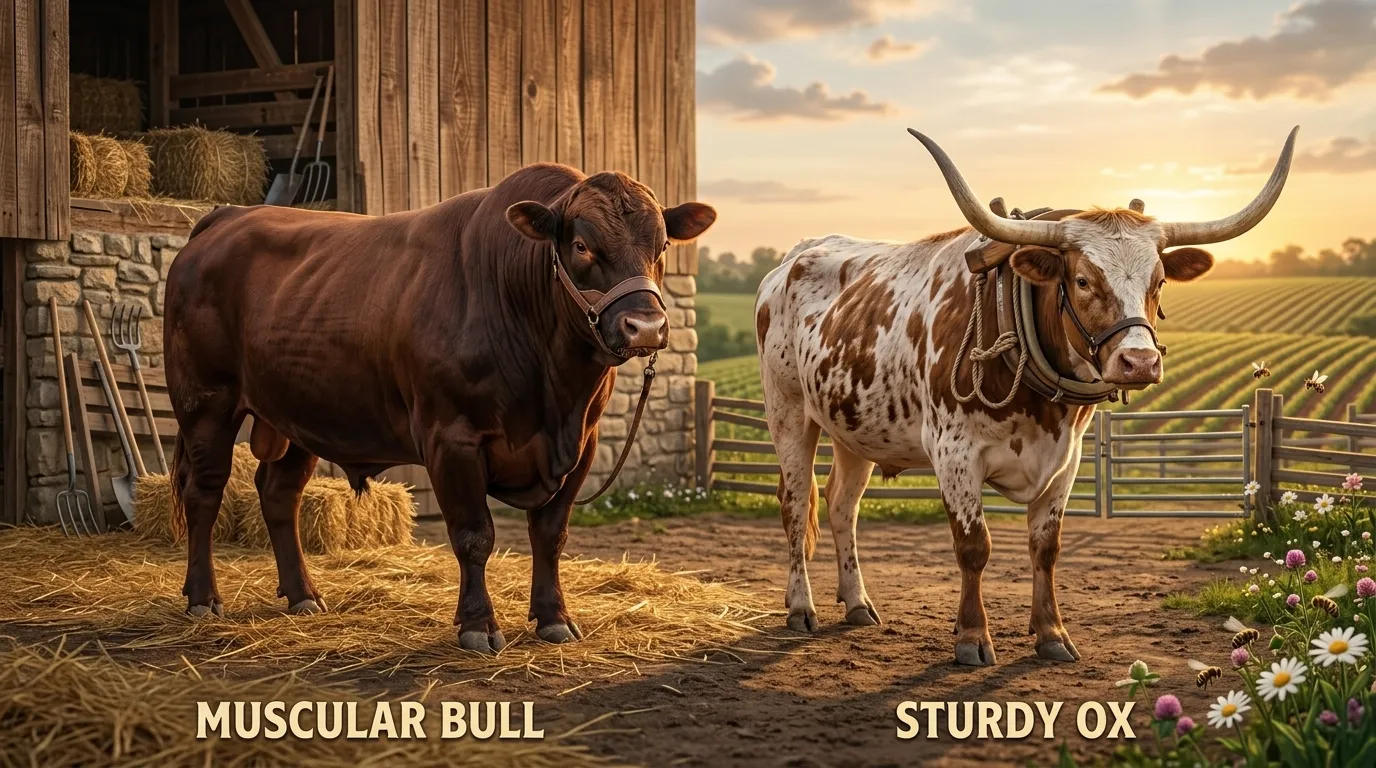
A bull is any intact adult male of cattle used for breeding, while an ox is a castrated adult male trained for hauling, plowing, or pulling carts.
Most people use “ox” and “bull” like they mean the same thing. They do not, and the difference between ox and bull actually matters a lot more than folks think.
Picture Sam, a first time farm buyer. He bought a young male calf at auction, calling it his “ox,” and planned to breed it later. A neighbor pointed out his mistake fast. An ox cannot breed. Once Sam understood the difference between ox and bull, he knew exactly what animal he needed for each job on his land.
So what really separates these two animals, and why does it change how you use them? A bull is a male bovine kept mostly whole for breeding purposes, full of natural hormones and strength. An ox is a male bovine that has been castrated, then trained for years to pull heavy loads. That single change, castration, reshapes everything about how the animal behaves, grows, and works. Understanding the difference between ox and bull will help you talk to farmers, read old books, and even shop for meat with more confidence.
Key Difference
The core difference between ox and bull comes down to one thing: castration. A bull keeps its natural reproductive organs and is used for breeding cows. An ox has been castrated and trained as a draft animal for labor. Keep reading, we break down all 10 differences in plain, simple terms below.
Why Is This Difference Important to Know?
Knowing the difference between ox and bull matters if you raise livestock, buy farm equipment alternatives, read historical texts, or just want to sound informed at a dinner table. Farmers pick the wrong animal for the wrong job when they confuse the two. History lovers misunderstand old farming methods without this knowledge. Even chefs and butchers sometimes mislabel meat cuts because of this mix up.
Before We Compare Them
If you also want to understand how farm animals get trained for work, check out our guide: Training Draft Animals for Beginners. Now let’s look closely at how an ox and a bull truly differ, point by point.
10 Points of Difference
1. Basic Definition and Meaning
A bull is an adult male cattle kept intact for breeding cows and producing calves. An ox is an adult male that has been castrated and trained to pull loads. For example, a rancher in Texas keeps a Brahman bull purely to mate with his herd. A farmer in rural India uses a trained ox named Raja to plow rice paddies every morning.
2. Origin and Source
Bulls come from natural cattle breeding lines chosen for strength, size, or milk genetics passed to offspring. Oxen usually start life as regular bull calves before being castrated around one year old. A dairy farm in Wisconsin selects a young bull calf from its best genetic line. A working farm in Nepal picks a strong calf specifically to raise into an ox.
3. Process: How They Are Made
A bull simply grows up naturally with no surgical change to its body at all. An ox goes through castration, usually done young, followed by years of patient training to pull equipment. A breeder in Kansas lets his bull mature untouched for stud work. An Amish farmer in Ohio spends two full years training his young ox to walk in a straight line.
4. Time Involved and Duration
A bull reaches breeding readiness in about one to two years with no extra training needed. An ox needs several years of steady training before it becomes a reliable, calm worker. A cattle rancher can use a fifteen month old bull for breeding right away. A farmer in Tanzania spends three years training his ox team before trusting them with heavy plowing.
5. Behavior, Temperament, and Output Quality
Bulls tend to be aggressive, territorial, and unpredictable because of high testosterone levels. Oxen become calm, steady, and easier to handle after castration removes that hormonal drive. A rodeo in Colorado keeps bulls fenced separately because of their aggression. A logging crew in Maine trusts its ox pair to work calmly beside children and dogs.
6. Primary Use Cases
Bulls are used almost entirely for breeding purposes within a cattle herd or artificial insemination program. Oxen are used for plowing fields, pulling carts, hauling logs, and other physical farm labor. A breeding facility in Montana keeps prize bulls for genetic sales alone. A small farm in Guatemala relies on its ox team to till corn fields every spring.
7. Effect and Impact on the Farm
A bull directly affects herd growth by fathering calves and shaping future genetics of the cattle line. An ox directly affects daily farm productivity by completing physical labor that machines might otherwise do. A ranch in Argentina tracks calf quality based on which bull sired them. A hill farm in Bhutan measures its harvest speed based on ox strength.
8. Degree of Specificity and Precision
The term bull applies broadly to any intact male bovine regardless of job or training level received. The term ox applies specifically to a trained, castrated animal used for labor, making it a narrower category. Any farmer can correctly call an untrained young male a bull calf. Only a trained, working, castrated animal earns the specific title ox.
9. Can They Replace Each Other?
A bull cannot do an ox’s job well since it lacks training and stays too aggressive for teamwork. An ox cannot do a bull’s job at all because castration removes its ability to breed cows. A construction team cannot swap in a bull for pulling carts safely. A breeding program cannot use an ox to father a single calf.
10. Long Term Results and Lasting Impact
A bull’s long term value shows up in its offspring, shaping herd genetics for many future generations. An ox’s long term value shows up in decades of steady, reliable farm labor across many seasons. A stud bull might influence hundreds of calves over its breeding lifetime. A well trained ox might work faithfully on the same farm for over fifteen years.
Nature and Behaviour
A bull carries raw power, restlessness, and a protective instinct that makes it thrilling but risky to be near. Its energy stays wild, shaped by nature rather than training.
An ox carries patience, steadiness, and quiet strength earned through years of gentle handling. Its temperament feels tamed, dependable, and almost gentle compared to a bull.
Why Do People Confuse Them?
People confuse the difference between ox and bull because both animals look similar at a glance, large, muscular, and horned. Old books and movies often use the words interchangeably without explaining the real distinction. Many people never learn that castration is the deciding factor separating the two terms. A tourist once asked a farmer to pet his “ox,” not realizing the animal was actually an untrained, intact bull grazing nearby.
Comparison Table
| Feature | Ox | Bull |
| Definition | Castrated, trained male bovine | Intact male bovine |
| Origin | Raised from a young bull calf | Natural cattle breeding line |
| Process | Castration plus years of training | No surgical change, natural growth |
| Duration | Several years to fully train | One to two years to maturity |
| Output | Calm, reliable physical labor | Strong breeding drive |
| Main Use | Plowing, hauling, pulling carts | Breeding cows, herd genetics |
| Impact | Boosts daily farm productivity | Shapes future herd generations |
| Interchangeable? | Cannot breed cows | Cannot safely do draft labor |
| Long Term Result | Years of steady, dependable work | Genetic legacy through offspring |
| Similarity | Both are large, muscular bovines | Both are large, muscular bovines |
| Key Difference | Castrated and trained for labor | Intact and kept for breeding |
📌 Save this for later, bookmark this page or share it with someone who always mixes up ox and bull.
Which Is Better and When?
A bull is better when your goal is breeding cows and improving herd genetics over time. A cattle ranch expanding its herd needs a strong, healthy bull for that job.
An ox is better when your goal is physical labor like plowing, hauling, or pulling heavy loads. A small farm without tractors benefits far more from a trained, patient ox team.
Quick Decision Guide
Choose an ox if: ☑ You need steady, reliable farm labor ☑ You want a calm, safer animal around people ☑ You lack modern farming machinery ☑ You value years of consistent, trained work
Choose a bull if: ☑ Your goal is breeding cows for calves ☑ You want to improve future herd genetics ☑ You run a dedicated breeding program ☑ You can safely manage an aggressive animal
Still unsure? Drop your question in the comments, we answer every single one.
Metaphors and Similes
A bull is like a storm, powerful, unpredictable, and impossible to fully control. An ox is like an old oak tree, steady, patient, and built to endure. Comparing them feels like comparing a racehorse to a plow horse, both strong, but built for entirely different jobs.
Connotative Meaning
Ox carries a positive connotation of strength and dependability, as in “he works like an ox.” It carries a slightly negative sense too, sometimes implying someone slow or unrefined. Neutrally, it simply names a working farm animal, as any agriculture textbook would use it.
Bull carries a positive connotation of raw power and confidence, as in “he charged in like a bull.” It carries a negative connotation of recklessness, as in “a bull in a china shop.” Neutrally, it names any intact male bovine, as used in livestock auction listings.
Idioms and Proverbs
“Strong as an ox” describes someone with impressive physical strength, like your uncle who carries furniture alone. “Take the bull by the horns” means facing a hard problem head on, like Maria did when she confronted her landlord. “Stubborn as an ox” [coined expression] describes someone who refuses to change their mind, no matter the argument.
FAQ Section
What is the main difference between ox and bull? The main difference between ox and bull is castration. A bull stays intact for breeding, while an ox is castrated and trained for physical farm labor over many years.
Can an ox be used instead of a bull? No. An ox cannot breed cows because it has been castrated. It can only perform physical labor tasks, unlike a bull, which exists specifically for breeding purposes.
Which is better, ox or bull? Neither is universally better. An ox suits farm labor needs, while a bull suits breeding needs. The right choice depends entirely on your specific farming goal.
How long does an ox or bull last? A trained ox can work reliably for over fifteen years on a farm. A breeding bull typically stays productive for around seven to ten years before retirement.
Why do people mix up ox and bull? People mix them up because both animals look similar, large and muscular with horns. Few realize that castration and training, not appearance, actually separate an ox from a bull.
You might also like: → How Draft Animals Shaped Early Agriculture, farmlife-guide.com/draft-animals → Choosing the Right Cattle Breed for Your Farm, farmlife guide.com/choosing cattle breeds
Real World Importance
Knowing the difference between ox and bull helps farmers choose the right animal for breeding versus labor. It helps historians correctly interpret old agricultural texts and photographs. It even helps everyday shoppers understand meat labeling and farm terminology used at local markets and fairs.
Conclusion
The difference between ox and bull really comes down to one surgical change and years of training that follow it. A bull stays intact, aggressive, and focused on breeding within a cattle herd. An ox becomes calm, patient, and dependable after castration and extensive training for physical labor. Each animal serves a completely different purpose on a farm, and neither can replace the other.
Now that you know the difference, you’ll never mix them up again. You can walk onto any farm and confidently tell an ox from a bull at first glance.
Read More: Milkshake vs Malt: Differences Most People Miss

I’m Ayesha Sadiqah, and I’m passionate about answering one simple question: “What’s the difference?” Through clear comparison guides, I help readers understand commonly confused words, products, concepts, and everyday topics. My goal is to make complex ideas easy to understand with accurate, practical, and reader-friendly explanations.