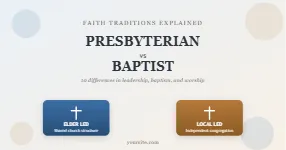
The main difference between Presbyterian and Baptist churches is church government and baptism. Presbyterians use elders and a leadership structure. Baptists believe in independent churches and baptize only believers by full immersion.
Most people think all Christian churches are basically the same. They are not. The difference between Presbyterian and Baptist churches actually shapes how each church runs and worships.
James grew up Baptist. He got married in a Presbyterian church. He was confused during the service. The pastor talked about elders and a session. James had never heard those words in his own church. He later learned this is a key part of the difference between Presbyterian and Baptist beliefs.
Presbyterian churches follow a system led by elders. Baptist churches let each local church run itself. Both are Christian, but they differ a lot in structure, baptism, and daily church life.
So what is the real difference between Presbyterian and Baptist churches? Let’s break it down step by step.
Key Difference
The biggest difference is how each church is run. Presbyterians use a leadership system with elders, called a session. Local churches report to a presbytery and a general assembly. Baptists believe each local church is independent. No outside group controls it.
Keep reading. We break down all 10 differences below in plain, simple terms.
Why Is This Difference Important to Know?
Knowing the difference between Presbyterian and Baptist churches helps you understand what to expect at each type of service. It matters if you are choosing a church, marrying into a new faith family, or just curious about your neighbor’s beliefs.
This knowledge helps beginners feel less lost in a new church. It also helps longtime church members explain their own beliefs more clearly to others.
Linking Hook
Now that you know the basics, it helps to learn how these churches compare to other Christian groups too. If you want to learn more, check out our guide: Methodist vs Baptist: What’s the Real Difference.
10 Points of Difference
1. Basic Meaning
Presbyterian churches are led by elders in a system called Presbyterian government. Baptist churches are led by their own members, with no higher church authority above the local church.
Example: A Presbyterian church in Charlotte reports to a regional presbytery. A Baptist church in Dallas answers only to its own members and pastor.
2. Origin and History
Presbyterian churches began during the Scottish Reformation. John Knox helped start this movement in the 1500s. Baptist churches began in the early 1600s in England and Holland, started by early Separatist Christians.
Example: Many Presbyterian churches trace roots back to Scotland. Many Baptist churches trace roots back to early English Baptist congregations.
3. How Each Church Is Run
Presbyterian churches use a system of courts. This includes the session, the presbytery, and the general assembly. Baptist churches use a congregational system. Members vote directly on major church decisions.
Example: A Presbyterian pastor is approved by the presbytery. A Baptist pastor is hired directly by the local congregation.
4. Time and Structure of Leadership
Presbyterian elders often serve for set terms and get elected by the congregation. Baptist deacons and pastors usually serve based on the local church’s own rules, which can vary widely.
Example: A Presbyterian elder might serve a three year term. A Baptist deacon might serve as long as the church wants them to stay.
5. Feel and Style of Worship
Presbyterian worship often feels formal and structured, following a set order of service. Baptist worship often feels more relaxed, with more room for spontaneous prayer and preaching style.
Example: A Presbyterian service may follow a printed bulletin closely. A Baptist service may include longer, more expressive sermons and singing.
6. Beliefs About Baptism
Presbyterians baptize infants and adults, usually by sprinkling water. Baptists baptize only people who choose it themselves, always by full immersion in water.
Example: A Presbyterian family may baptize their newborn baby. A Baptist teenager gets baptized after publicly declaring their faith.
7. Effect on Church Membership
In Presbyterian churches, baptism as an infant often marks the start of a lifelong church journey. In Baptist churches, baptism as a believer marks a clear, personal decision to join the faith.
Example: A Presbyterian child grows up already baptized within the church family. A Baptist adult chooses baptism after deciding to follow their faith personally.
8. Degree of Central Authority
Presbyterian churches follow decisions made by regional and national church bodies. Baptist churches keep almost all authority at the local level, with very little outside control.
Example: A Presbyterian congregation follows rulings from its denomination’s general assembly. A Baptist congregation makes its own rules about membership and leadership.
9. Can They Be Combined or Confused?
No, the systems cannot simply swap. A Presbyterian church cannot run without its leadership courts. A Baptist church cannot function under an outside authority without changing its core beliefs.
Example: A Presbyterian church cannot skip presbytery approval for a new pastor. A Baptist church cannot allow a regional body to overrule its own vote.
10. Long Term Impact on Church Culture
Presbyterian churches often build a strong sense of tradition and shared structure across many congregations. Baptist churches often build strong independence and local identity, since each church shapes its own path.
Example: Presbyterian denominations often share the same hymnals and doctrine across the country. Baptist churches often differ widely from one town to the next.
Nature and Behaviour
Presbyterian churches feel structured and steady. They lean on shared rules and elder leadership to guide decisions across many churches at once.
Baptist churches feel independent and personal. They lean on local voice and individual choice, giving each congregation its own identity and freedom.
Why Do People Confuse Them?
People confuse Presbyterian and Baptist churches because both are Protestant Christian groups with similar worship styles. Both use the Bible as their main guide. Both include hymns, sermons, and prayer.
Many people also assume all Protestant churches share the same rules on baptism and leadership. James’s story is a common example. He didn’t expect such a different church structure at a Presbyterian wedding.
Comparison Table
| Feature | Presbyterian | Baptist |
| Definition | Led by elders in a shared system | Led independently by each local church |
| Origin | Scottish Reformation, 1500s | English Separatists, early 1600s |
| Process | Session, presbytery, general assembly | Congregational vote at local level |
| Structure | Elders serve set terms | Leaders serve based on local church rules |
| Worship Style | Formal, structured order | Relaxed, expressive style |
| Baptism | Infants and adults, by sprinkling | Believers only, by full immersion |
| Main Authority | Regional and national church bodies | Local congregation only |
| Interchangeable? | No | No |
| Long Term Result | Shared tradition across churches | Strong local independence |
| Similarity | Both Protestant, Bible centered | Both Protestant, Bible centered |
| Key Difference | Elder led system | Independent local church |
📌 Save this for later. Share it with someone who always mixes up Presbyterian and Baptist churches.
Which Is Better and When?
Neither one is better, since both offer strong, faithful communities. Presbyterian churches work well for people who like clear structure and shared decision making, such as families who value tradition.
Baptist churches work well for people who prefer local control and a personal, chosen faith journey, such as someone who wants a hands on role in church decisions.
Quick Decision Guide
Presbyterian may fit you if: ☑ You like structured, elder led leadership ☑ You value shared tradition across churches ☑ You prefer infant baptism for your children ☑ You like a formal worship style
Baptist may fit you if: ☑ You value local church independence ☑ You want to choose baptism yourself ☑ You prefer a more relaxed worship style ☑ You want a personal, chosen faith decision
Still unsure? Drop your question in the comments. We answer every single one.
Metaphors and Similes
Think of a Presbyterian church like a large family tree, with shared roots and connected branches. Think of a Baptist church like its own small house, standing on its own ground.
Presbyterian and Baptist churches are like two different types of teams, one plays under a league’s shared rules, the other plays by its own house rules.
Connotative Meaning
Presbyterian often carries a calm, orderly connotation, as in “a Presbyterian sense of order.” In a negative sense, some people call it “too formal” or “too rigid.” Neutrally, people simply say “she attends a Presbyterian church.”
Baptist often carries a warm, personal connotation, as in “a heartfelt Baptist sermon.” In a negative sense, some people call certain Baptist churches “too strict” on personal rules. Neutrally, people simply say “he was raised Baptist.”
Idioms and Proverbs
“Order in the house” fits the Presbyterian style well, since structure and process guide their decisions. “Every church for itself” [coined expression] captures the Baptist belief in local independence.
“Faith of our fathers” applies to both groups, since each traces its roots to strong early religious movements.
FAQ Section
Q1: What is the main difference between Presbyterian and Baptist churches? Presbyterian churches use a shared leadership system with elders and regional oversight. Baptist churches run independently, with each local congregation making its own decisions without outside control.
Q2: Can a Presbyterian church function like a Baptist church? No. A Presbyterian church relies on its elder led courts for major decisions. A Baptist church relies only on its own local vote, so the two systems cannot simply swap.
Q3: Which is better, Presbyterian or Baptist? Neither is better overall. It depends on personal preference for structure versus independence, along with your views on baptism and worship style.
Q4: How long has each church tradition lasted? Presbyterian churches trace back to the 1500s in Scotland. Baptist churches trace back to the early 1600s in England and Holland, so both have centuries of history.
Q5: Why do people mix up Presbyterian and Baptist churches? People mix them up because both are Protestant, use the Bible, and share similar worship elements like hymns and sermons, even though their structure and baptism beliefs differ.
You might also like: → Methodist vs Baptist: What’s the Real Difference, yoursite.com/methodist-vs-baptist → Catholic vs Protestant: Key Differences Explained, yoursite.com/catholic-vs-protestant
Real World Importance
Knowing the difference between Presbyterian and Baptist churches helps you choose a church that fits your beliefs and comfort level. It helps in interfaith marriages, moving to a new town, or simply understanding a friend’s faith background.
This knowledge also helps in respectful conversations about religion, especially in mixed families or diverse communities.
Conclusion
The difference between Presbyterian and Baptist churches comes down to leadership and baptism. Presbyterian churches use elders and a shared system across many congregations. Baptist churches stay independent, with each local church making its own choices. Both baptize believers, but only Presbyterians also baptize infants.
Nowthat you know the difference, you’ll never mix them up again, and your next church visit or conversation about faith will feel a lot more clear.
See More: Macronutrients vs Micronutrients: 10 Key Differences

I’m Ayesha Sadiqah, and I’m passionate about answering one simple question: “What’s the difference?” Through clear comparison guides, I help readers understand commonly confused words, products, concepts, and everyday topics. My goal is to make complex ideas easy to understand with accurate, practical, and reader-friendly explanations.