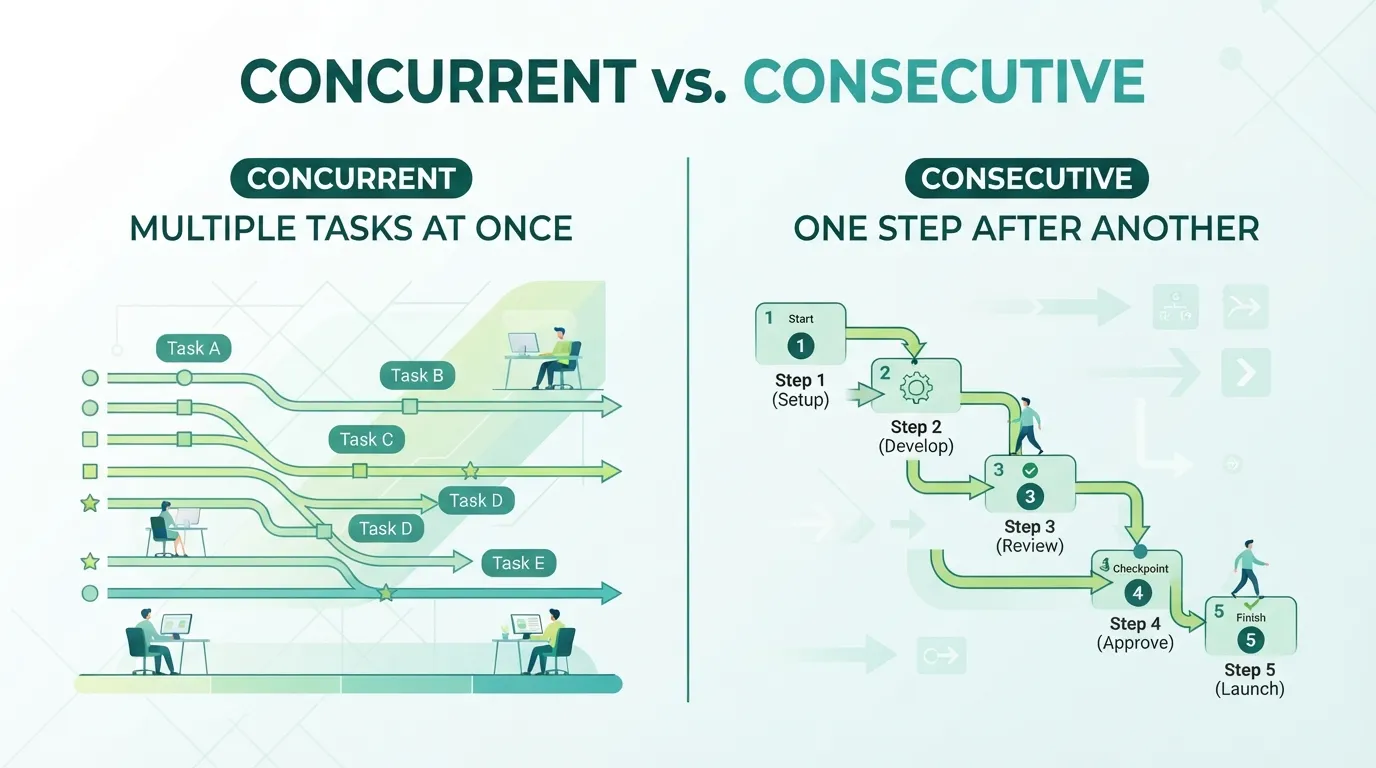
Concurrent means things happen at the same time. Consecutive means things happen one after another, in order.
Most people use “concurrent” and “consecutive” like they mean the same thing. They don’t, and mixing them up can cause real problems.
Sarah, a project manager in Austin, once told her team to run two tasks “consecutively” when she actually meant “concurrently.” The result? Her team wasted three extra days finishing a project that should have taken half the time. One small word mix-up cost her whole team a week of work.
So what is the real difference between concurrent and consecutive, and why does it matter so much? Let’s break it down in plain, simple English.
Concurrent means happening at the same moment, side by side, in parallel. Consecutive means happening in a row, one after the next, without skipping. Once you understand the difference between concurrent and consecutive, you’ll start noticing it everywhere, from court sentences to gym schedules to computer programming.
Key Difference
The core difference between concurrent and consecutive comes down to timing. Concurrent events overlap and happen together. Consecutive events follow each other in sequence, one finishing before (or as) the next begins.
Keep reading. We break down all 10 differences in plain, simple terms below.
Why Is This Difference Important To Know?
Knowing the difference between concurrent and consecutive can change real outcomes. In law, a judge choosing concurrent sentences versus consecutive sentences can mean years of difference in prison time. In business, running tasks concurrently instead of consecutively can cut a project’s timeline in half.
Even in daily life, this matters. Missing three consecutive workouts is very different from missing three concurrent commitments in one busy week. Whether you’re a student, a manager, or just a curious reader, this small word choice carries big weight.
10 Points of Difference
1. Basic Definition and Meaning
Concurrent means two or more things happening at the same time. Consecutive means things happening one right after another. For example, two doctors, Maria and Tom, seeing patients concurrently means they work at the same hour. If Maria sees patients consecutively, she sees one, finishes, then sees the next.
2. Origin and Main Components
Concurrent comes from Latin words meaning “running together.” Consecutive comes from Latin words meaning “following closely.” A runner named Diego training concurrently with swimming lessons does both in the same week. A runner training consecutively runs five days straight without a break.
3. Process: How It Happens
A concurrent process involves overlap, like two chefs, Ana and Ben, cooking different dishes on the stove at once. A consecutive process involves strict order, like a baker, Ana, making bread, then cookies, then pie, one after the other, never at the same time.
4. Time Involved or Duration
Concurrent events share the same time window, even if they don’t start or end at the exact same second. Consecutive events happen in unbroken sequence. A student, Priya, taking two concurrent classes attends both during the same semester. Taking them consecutively means one semester, then the next.
5. Flavor, Feel, or Output Quality
Concurrent tasks often feel busy and layered, like a manager, James, juggling three calls in one afternoon. Consecutive tasks feel steady and linear, like a runner, Kevin, completing five consecutive miles without stopping. One feels like a juggling act, the other feels like a straight line.
6. Primary Use Cases
Concurrent is common in computing, law, and multitasking, like a computer running concurrent programs. Consecutive is common in counting, streaks, and scheduling, like a employee, Lisa, working five consecutive days before her day off. Each word fits very different real world situations.
7. Effect or Impact
Concurrent sentences in court often mean shorter total prison time, since sentences overlap. Consecutive sentences stack up, adding real years. A defendant named Robert given two concurrent five year sentences serves five years total. Given consecutive sentences, he serves ten years total.
8. Degree of Specificity or Precision
Concurrent focuses on overlap in time, without needing perfect order. Consecutive demands strict, unbroken sequence with no gaps. A gym goer, Nina, working out on concurrent days just needs the days to overlap with another activity. Consecutive days require back to back attendance, no skipping allowed.
9. Can They Replace Each Other?
No, concurrent and consecutive cannot be swapped without changing the meaning completely. Saying a company ran “concurrent quarters of profit” means separate quarters overlapped somehow, which rarely makes sense. Saying “consecutive quarters of profit,” like a company, TechCorp, having four consecutive profitable quarters, means four in a row with no losses between them.
10. Long Term Results or Lasting Impact
Concurrent activities often build broad skills quickly, since things develop side by side. Consecutive activities build deep, steady progress, since each step builds directly on the last. A student, Omar, studying concurrent subjects gains variety. A student studying consecutive courses in one subject builds deep mastery over time.
Nature and Behaviour
Concurrent behaves like a busy intersection, full of overlapping movement, energy, and simultaneous action. It thrives in environments that demand multitasking and flexibility, like a hospital emergency room handling several cases at once.
Consecutive behaves like a straight hallway, calm, ordered, and predictable. It thrives where structure and sequence matter most, like a training program that must be followed step by step, in order, without skipping ahead.
Why Do People Confuse Them?
People confuse concurrent and consecutive because both words sound formal and both involve time. Both start with similar rhythm and appear in similar contexts, like scheduling or legal documents. Many readers also skim past these words without pausing to check the exact meaning.
A common real life mistake happens when someone books “consecutive meetings” but actually needs them to overlap, causing a scheduling disaster where nobody can attend both.
Comparison Table
| Feature | Concurrent | Consecutive |
| Definition | Happening at the same time | Happening one after another |
| Origin | Latin, “running together” | Latin, “following closely” |
| Process | Overlapping, parallel | Sequential, in order |
| Duration | Shared time window | Unbroken sequence |
| Output | Layered, busy | Linear, steady |
| Main Use | Multitasking, law, computing | Counting, streaks, scheduling |
| Impact | Can shorten total time | Can lengthen total time |
| Interchangeable? | No | No |
| Long Term Result | Broad, varied progress | Deep, focused progress |
| Similarity | Both relate to time and order | Both relate to time and order |
| Key Difference | Overlap | Sequence |
📌 Save this for later. Bookmark this page or share it with someone who always mixes up concurrent and consecutive.
Which Is Better and When?
Concurrent is better when speed and efficiency matter most, like a factory running concurrent production lines to finish an order faster. It works well when tasks don’t depend on each other.
Consecutive is better when order and consistency matter most, like a therapist recommending consecutive sessions so progress builds properly. Neither is truly “better.” Each fits a different goal.
Quick Decision Guide
Choose Concurrent if: ☑ Tasks don’t depend on each other’s results ☑ You need to save total time ☑ You can manage multiple things at once ☑ Overlap won’t cause confusion
Choose Consecutive if: ☑ Each step depends on the last one ☑ Order and structure matter most ☑ You need a clear, trackable sequence ☑ Skipping a step would break progress
Still unsure? Drop your question in the comments, we answer every single one.
Metaphors and Similes
Concurrent is like several rivers flowing into one lake at the same time. Consecutive is like stepping stones crossing a river, one after another. Comparing them is like comparing a busy kitchen full of cooks working together to a single chef following a recipe step by step.
Connotative Meaning
Concurrent can feel positive, like efficient teamwork; negative, like overwhelming chaos; or neutral, like simple scheduling overlap. For example, “concurrent projects” can sound impressive or exhausting depending on context.
Consecutive can feel positive, like a strong winning streak; negative, like a tiring grind; or neutral, like plain counting. “Five consecutive wins” sounds exciting, while “five consecutive night shifts” sounds draining.
Idioms and Proverbs
“Firing on all cylinders” often describes concurrent effort working smoothly together, as in, “The team was firing on all cylinders during the concurrent launch.” “One step at a time” reflects consecutive progress, as in, “She finished the course one step at a time, consecutive lesson by lesson.” A coined expression, “stacking the streak,” fits consecutive success, as in, “He kept stacking the streak with ten consecutive victories.”
FAQ Section
Q1: What is the main difference between concurrent and consecutive? Concurrent means things happen at the same time. Consecutive means things happen one after another, in order, without gaps or overlap between them.
Q2: Can concurrent be used instead of consecutive? No. They describe opposite timing patterns. Swapping them changes the meaning completely and can cause real confusion in scheduling, legal, or business contexts.
Q3: Which is better, concurrent or consecutive? Neither is better overall. Concurrent suits independent tasks needing speed. Consecutive suits dependent tasks needing order, structure, and steady progress over time.
Q4: How long does concurrent or consecutive last? Length depends entirely on context. Concurrent events last as long as their overlap continues. Consecutive events last as long as the unbroken sequence continues without a gap.
Q5: Why do people mix up concurrent and consecutive? Both words sound formal, involve time, and appear in similar settings like law or scheduling. Readers often skim past them without checking the exact meaning.
You might also like: → How Judges Decide Between Concurrent and Consecutive Sentences, /legal-sentencing-guide → Time Management Tips for Overlapping Projects, /time-management-tips
Real World Importance
Understanding the difference between concurrent and consecutive helps in courtrooms, workplaces, and daily planning. It affects how prison sentences are served, how project deadlines are set, and how personal habits, like workout streaks, are tracked and understood correctly.
Conclusion
The difference between concurrent and consecutive comes down to one simple idea: overlap versus order. Concurrent events share the same time. Consecutive events follow each other in a row. This single distinction shapes outcomes in law, business, fitness, and everyday scheduling.
Now that you know the difference, you’ll never mix them up again. You’ve got this.
See More: Presbyterian vs Baptist: 10 Differences Most People Miss

I’m Ayesha Sadiqah, and I’m passionate about answering one simple question: “What’s the difference?” Through clear comparison guides, I help readers understand commonly confused words, products, concepts, and everyday topics. My goal is to make complex ideas easy to understand with accurate, practical, and reader-friendly explanations.