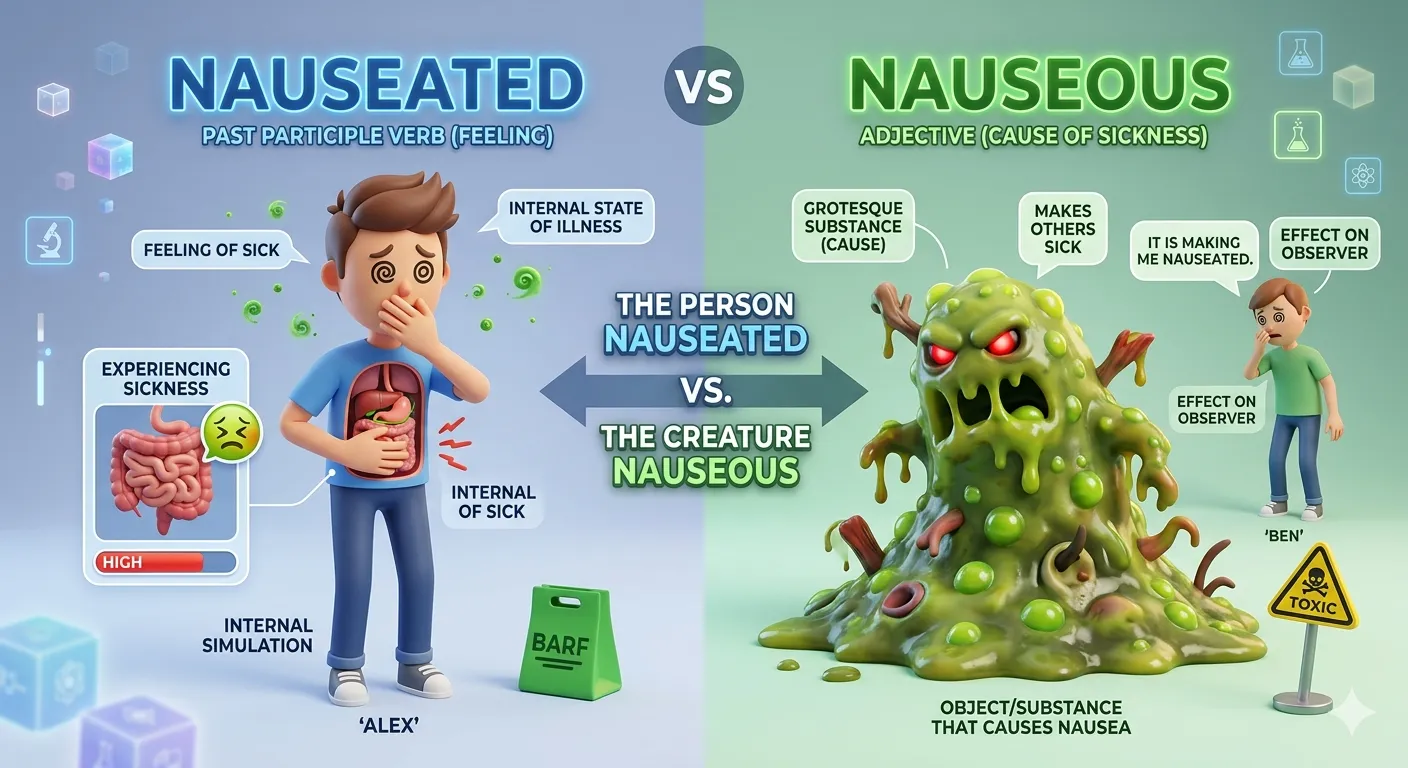
Nauseated means you feel sick and want to vomit. Nauseous traditionally means something causes nausea, but many people now use it to mean feeling sick as well.
A few years ago, I was editing an article when I spotted a sentence that read, “I felt nauseous after the boat ride.” It looked perfectly normal. Yet another editor insisted it should be “nauseated.”
That small disagreement sparked a surprisingly long debate.
If you’ve ever wondered whether you should say nauseous or nauseated, you’re not alone. These two words confuse students, writers, professionals, and even language experts. They are often used interchangeably in everyday speech, but traditional grammar guides draw an important distinction between them.
The confusion grows because dictionaries, style guides, and common usage do not always agree. As language changes, meanings shift. What was once considered incorrect may become widely accepted.
In this guide, you’ll learn the real difference between nauseous and nauseated, when to use each one, common mistakes to avoid, and which choice works best in formal and casual writing.
Let’s clear up the confusion once and for all.
Difference Between Nauseous and Nauseated Quick Answer
The simplest difference is this:
- Nauseated = feeling sick or wanting to vomit.
- Nauseous = causing nausea.
Examples
- I felt nauseated after eating spoiled food.
- The strong smell was nauseous.
However, modern English speakers often say:
- I feel nauseous.
Today, this usage is widely accepted in everyday conversation.
The Origin / Background of Difference Between Nauseous and Nauseated
Both words come from the Latin word nausea, meaning seasickness or sickness of the stomach.
Nauseous
The word nauseous entered English first. Historically, it meant:
- Causing nausea
- Offensive or disgusting
- Producing feelings of sickness
Example:
- The nauseous odor filled the room.
Nauseated
The word nauseated developed later to describe a person experiencing nausea.
Example:
- She felt nauseated during the flight.
Why the Confusion Exists
Language changes over time.
Many native speakers began using nauseous to mean “feeling sick.” This became so common that major dictionaries eventually recognized the newer meaning.
As a result:
- Traditional grammar prefers nauseated for feeling sick.
- Modern usage accepts nauseous for feeling sick.
Both appear frequently in everyday English today.
Difference Between Nauseous and Nauseated Explained Key Differences
| Term | Meaning | When to Use | Region/Context |
| Nauseous | Causing nausea; sometimes feeling sick | Formal writing often uses it for something that causes sickness | Traditional grammar |
| Nauseated | Feeling sick or wanting to vomit | Best when describing your own condition | Formal and academic writing |
Nauseous Example
- The chemical fumes were nauseous.
- The smell from the trash bin was nauseous.
In these examples, the thing itself causes sickness.
Nauseated Example
- I became nauseated during the car ride.
- She felt nauseated after surgery.
In these examples, a person feels sick.
Modern Usage
Many speakers now say:
- I feel nauseous.
Although traditionalists may object, this usage is widely accepted in modern English.
Which Version Should You Use?
The best choice depends on your audience.
For Students
Use nauseated when talking about feeling sick.
Why?
- It follows traditional grammar.
- Teachers often prefer it.
Example:
- I felt nauseated after lunch.
For Professional Writers
Choose nauseated in formal documents.
Why?
- It avoids criticism.
- It is precise.
Example:
- The patient reported feeling nauseated.
For Casual Conversation
Both words are generally accepted.
Examples:
- I feel nauseous.
- I feel nauseated.
Most listeners will understand either version.
For Global or Neutral Use
Use nauseated when referring to a sick feeling.
It is the safest choice in nearly every situation.
Common Mistakes with Difference Between Nauseous and Nauseated
Here are mistakes people make most often.
| Mistake | Better Choice |
| I became nauseous after food poisoning. | I became nauseated after food poisoning. |
| The patient appeared nauseous. | The patient appeared nauseated. |
| The nauseated smell filled the room. | The nauseous smell filled the room. |
| The garbage was nauseated. | The garbage was nauseous. |
| Those fumes looked nauseated. | Those fumes were nauseous. |
Why These Errors Happen
- People hear nauseous more often.
- Everyday speech influences writing.
- Many dictionaries accept both meanings.
- Traditional and modern rules sometimes conflict.
Difference Between Nauseous and Nauseated in Real-World Examples
Professional Email
I am feeling nauseated today and may need to leave work early.
News Headline
Passengers Report Feeling Nauseated During Severe Turbulence
Social Media Post
Just got off a roller coaster and I’m so nauseous right now!
Medical Report
The patient reported feeling nauseated following treatment.
Academic Writing
Several participants became nauseated after exposure to the strong odor.
These examples show that nauseated remains common in formal contexts, while nauseous often appears in casual communication.
Difference Between Nauseous and Nauseated Data, Trends & Usage
Search interest in this topic remains strong because many people are unsure which word is correct.
Who Searches for This Topic?
- Students
- English learners
- Writers
- Editors
- Healthcare professionals
- Job seekers preparing formal documents
Search Intent
The keyword primarily falls into the informational category.
Users want to know:
- Which word is correct
- Whether the words mean the same thing
- How to use each word in a sentence
Regions with High Interest
Interest commonly comes from:
- United States
- Canada
- United Kingdom
- Australia
- Countries where English is learned as a second language
Why It Matters Today
As language evolves, older grammar rules often clash with modern usage. Understanding both perspectives helps you communicate clearly and confidently.
Standalone Comparison Table
| Term/Variant | Meaning | Region/Context | Best Used When |
| Nauseous | Causing nausea | Traditional grammar | Describing something that makes people sick |
| Nauseous | Feeling sick | Modern everyday English | Casual speech and informal writing |
| Nauseated | Feeling sick or wanting to vomit | Formal, academic, and medical contexts | Describing a person’s condition |
| Nauseated | Experiencing nausea | Professional communication | Reports, essays, and official documents |
Frequently Asked Questions
Q: What does the difference between nauseous and nauseated mean?
A: The traditional difference is simple. Nauseous means causing nausea, while nauseated means feeling nausea. Modern English often uses nauseous for both meanings.
Q: How do you use nauseated correctly?
A: Use nauseated when describing someone who feels sick. Example: “I felt nauseated after the long bus ride.”
Q: Nauseous vs nauseated — what’s the difference?
A: Traditionally, a nauseous thing causes sickness. A nauseated person experiences sickness. Today, many people use nauseous to mean feeling sick as well.
Q: Is nauseous acceptable in formal writing?
A: It can be, but many editors still prefer nauseated when describing a person who feels sick. Nauseated is usually the safer choice.
Q: Which version is correct — nauseous or nauseated?
A: Both can be correct depending on context. For formal accuracy, use nauseated for feeling sick and nauseous for causing sickness.
Q: Where does the word nauseous come from?
A: It comes from the Latin word nausea, which referred to seasickness and stomach discomfort.
Q: Can nauseous be used in medical writing?
A: Medical professionals usually prefer nausea when referring to patients who feel sick. This usage is clearer and more precise.
Conclusion
Understanding the difference between nauseous and nauseated is easier than many people think. Traditionally, nauseous describes something that causes nausea, while nauseated describes a person who feels sick. That distinction still appears in formal writing, academic work, and medical documents.
At the same time, modern English has evolved. Many native speakers now use nauseous to mean feeling sick, and major dictionaries recognize that usage. Because of this, you will encounter both meanings in everyday life.
If you want the safest and most precise option, use nausea when describing your own symptoms and nauseous when describing something that causes those symptoms.
Remember these simple rules, and you’ll avoid one of English’s most common word-choice mistakes.
Bookmark this guide so you never second-guess the difference between nauseous and nauseated again. And share it with someone who has been using the wrong word without realizing it.
Read More:
Difference Between Yeast and Bv Infection: Quick Guide

I’m Rubab, an SEO content writer specializing in high-quality comparison articles that simplify complex topics and highlight key differences with clarity and accuracy. My content combines in-depth research, proven SEO strategies, and a reader-first approach to deliver valuable insights across language, technology, health, food, and lifestyle topics.
🔍📈 Turning complex comparisons into clear, search-friendly content that informs, engages, and ranks. ✨🏆