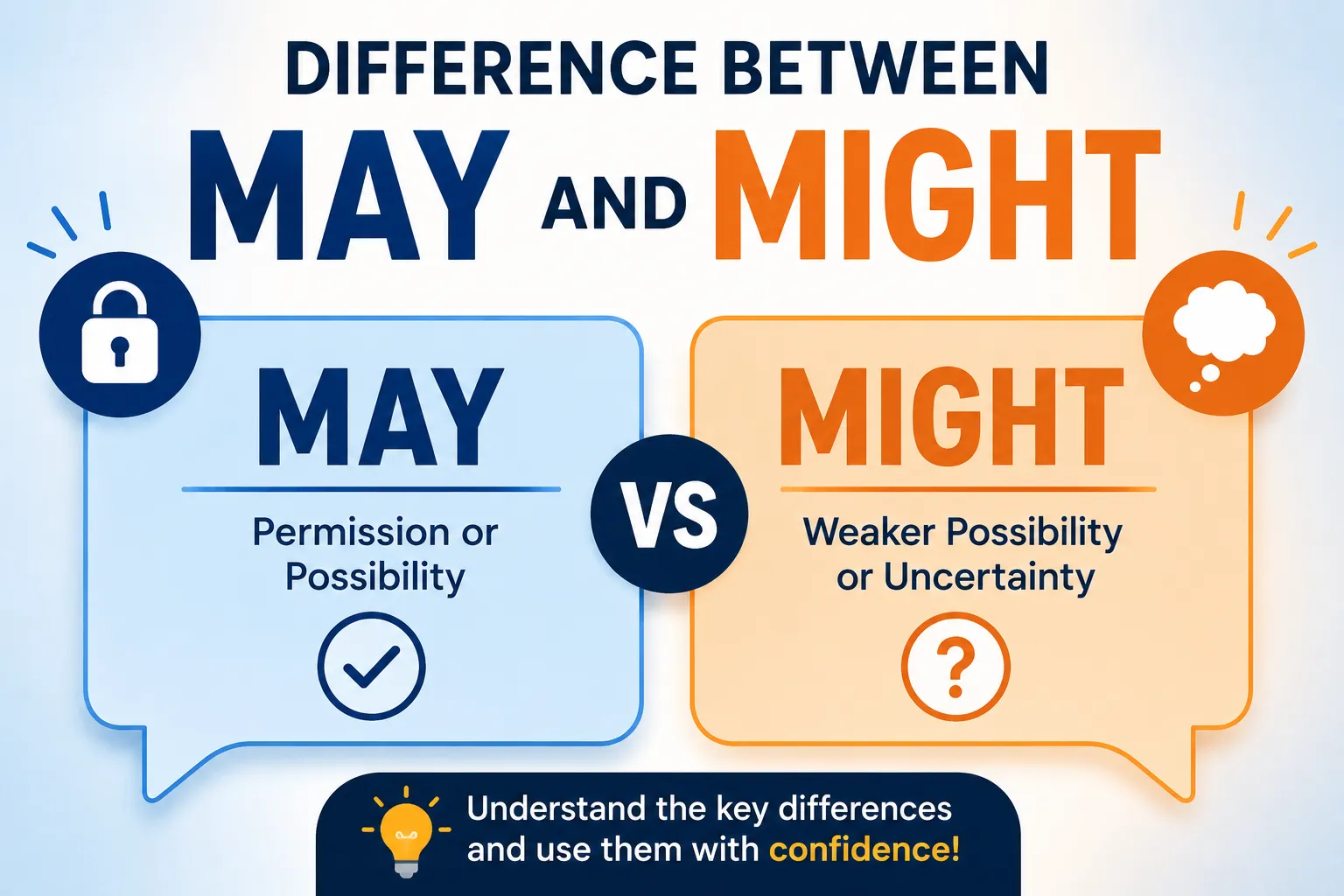
“May” points to a real, fairly likely possibility (or permission) right now, while “might” points to a weaker, more uncertain, or hypothetical possibility, often about the past or an imagined situation.
Most people use “may” and “might” like they’re the exact same word. They’re not, and the difference between may or might can actually change what you’re telling someone.
Here’s a quick story. Jake, a project manager, emailed his client: “We may miss the deadline.” The client panicked and pulled the contract early. What Jake meant was something closer to “we might miss it”, a small, unlikely risk, not a near-certain one. One word changed how serious his message sounded.
So how do you pick the right one every time? Let’s break down the difference between may or might in plain English, with real examples you’ll actually remember.
Key Difference
“May” usually signals a stronger chance something will happen, or it asks for permission. “Might” signals a weaker, more doubtful chance, especially for past or imagined events. Keep reading — we break down all 10 differences in plain, simple terms below.
Why Is This Difference Important to Know?
Getting the difference between may or might wrong can make an email sound more alarming or less serious, than you intend. In a job interview, a doctor’s office, or a legal document, this tiny word choice changes how confident you sound. Writers, students, and professionals all lean on these words daily, so getting them right builds trust and clarity.
10 Points of Difference
1. Basic Definition and Meaning
“May” expresses a real possibility or grants permission. “Might” expresses a smaller, more uncertain possibility. Example: “You may leave early” (permission granted). Example: “She might call later” (not very sure she will).
2. Origin and Source
“May” comes from Old English “magan,” meaning “to be able.” “Might” is its past-tense form, which later became its own separate word for weaker possibility. Linguists like those cited in the Oxford English Dictionary trace both back to the same root. Grammar teachers like Mrs. Patel often explain this history to clear up confusion.
3. Process, How Each Is Used
“May” is used for present or future possibility, or to ask permission directly. “Might” is used for past possibility, hypothetical situations, or softer present guesses. Example: “He may join us tonight.” Example: “He might have joined us, but his car broke down.”
4. Time Involved
“May” usually points to something close to now or the near future. “Might” stretches more easily into the past or distant, unreal scenarios. Example: “It may rain today.” Example: “It might have rained yesterday, the ground looks damp.”
5. Tone, Feel, and Output Quality
“May” feels confident and a bit formal. “Might” feels softer, more cautious, and more polite. Example: A weather reporter says, “Skies may clear by noon.” Example: A nervous friend says, “I might be free, not sure yet.”
6. Primary Use Cases
“May” is common in formal writing, rules, and permission requests. “Might” is common in everyday speech, guesses, and hypothetical talk. Example: A sign reads, “Visitors may park here.” Example: A teenager says, “I might skip the party.”
7. Effect or Impact on the Listener
“May” can sound more certain, sometimes even official. “Might” sounds more relaxed and leaves room for doubt. Example: A boss saying “You may be promoted” feels like a real signal. Example: A coworker saying “You might get promoted” feels like a casual guess.
8. Degree of Specificity or Precision
“May” leans toward a higher chance, closer to 50% or more. “Might” leans toward a lower chance, often under 50%. Example: A doctor saying “This medicine may cause drowsiness” warns of a common side effect. Example: “This medicine might cause a rare reaction” warns of something less likely.
9. Can They Replace Each Other?
In casual speech, people often swap them without much harm. In formal, legal, or medical writing, swapping them can shift meaning and even create liability. Example: A casual text “I may/might be late” works either way. Example: A legal clause “The tenant may terminate the lease” should not be swapped with “might.”
10. Long-Term Results and Lasting Impact
Choosing “may” repeatedly in writing builds a tone of authority and certainty over time. Choosing “might” repeatedly builds a tone of caution and humility. A business report full of “may” sounds confident. A diary full of “might” sounds reflective and unsure.
Nature and Behaviour
“May” behaves like a steady, confident voice in the room. It states things plainly and doesn’t apologize for taking up space.
“Might” behaves like a careful, soft-spoken voice. It hedges, softens, and leaves the door open for being wrong.
Why Do People Confuse Them?
Both words look related, sound similar, and show up in the same sentence positions, so the brain treats them as twins. Many schools don’t teach the permission-versus-possibility split clearly. Regional habits also matter, some English speakers default to “might” for everything. A common mistake: someone writes “May I be wrong” instead of “I might be wrong,” mixing up permission with possibility.
Comparison Table
| Feature | May | Might |
| Definition | Real possibility or permission | Weaker, uncertain possibility |
| Origin | Old English “magan” | Past tense of “may,” now separate |
| Process | Present/future possibility, permission | Past, hypothetical, or soft guess |
| Duration | Near-term focus | Stretches into past or unreal scenarios |
| Output | Confident, formal tone | Cautious, casual tone |
| Main Use | Rules, formal permission | Everyday guesses, hypotheticals |
| Impact | Sounds more certain | Sounds more doubtful |
| Interchangeable? | Sometimes, in casual speech | Sometimes, but risky in formal text |
| Long-term Result | Builds authority | Builds humility, caution |
| Similarity | Both express possibility | Both express possibility |
| Key Difference | Higher likelihood, permission | Lower likelihood, hypothetical |
📌 Save this for later, bookmark this page or share it with someone who always mixes up “may” and “might.”
Which Is Better and When?
Use “may” when you want to sound confident, formal, or when granting permission, like in a workplace policy: “Employees may work remotely on Fridays.” Use “might” when you want to sound careful, unsure, or when describing a hypothetical, like in casual planning: “We might go hiking if the weather holds.”
Quick Decision Guide
Choose May if: ☑ You’re granting or asking for permission ☑ The chance feels fairly likely ☑ You’re writing something formal or official ☑ You want to sound confident
Choose Might if: ☑ The chance feels unlikely or uncertain ☑ You’re talking about the past or a hypothetical ☑ You’re speaking casually ☑ You want to sound cautious or polite
Still unsure? Drop your question in the comments, we answer every single one.
Metaphors and Similes
“May” is like a green traffic light, a clear go-ahead. “Might” is like a foggy morning, you can see a little, but not the full road. Choosing between them is like choosing between a firm handshake and a hesitant wave.
Connotative Meaning
May (Positive): confident, like “You may proceed.” Negative: can sound bossy or official, like a rule on a sign. Neutral: simple possibility, like “It may snow.”
Might (Positive ): gentle and humble, like “I might be wrong.” Negative: can sound wishy-washy, like avoiding a real answer. Neutral: soft guess, like “She might come by later.”
Idioms and Proverbs
“Might makes right” an old proverb about power, not grammar, but often confused with our “might.” “You may as well” a common phrase meaning there’s little reason not to. “It might just work” a hopeful phrase used when an unlikely plan seems worth trying anyway.
FAQ
Q1: What is the main difference between may and might? “May” suggests a stronger, more likely possibility or grants permission. “Might” suggests a weaker, more uncertain possibility, often hypothetical or in the past.
Q2: Can “may” be used instead of “might”? Sometimes, in casual speech, they’re swapped without major harm. In formal or legal writing, swapping them can shift meaning, so it’s safer to avoid this.
Q3: Which is better, may or might? Neither is “better” overall. “May” fits confident, formal, or permission-based statements. “Might” fits cautious, casual, or hypothetical ones.
Q4: How long does the “may” or “might” feeling last in a sentence? It’s about tone, not time “may” carries a confident tone throughout the sentence, while “might” carries a softer, more doubtful tone throughout.
Q5: Why do people mix up may and might? They share the same root word and similar sounds, and many schools don’t clearly teach the permission-versus-possibility split, leading to habitual confusion.
Real-World Importance
Knowing the difference between may or might helps in emails, job applications, medical consent forms, and legal documents, where one word can shift how serious a statement sounds. It also helps in everyday texting, so your friends know whether you’re “probably coming” or “not sure yet.” Clear communication builds trust, whether you’re a student, professional, or just texting a friend.
Conclusion
The difference between may or might comes down to confidence and time. “May” leans toward stronger possibility and formal permission, while “might” leans toward softer, more uncertain, or hypothetical situations. Once you see this pattern, the choice becomes almost automatic.
Now that you know the difference, you’ll never mix them up again, and your writing will sound clearer and more intentional every time.
See More: What’s the Real Difference Between Systemic and Systematic?

I’m Ayesha Sadiqah, and I’m passionate about answering one simple question: “What’s the difference?” Through clear comparison guides, I help readers understand commonly confused words, products, concepts, and everyday topics. My goal is to make complex ideas easy to understand with accurate, practical, and reader-friendly explanations.