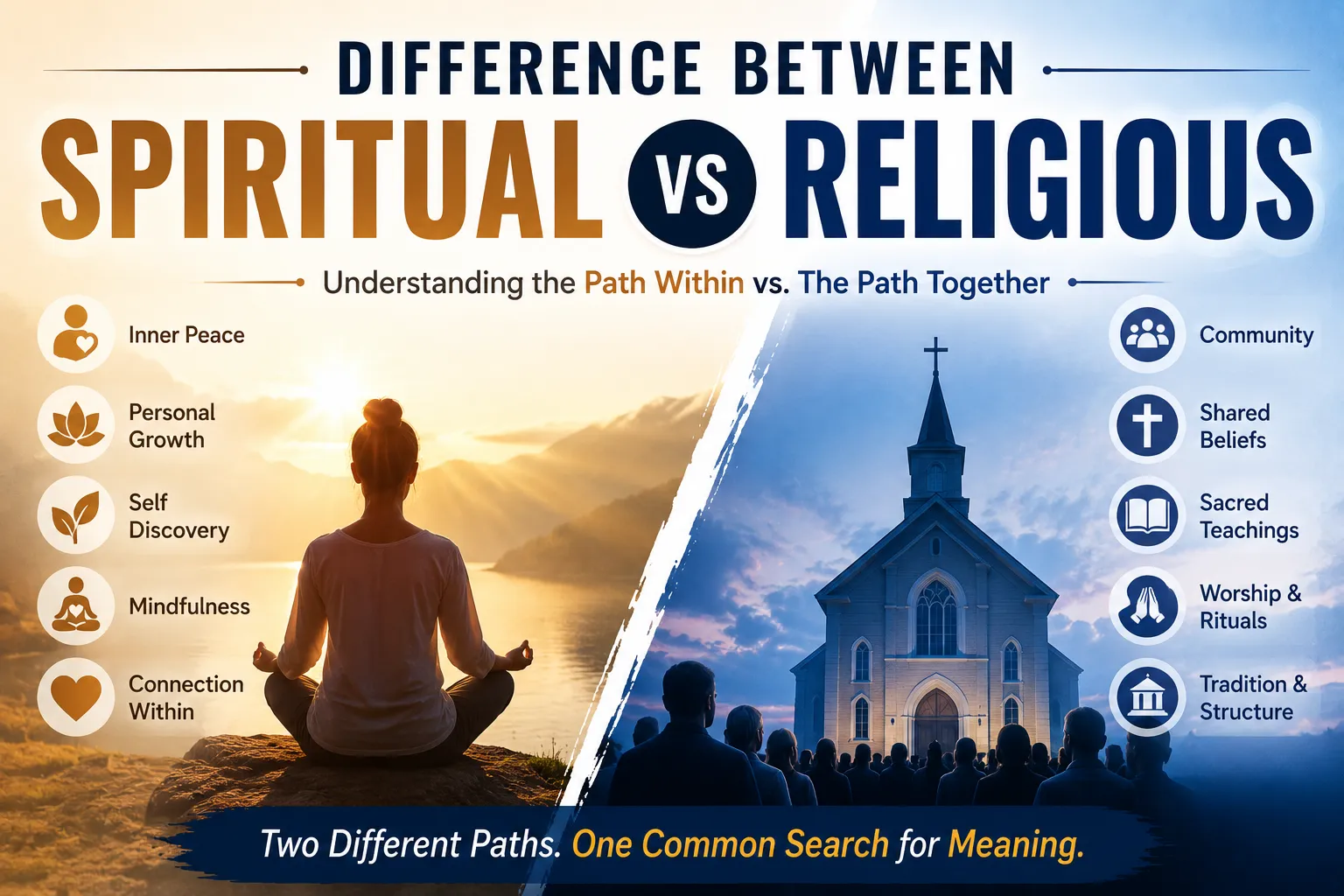
Being spiritual means connecting to your inner soul and a higher power on your own, while being religious means following the set rules and sacred rituals of an organized religion
Most people use these like synonyms. They’re not, and the difference actually matters. Last year, my friend Anna told her traditional grandmother she felt deeply spiritual. Her grandmother got very upset because she thought Anna was leaving their family church community completely.
Want to know how to avoid this painful mix-up? Let’s clear up the confusion. Understanding the difference between spiritual and religious helps you find your own personal belief system. Some people seek inner peace alone, while others love organized religion. The true difference between spiritual and religious comes down to freedom versus tradition. Once you spot the real difference between spiritual and religious, you will understand yourself and others much better.
Key Difference
The main difference between spiritual and religious is where you look for truth. Being spiritual is a solo journey inward to find personal meaning and connect with a higher power. Being religious is an outward practice of sharing set beliefs with a faith community. Keep reading , we break down all 10 differences in plain, simple terms below.
Why Is This Difference Important to Know?
Why should you care about the difference between spiritual and religious? Knowing this saves you from awkward talks with family. It helps you choose how to spend your Sunday mornings. It also helps you find your own path to inner peace without feeling guilty. Whether you want a strict path or total freedom, knowing this difference keeps your soul happy.
10 Points of Difference
1. Basic Definition and Meaning
Being spiritual means finding your own personal connection to life and a higher power. Being religious means believing in a specific church, temple, or holy book. They look at life differently.
- Example 1: Sarah meditates alone in the woods to feel close to nature.
- Example 2: David reads the Torah every morning with his local rabbi.
2. Origin / Source / Main Components
Spirituality comes from inside your own heart and personal feelings. Religion comes from outside history, ancient texts, and leaders.
- Example 1: Maya writes in her private journal to discover her core values.
- Example 2: Tom studies the Catechism rules written by church leaders long ago.
3. Process: How It Is Made or Done
The spiritual path is made by making your own rules and trying new things. The religious path is done by following sacred rituals that never change.
- Example 1: Leo mixes yoga with quiet prayer every night in his bedroom.
- Example 2: Elena takes Holy Communion exactly the same way every single Sunday morning.
4. Time Involved / Duration
Spirituality is a fluid, lifelong search that changes as you grow older. Religion often relies on fixed times, weekly schedules, and calendar holidays.
- Example 1: Chloe feels her beliefs shift after traveling the world for five years.
- Example 2: Mark attends a one-hour Friday prayer service at his mosque every week.
5. Flavor, Feel, or Output Quality
Spirituality feels very free, open, and unique to you. Religion feels structured, safe, and deeply shared with others in an organized religion.
- Example 1: John feels a warm wave of peace while watching the morning sun rise.
- Example 2: Mary feels a powerful sense of community pride while singing hymns with a choir.
6. Primary Use Cases
Use spirituality when you want to heal personal stress or find deep self-worth. Use religion when you want to raise children with strong traditions and a stable faith community.
- Example 1: James uses silent breathing tools to overcome a tough divorce.
- Example 2: The Smith family uses Sunday school to teach their kids moral laws.
7. Effect or Impact
Spirituality changes how you feel about your inner self. Religion changes how you act in society and how you follow group laws.
- Example 1: Rachel becomes a kinder person by listening to her inner voice.
- Example 2: Paul obeys a specific dress code to honor his temple community.
8. Degree of Specificity or Precision
Spirituality is flexible and has no exact right or wrong answers. Religion is highly precise with clear dogmas and strict rules to follow.
- Example 1: Sam says God is just love and energy all around us.
- Example 2: Peter recites the exact Apostles’ Creed to state his specific faith.
9. Can They Replace Each Other?
They cannot fully replace each other because they feed different parts of the human soul. One gives raw freedom, while the other gives structure.
- Example 1: Lisa tries to replace her church with hiking but misses her friends.
- Example 2: Kevin goes to church but feels empty without personal meditation.
10. Long-Term Results / Lasting Impact
Spirituality leads to individual wisdom and personal enlightenment. Religion leads to strong cultures, massive charities, and lasting institutions that survive for centuries.
- Example 1: Buddha sat alone under a tree to find total inner peace.
- Example 2: The Catholic Church built thousands of hospitals across the earth.
Nature and Behaviour
Spirituality is like a wild river. It moves freely, changes shape, and flows wherever it wants. It values personal discovery, flexible thoughts, and quiet inner feelings.
Religion is like a sturdy stone pool. It keeps the water safe, has clear borders, and stays in one place. It values group order, shared traditions, and ancient sacred rituals.
Why Do People Confuse Them?
People confuse them because both deal with God, faith, and the deep meaning of life. They use the same words like “holy” or “soul.”
A short mistake happened when Jim invited his spiritual coworker, Lily, to a strict prayer group. Lily felt trapped, and Jim felt judged. They forgot that loving the universe is not the same as loving a specific church.
Comparison Table
| Feature | Spiritual | Religious |
| Definition | Internal connection to the soul | System of shared faith and rules |
| Origin | Inside the individual heart | External history and ancient texts |
| Process | Creating your own personal path | Following set sacred rituals |
| Duration | Fluid and changes over a lifetime | Fixed schedules and calendar holidays |
| Output | Personal freedom and inner peace | Structured safety and group bond |
| Main Use | Healing stress and self-discovery | Raising families with traditions |
| Impact | Changes your inner thoughts | Changes social habits and actions |
| Interchangeable? | No, they fulfill different needs | No, they fulfill different needs |
| Long-term Result | Individual wisdom and insight | Lasting cultures and institutions |
| Similarity | Both seek a higher power | Both seek a higher power |
| Key Difference | Solo journey vs. Faith community | Faith community vs. Solo journey |
📌 Save this for later, bookmark this page or share it with someone who always mixes up spiritual and religious paths.
Which Is Better and When?
Spirituality is better when you feel trapped by rules and need to heal your inner self. For example, choose it if you want to connect with a higher power while walking alone in the mountains.
Religion is better when you want a strong faith community to back you up. For example, choose it if you want to celebrate holidays with a large, loving group.
Quick Decision Guide
Choose Spiritual if:
- ☑ You want to make your own rules for faith.
- ☑ You find peace alone in nature or quiet rooms.
- ☑ You dislike strict schedules and weekly meetings.
- ☑ You want a highly custom personal belief system.
Choose Religious if:
- ☑ You want a clear book of rules to guide you.
- ☑ You love sharing rituals with a big group.
- ☑ You want ancient traditions passed down to your kids.
- ☑ You feel safest inside an organized religion.
Still unsure? Drop your question in the comments, we answer every single one.
Metaphors and Similes
Spirituality is a solo hike through the woods. Religion is a guided bus tour on a paved highway. Comparing them is like comparing a home-cooked meal made without a recipe to a famous restaurant dish made exactly by the book.
Connotative Meaning
- Spiritual: It sounds warm and free, but some see it as self-centered. A positive view is “peaceful seeker,” a negative view is “flaky,” and a neutral view is “independent.”
- Religious: It sounds stable and faithful, but some see it as rigid. A positive view is “devout,” a negative view is “narrow-minded,” and a neutral view is “traditional.”
Idioms and Proverbs
- People say “cleanliness is next to godliness” when talking about pure religious rules.
- Spiritual people often say “look within” to find deep truths.
- If you mix them up, you are “barking up the wrong tree.”
- To describe someone who does both, we can say they are “holding the sky with both hands” [coined expression].
FAQ Section
Q1: What is the main difference between spiritual and religious?
A1: Spirituality is an individual journey to find inner peace and personal meaning. Religion is an organized system of shared beliefs, sacred rituals, and rules within a specific faith community.
Q2: Can being spiritual be used instead of being religious?
A2: It can if you only want personal faith. However, spirituality cannot replace the community support, grand traditions, and structured charity work that an organized religion easily provides.
Q3: Which is better, being spiritual or being religious?
A3: Neither is better. Spirituality is perfect for people who love freedom and solo reflection. Religion is ideal for those who crave structure, historic rituals, and a tight faith community.
Q4: How long does spirituality / religion last?
A4: Spirituality lasts as long as you keep seeking truth inside your soul. Religion can last for thousands of years because groups pass down books and laws to new generations.
Q5: Why do people mix up being spiritual and being religious?
A5: People mix them up because both paths focus on God, faith, and life’s big questions. They also share words like soul, sacred, and holy, which blurs the lines.
You might also like:
→ [Understanding Inner Peace] [example.com/inner-peace]
→ [The Power of Faith Communities] [example.com/faith-communities]
Real-World Importance
Knowing the difference between spiritual and religious helps you navigate family dinners, choose the right books, and understand world news. It lets you respect a friend’s quiet meditation while also honoring another friend’s holy church service. This keeps your relationships strong and full of real respect in daily life.
Conclusion
To wrap up, the difference between spiritual and religious shows us two beautiful ways to experience life. Spirituality gives you the freedom to build a personal belief system and find inner peace on your own terms. Religion connects you to an organized religion with sacred rituals and a supportive faith community. Both paths help humans touch a higher power and live with deeper purpose. They are not enemies; they are just different maps for the exact same journey. Now that you know the difference, you’ll never mix them up again. You can now talk about faith with real confidence, wisdom, and grace.
See More: May vs Might: 10 Differences Most People Miss

I’m Ayesha Sadiqah, and I’m passionate about answering one simple question: “What’s the difference?” Through clear comparison guides, I help readers understand commonly confused words, products, concepts, and everyday topics. My goal is to make complex ideas easy to understand with accurate, practical, and reader-friendly explanations.