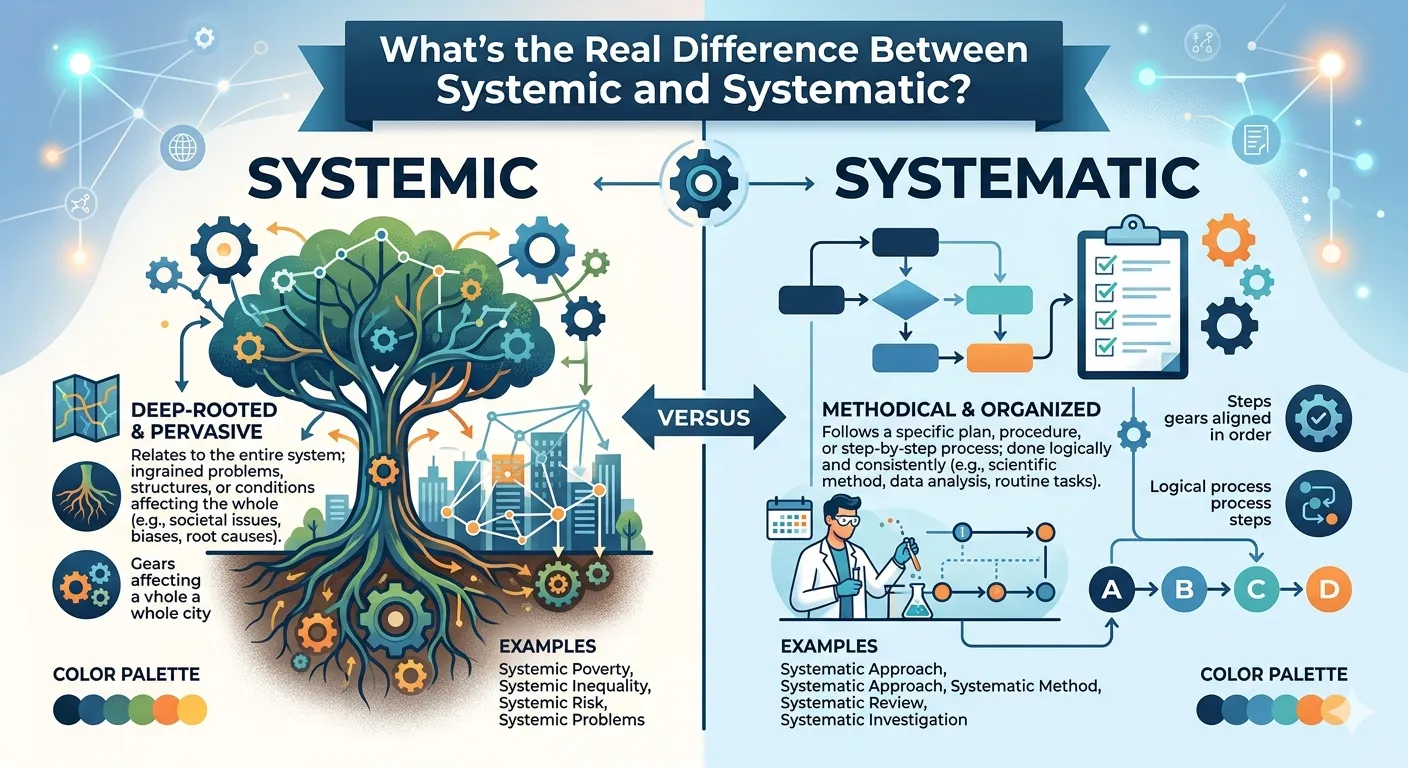
Systemic relates to an entire system or affects the whole system, while systematic means something is done in an organized, step-by-step, and methodical way.
Most people use systemic and systematic like synonyms. They’re not, and the difference actually matters. A single wrong word can completely change the meaning of a sentence.
A few years ago, Sarah, a project manager in Chicago, wrote that her company had a “systemic approach” to quality checks. Her team later pointed out that she actually meant a “systematic approach.” Instead of describing an organized process, she accidentally suggested the issue involved the entire company system.
If you’ve ever wondered about the difference between systemic and systematic, you’re not alone. Understanding the difference between systemic and systematic can help you communicate more clearly in school, business, and everyday life. In this guide, we’ll explain the difference between systemic and systematic in simple language and show exactly when to use each word.
Key Difference
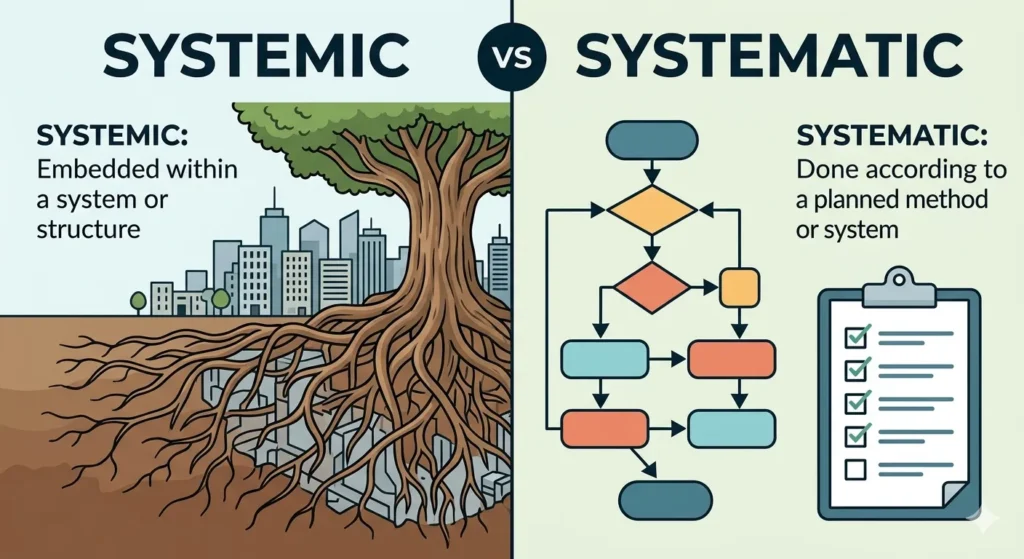
The main difference is simple:
- Systemic describes something connected to or affecting an entire system.
- Systematic describes something done according to a planned method or organized process.
Keep reading, we break down all 10 differences in plain, simple terms below.
Why Is This Difference Important to Know?
Using the wrong word can confuse readers, coworkers, teachers, or customers. In business, medicine, education, and research, these words often appear in reports and presentations. Knowing the difference between systemic and systematic helps you choose the right term, sound more professional, and avoid misunderstandings that can change the meaning of your message.
10 Points of Difference
1. Basic Definition and Meaning
Systemic means related to an entire system. It often describes problems, changes, or effects that spread throughout a whole structure.
Systematic means organized, methodical, and carried out step by step.
Examples:
- Systemic inequality affects many parts of society.
- Marie Curie kept systematic notes during her experiments.
2. Origin, Source, or Main Components
Systemic comes from the idea of a system made up of connected parts. The focus is on relationships between those parts.
Systematic comes from following a system or method. The focus is on order and procedure.
Examples:
- A systemic banking issue affects many financial institutions.
- NASA uses systematic testing before launches.
3. Process: How It Is Made or Done
Systemic does not describe a process. It describes how something affects a whole network or structure.
Systematic directly describes a process that follows a clear sequence of steps.
Examples:
- A systemic failure spread across the power grid.
- Toyota uses systematic quality inspections.
4. Time Involved or Duration
Systemic issues often develop over long periods because they involve large systems.
Systematic actions can be short or long, depending on the process being followed.
Examples:
- Systemic poverty can exist for generations.
- A systematic inventory check may take one afternoon.
5. Feel, Outcome, or Output Quality
Systemic often suggests broad impact, especially in discussions about society, healthcare, or organizations.
Systematic suggests accuracy, consistency, and careful planning.
Examples:
- Experts studied systemic risks in the economy.
- Florence Nightingale used systematic record-keeping.
6. Primary Use Cases
Systemic is common in medicine, sociology, economics, and public policy.
Systematic is common in research, management, education, and project planning.
Examples:
- Doctors discuss systemic infections.
- Scientists perform systematic reviews.
7. Effect or Impact
Systemic affects many connected parts at once.
Systematic improves efficiency and organization through a structured approach.
Examples:
- A systemic software bug affected millions of users.
- Google’s teams use systematic testing procedures.
8. Degree of Specificity or Precision
Systemic focuses on the big picture and overall structure.
Systematic focuses on exact steps and detailed execution.
Examples:
- Policymakers studied systemic unemployment trends.
- Sherlock Holmes used a systematic method of investigation.
9. Can They Replace Each Other?
Usually, no. Swapping these words often changes the meaning completely.
A systemic issue is not necessarily systematic, and a systematic process is not necessarily systemic.
Examples:
- “Systemic corruption” means corruption throughout a system.
- “Systematic inspection” means an organized inspection process.
10. Long-Term Results or Lasting Impact
Systemic changes often reshape entire systems for years.
Systematic approaches create consistent and repeatable results over time.
Examples:
- Education reforms can create systemic change.
- A systematic study routine improves grades steadily.
Nature and Behaviour
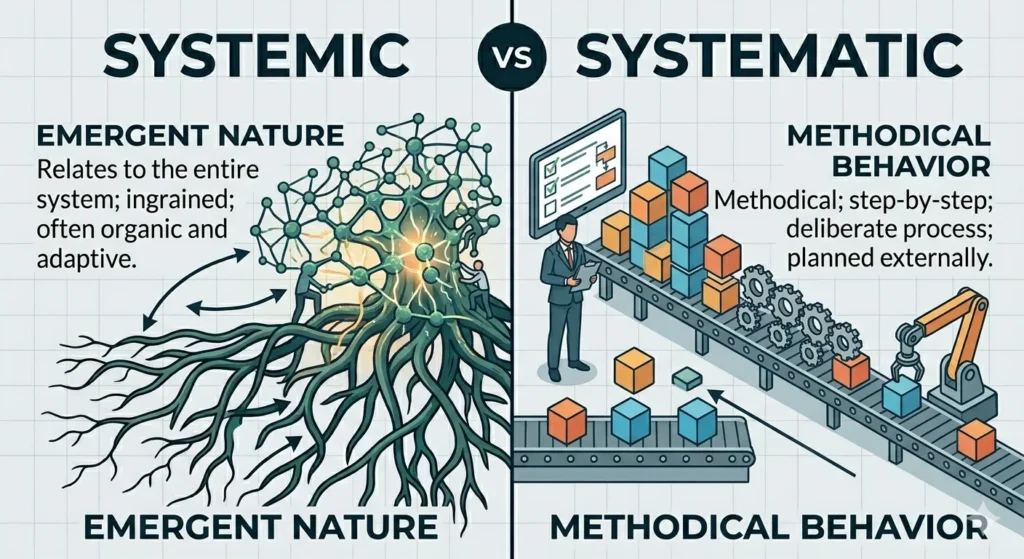
Systemic is broad in nature. It focuses on connections, structures, and how different parts of a system interact. It often appears when discussing widespread issues or large-scale effects.
Systematic is organized and disciplined. It focuses on planning, order, and following a clear method. It often appears when discussing procedures and workflows.
Why Do People Confuse Them?
People confuse these words for several reasons:
- They look almost identical.
- Both come from the word “system.”
- Both are common in professional writing.
- Both often appear in reports and academic papers.
For example, a student might write “systemic research process” when “systematic research process” is the correct phrase.
Comparison Table
| Feature | Systemic | Systematic |
| Definition | Related to an entire system | Done in an organized way |
| Origin | Connected systems | Structured methods |
| Process | Describes system-wide effects | Describes step-by-step actions |
| Duration | Often long-term | Can be short or long |
| Output | Broad impact | Consistent results |
| Main Use | Society, medicine, economics | Research, management, planning |
| Impact | Affects whole systems | Improves organization |
| Interchangeable? | Usually no | Usually no |
| Long-term Result | System-wide change | Repeatable improvement |
| Similarity | Both relate to systems | Both relate to systems |
| Key Difference | Whole-system focus | Method-focused approach |
📌 Save this for later, bookmark this page or share it with someone who always mixes up systemic and systematic.
Which Is Better and When?
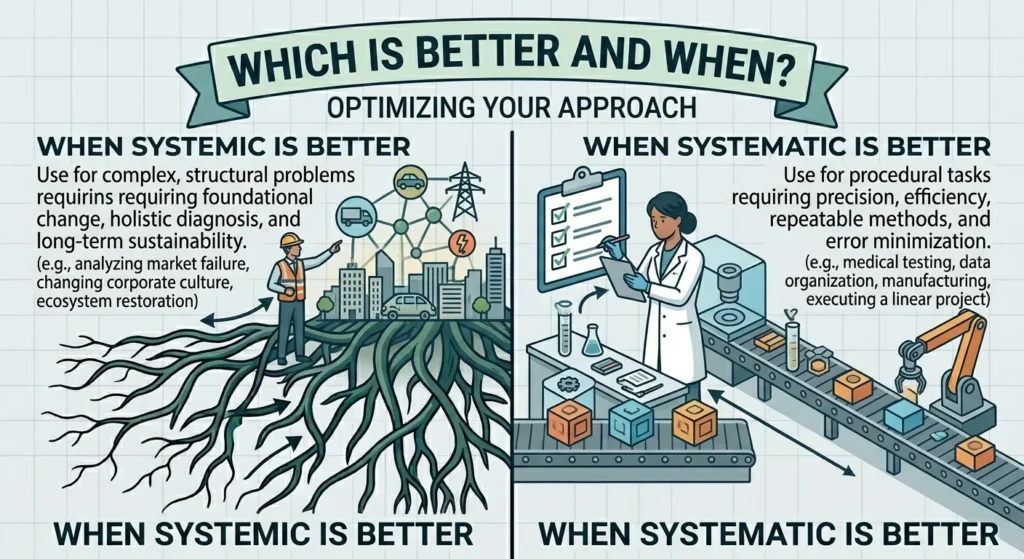
Neither word is better. They serve different purposes.
Use systemic when discussing something that affects an entire system. For example, “systemic healthcare problems” describes issues across the healthcare system.
Use systematic when discussing an organized process. For example, “a systematic training program” describes a structured learning method.
Quick Decision Guide
Choose Systemic if:
☑ It affects an entire system
☑ You are discussing widespread issues
☑ The focus is on connected parts
☑ You mean system-wide impact
Choose Systematic if:
☑ You mean organized and methodical
☑ A process follows clear steps
☑ Planning is important
☑ Consistency is the goal
Still unsure? Drop your question in the comments, we answer every single one.
Metaphors and Similes
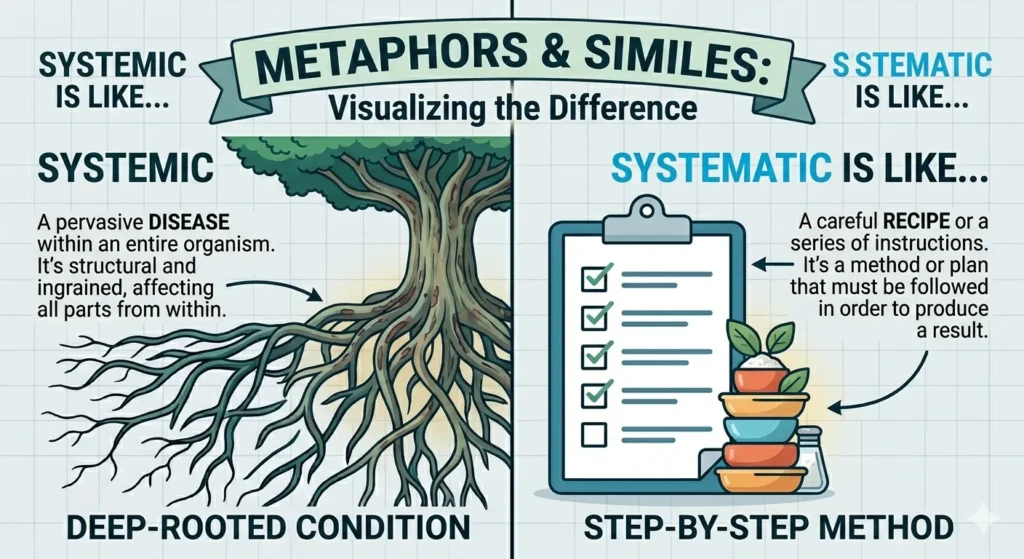
Systemic is like the roots of a tree, affecting every branch above it.
Systematic is like a recipe, guiding each step toward the final result.
Together, they are like a city map and a travel plan, one shows the whole system, while the other shows the route.
Connotative Meaning
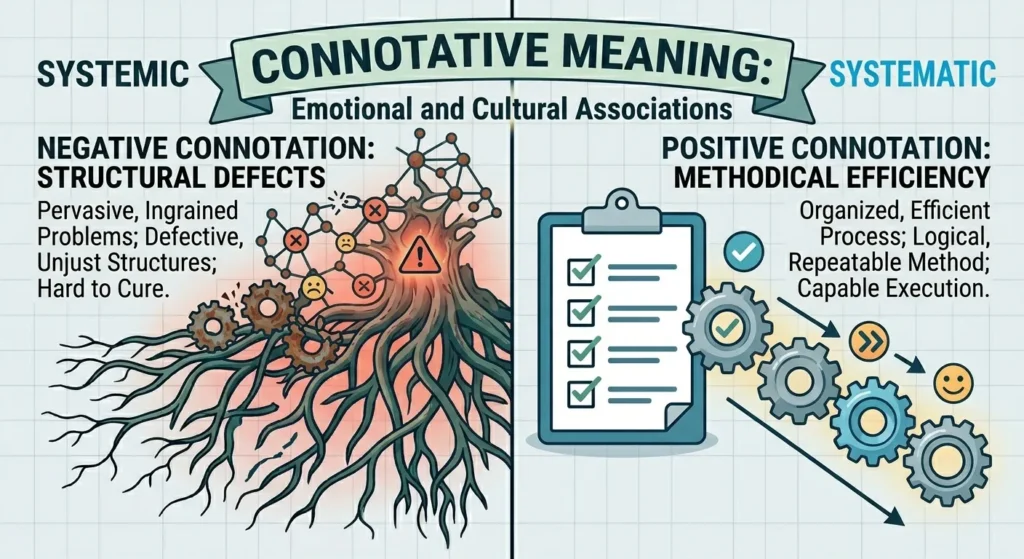
Systemic
- Positive: Systemic reform improved education.
- Negative: Systemic discrimination harmed communities.
- Neutral: Researchers analyzed systemic factors.
Systematic
- Positive: Her systematic approach improved productivity.
- Negative: The scam was systematic and carefully planned.
- Neutral: The team used systematic data collection.
Both words can carry positive, negative, or neutral meanings depending on context.
Idioms and Proverbs
- “See the bigger picture” fits many discussions about systemic issues. Example: Leaders must see the bigger picture before making reforms.
- “Step by step” reflects a systematic approach. Example: The engineer solved the problem step by step.
- “Fix the roots, not the leaves.” Example: The mayor focused on systemic causes instead of temporary solutions.
Frequently Asked Questions

1. What is the main difference between systemic and systematic?
Systemic refers to something affecting an entire system or structure. Systematic refers to a methodical process that follows an organized set of steps.
2. Can systemic be used instead of systematic?
Usually not. Although the words look similar, they have different meanings. Replacing one with the other often changes the message completely.
3. Which is better, systemic or systematic?
Neither is better. Choose systemic when discussing system-wide effects. Choose systematic when describing an organized process or method.
4. How long does systemic or systematic last?
Systemic effects often last longer because they involve entire systems. Systematic processes can be temporary or ongoing depending on the situation.
5. Why do people mix up systemic and systematic?
They share the same root word, look similar, and often appear in professional writing. Many people assume they mean the same thing when they do not.
Related Reading
You might also like:
→ Affect vs Effect — /affect-vs-effect/
→ Principal vs Principle — /principal-vs-principle/
Real-World Importance
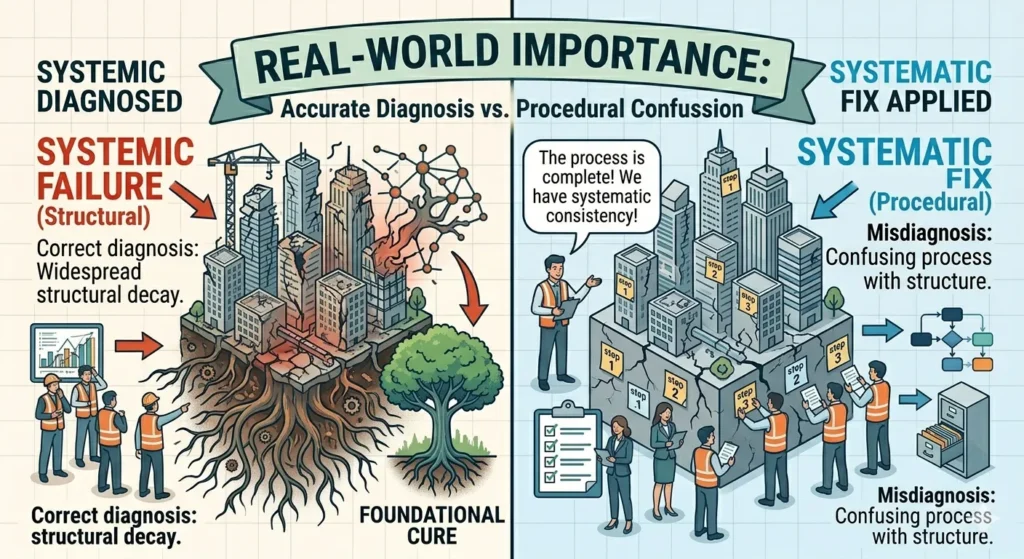
Understanding the difference between systemic and systematic helps in many situations. Students use these words in essays. Professionals use them in reports and presentations. Healthcare workers, researchers, and business leaders rely on the correct term to communicate clearly and avoid costly misunderstandings.
Conclusion
The difference between systemic and systematic comes down to scope versus method. Systemic refers to something that affects an entire system, while systematic refers to something done through an organized, step-by-step process. Although the words look similar, they serve very different purposes.
Now that you know the difference, you’ll never mix them up again. The next time you see these words in an article, report, or conversation, you’ll instantly know which one fits the situation best. Keep this guide handy whenever you need a quick reminder.
Read More: Difference Between Lossy and Lossless: 10 Differences

I’m Ayesha Sadiqah, and I’m passionate about answering one simple question: “What’s the difference?” Through clear comparison guides, I help readers understand commonly confused words, products, concepts, and everyday topics. My goal is to make complex ideas easy to understand with accurate, practical, and reader-friendly explanations.