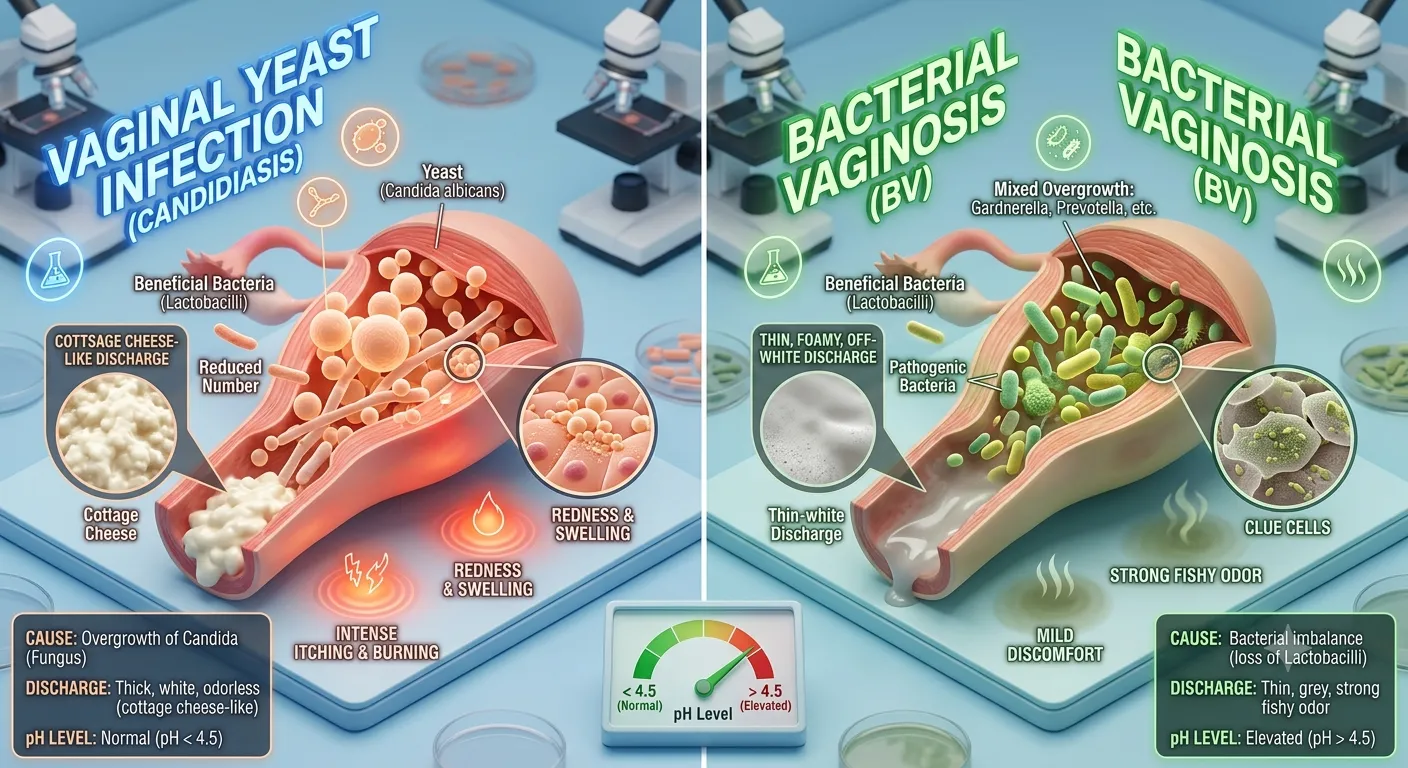
The difference between yeast and BV (bacterial vaginosis) is that a yeast infection is caused by an overgrowth of fungus, while BV is caused by an imbalance of vaginal bacteria. Although both can cause vaginal discomfort and discharge, their symptoms, causes, and treatments are different.
A few years ago, while researching common women’s health concerns for an educational project, I noticed the same question appearing repeatedly: “Do I have a yeast infection or BV?” Many people assumed the two conditions were the same because both affect the vagina and can cause unusual discharge.
That confusion is completely understandable.
When symptoms appear suddenly, it can be difficult to tell what is happening. Itching, irritation, odor, and changes in discharge often overlap. Many people search online hoping for a quick answer, only to find complicated medical explanations that leave them even more confused.
The good news is that understanding the difference between yeast and BV is easier than it seems.
Once you know the main signs, causes, and treatment options, you can better understand what may be going on and when it is time to seek medical advice.
This guide breaks everything down into simple language. You’ll learn how yeast infections and BV differ, what symptoms to watch for, common mistakes people make, and which condition is more likely based on your symptoms.
Difference Between Yeast and BV Quick Answer
A yeast infection happens when too much yeast, usually Candida, grows in the vagina.
Bacterial vaginosis (BV) happens when the natural balance of vaginal bacteria is disrupted, allowing harmful bacteria to outnumber beneficial bacteria.
Simple Examples
- Thick, white, cottage cheese-like discharge with intense itching often points to a yeast infection.
- Thin gray or white discharge with a strong fishy odor often suggests BV.
While both conditions are common, they require different treatments.
The Origin / Background of Difference Between Yeast and BV
Understanding why these conditions occur helps explain why they are often confused.
What Is a Yeast Infection?
Yeast naturally lives in the body. Small amounts are usually harmless.
Problems begin when yeast grows too quickly. This can happen due to:
- Antibiotic use
- Hormonal changes
- Pregnancy
- Diabetes
- A weakened immune system
The result is a vaginal yeast infection, also called vaginal candidiasis.
What Is BV?
The vagina naturally contains both good and bad bacteria.
Healthy bacteria help maintain balance.
BV develops when harmful bacteria multiply and reduce the number of healthy bacteria.
Common triggers include:
- Douching
- New sexual partners
- Multiple sexual partners
- Changes in vaginal pH
Because both conditions affect the same area, many people mistake one for the other.
Difference Between Yeast and BV Explained Key Differences
The easiest way to tell yeast and BV apart is by looking at symptoms.
| Term | Meaning | When to Suspect It | Context |
| Yeast Infection | Fungal overgrowth in the vagina | Intense itching and thick white discharge | Common after antibiotics |
| BV | Bacterial imbalance in the vagina | Fishy odor and thin discharge | Common after pH disruption |
Symptom Comparison
| Feature | Yeast Infection | BV |
| Cause | Fungus (Candida) | Bacterial imbalance |
| Odor | Usually none | Strong fishy smell |
| Discharge | Thick and white | Thin gray or white |
| Itching | Very common | Mild or absent |
| Burning | Common | Sometimes |
| Vaginal pH | Usually normal | Usually elevated |
| Treatment | Antifungal medication | Antibiotics |
Example 1
Sarah notices severe itching and thick white discharge.
This pattern is more consistent with a yeast infection.
Example 2
Emma notices a fishy odor and thin gray discharge.
These symptoms are more typical of BV.
Which Approach Should You Use?
Self-diagnosis is not always accurate.
If symptoms are mild and familiar, some people may recognize recurring infections. However, medical evaluation is often the safest choice.
For Someone With Severe Itching
A yeast infection may be more likely because itching is one of its most common symptoms.
For Someone With Strong Odor
BV may be more likely because a fishy smell is a classic sign.
For Pregnant Individuals
Seek professional medical advice.
Both conditions should be evaluated during pregnancy.
For Frequent Recurring Symptoms
Schedule a healthcare visit.
Repeated infections may indicate another underlying issue.
For General Uncertainty
A healthcare provider can perform simple tests to identify the exact cause and recommend the correct treatment.
Common Mistakes With Yeast and BV
Many people confuse these conditions.
Here are some common errors.
| Mistake | Correction |
| Assuming all discharge means yeast | BV can also cause discharge |
| Treating BV with antifungal medication | BV usually requires antibiotics |
| Ignoring a strong fishy odor | Odor is a common BV symptom |
| Assuming itching always means BV | Itching is more common with yeast |
| Self-treating every infection | Get tested if symptoms keep returning |
Why These Mistakes Happen
The symptoms often overlap.
Many people rely on internet searches or previous experiences instead of getting a proper diagnosis.
That can delay effective treatment.
Difference Between Yeast and BV in Real-World Examples
Professional Email
I have been experiencing symptoms that may be related to a yeast infection or BV and would like to schedule an appointment for evaluation.
News Headline
Health Experts Explain the Difference Between Yeast Infections and BV
Social Media Post
Thought I had a yeast infection, but it turned out to be BV. The symptoms can be surprisingly similar.
Formal Medical Report
Clinical findings suggested bacterial vaginosis rather than a yeast infection based on pH testing and symptom presentation.
Difference Between Yeast and BV Data, Trends & Usage
Search Intent
The keyword difference between yeast and BV has primarily informational search intent.
People usually want to:
- Identify symptoms
- Understand causes
- Compare treatments
- Determine when to seek medical care
Who Searches This Topic?
Common audiences include:
- Women experiencing symptoms
- Students studying health topics
- Healthcare researchers
- Health-conscious readers
Regions With High Interest
Search volume is often strong in:
- United States
- Canada
- United Kingdom
- Australia
- India
Why This Topic Matters Today
People are increasingly seeking health information online before visiting a healthcare provider.
Understanding the difference between yeast and BV helps people ask better questions and seek appropriate care sooner.
Standalone Comparison Table
| Term/Variant | Meaning | Region/Context | Best Used When |
| Yeast Infection | Fungal infection caused by Candida overgrowth | Global medical use | Symptoms include itching and thick white discharge |
| BV | Bacterial imbalance in the vagina | Global medical use | Symptoms include fishy odor and thin discharge |
| Vaginal Candidiasis | Medical term for yeast infection | Healthcare settings | Clinical diagnosis |
| Bacterial Vaginosis | Full medical name for BV | Healthcare settings | Formal medical communication |
| Recurrent Yeast Infection | Repeated fungal infections | Medical evaluation | Frequent episodes occur |
| Recurrent BV | Repeated bacterial imbalance | Medical evaluation | Symptoms keep returning |
Frequently Asked Questions
Q: What does the difference between yeast and BV mean?
A: It refers to distinguishing between a fungal infection and a bacterial imbalance. The symptoms and treatments are different.
Q: How can I tell if I have a yeast infection or BV?
A: Thick white discharge and itching often suggest yeast. Thin discharge with a fishy odor is more commonly associated with BV.
Q: Can BV turn into a yeast infection?
A: BV does not directly become a yeast infection. However, treatment or changes in vaginal balance may sometimes lead to a yeast infection later.
Q: Is BV worse than a yeast infection?
A: Neither is necessarily worse. Both should be treated appropriately, especially if symptoms are severe or recurring.
Q: Can I treat BV with yeast infection medicine?
A: No. Yeast infections usually require antifungal medications, while BV is commonly treated with antibiotics.
Q: Where do yeast infections and BV come from?
A: Yeast infections result from fungal overgrowth. BV develops when the balance of healthy and harmful bacteria changes.
Q: Can yeast infections and BV happen at the same time?
A: Yes. Some people can have both conditions simultaneously, which may make symptoms harder to identify.
Conclusion
Understanding the difference between yeast and BV can help you recognize symptoms more accurately and seek the right treatment.
Here are the key points to remember:
- Yeast infections are caused by fungal overgrowth.
- BV is caused by a bacterial imbalance.
- Itching is more common with yeast infections.
- A fishy odor is more commonly linked to BV.
- The treatments are different, so proper diagnosis matters.
Although symptom guides can be helpful, they are not a substitute for professional medical advice. If symptoms are severe, unusual, or keep coming back, a healthcare provider can determine the exact cause and recommend the most effective treatment.
Knowing these differences puts you in a better position to understand your symptoms and make informed decisions about your health.
Bookmark this guide so you never second-guess the difference between yeast and BV again, and share it with someone who may find it helpful.
Read More:
Difference Between Nauseous and Nauseated: Quick Guide

I’m Rubab, an SEO content writer specializing in high-quality comparison articles that simplify complex topics and highlight key differences with clarity and accuracy. My content combines in-depth research, proven SEO strategies, and a reader-first approach to deliver valuable insights across language, technology, health, food, and lifestyle topics.
🔍📈 Turning complex comparisons into clear, search-friendly content that informs, engages, and ranks. ✨🏆