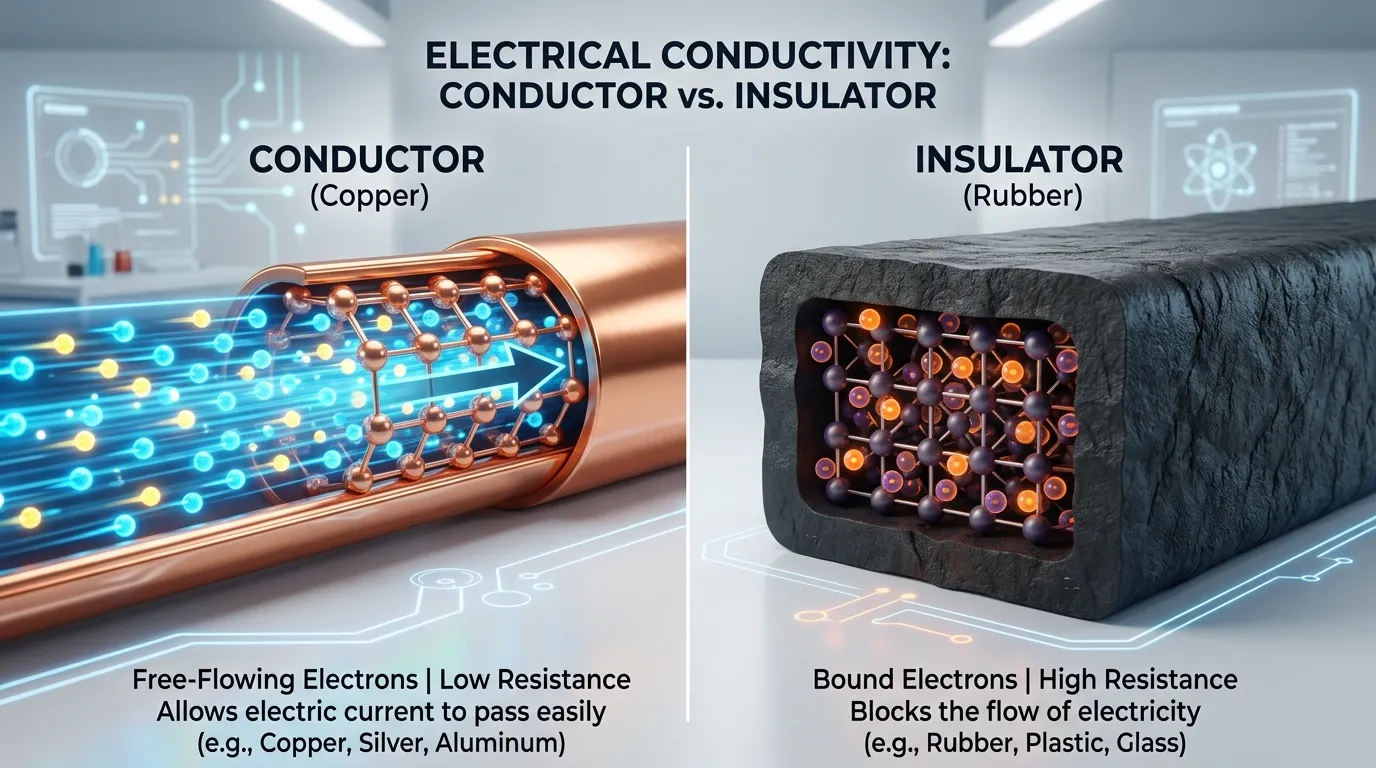
A conductor allows electric current to flow easily, while an insulator resists or blocks the flow of electric current.
Most people use the words conductor and insulator as if they are opposites without understanding why. They’re not just different terms, they play completely different roles in electricity.
A student named Ali learned this the hard way during a science project. He used a plastic ruler instead of a copper wire to complete a simple circuit. The bulb never lit up. He thought something was wrong with the battery, but the real problem was that he had confused a conductor with an insulator.
If you’ve ever wondered about the difference between conductor and insulator, you’re not alone. Understanding the difference between conductor and insulator helps you stay safe around electricity and understand how electrical devices work. In this guide, we’ll explain the difference between conductor and insulator in simple language with examples, a comparison table, and a quick decision guide.
Key Difference
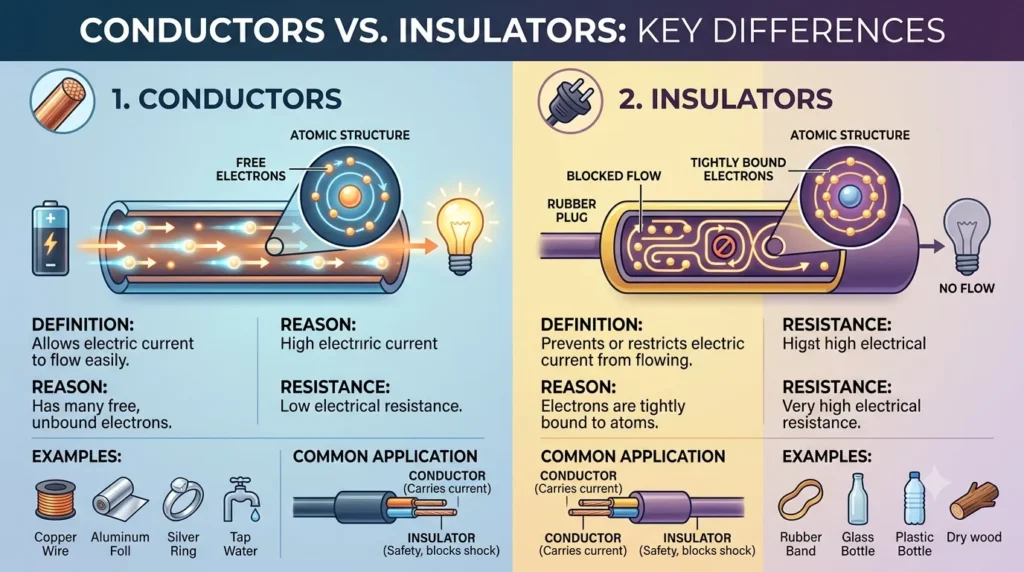
The main difference is simple. A conductor lets electricity move through it easily, while an insulator prevents or slows down that movement.Copper wire is a conductor. Plastic covering around the wire is an insulator.
Keep reading, we break down all 10 differences in plain, simple terms below.
Why Is This Difference Important to Know?
Knowing the difference between conductor and insulator helps you make safer and smarter choices. Electricians use both every day. Students learn about them in science classes. Engineers use them when designing electrical systems.
Without conductors, electricity could not reach your devices. Without insulators, electrical shocks and short circuits would be much more common.
10 Points of Difference
1. Basic Definition and Meaning
A conductor is a material that allows electric charges to move freely. An insulator is a material that blocks or greatly limits the movement of electric charges.
Examples: Copper wire, aluminum cable (conductors). Rubber gloves, plastic ruler (insulators).
2. Origin, Source, or Main Components
Most conductors are metals because they contain free electrons. These electrons move easily through the material.
Insulators are usually made from materials whose electrons are tightly held and cannot move freely.
Examples: Silver and copper are conductors. Glass and rubber are insulators.
3. Process, How It Is Made or Used
Conductors are processed to improve electrical flow. Metals may be purified and shaped into wires or cables.
Insulators are manufactured to maximize safety and resistance to electricity.
Examples: Copper wiring in homes. Plastic coating around charging cables.
4. Time Involved or Duration
Electricity moves through conductors almost instantly. This allows devices to work immediately when switched on.
Insulators continue blocking electricity as long as they remain in good condition.
Examples: Power lines transmit electricity instantly. Rubber safety boots provide long-term protection.
5. Output Quality
Conductors transfer electrical energy efficiently with little resistance. This helps devices operate properly.
Insulators prevent unwanted current flow and reduce energy loss in dangerous places.
Examples: Copper wiring in a laptop. Ceramic insulators on power poles.
6. Primary Use Cases
Conductors are used to carry electricity from one place to another. Insulators are used to protect people and equipment.
Both are essential in every electrical system.
Examples: Electrical wiring in homes. Plastic handles on screwdrivers.
7. Effect or Impact
Conductors make electricity useful by allowing it to travel. Insulators improve safety by controlling where electricity can and cannot go.
Together, they create reliable electrical systems.
Examples: Aluminum transmission lines. Rubber gloves used by electricians.
8. Degree of Specificity or Precision
Conductors are selected based on conductivity levels. Some conduct electricity better than others.
Insulators are selected based on how effectively they resist electrical flow.
Examples: Silver has very high conductivity. Glass offers strong insulation.
9. Can They Replace Each Other?
No. A conductor cannot do the job of an insulator, and an insulator cannot do the job of a conductor.
Each material has a unique purpose.
Examples: A copper wire cannot safely replace rubber insulation. Plastic cannot replace a metal circuit wire.
10. Long-Term Results and Lasting Impact
Good conductors ensure efficient power delivery over time. Good insulators provide long-term protection from electrical hazards.
Using the wrong material can cause system failure or safety risks.
Examples: Copper house wiring lasting decades. Ceramic insulators protecting power grids for years.
Nature and Behaviour
A conductor is open and welcoming to electric charges. It allows electrons to move quickly and freely. This makes it ideal for carrying electricity.
An insulator is protective and resistant. It holds electrons tightly and prevents current from moving easily. This makes it excellent for safety applications.
Why Do People Confuse Them?
People often confuse conductors and insulators because both are used in electrical systems. They also appear together in many products, such as electrical wires.
Another reason is that students remember they are related to electricity but forget their specific roles. For example, someone may think the plastic covering on a charger helps carry electricity when it actually prevents electrical shocks.
Comparison Table
| Feature | Conductor | Insulator |
| Definition | Allows electricity to flow | Blocks electricity |
| Origin | Usually metals | Usually non-metals |
| Process | Carries electric current | Prevents current flow |
| Duration | Conducts continuously | Insulates continuously |
| Output | Efficient energy transfer | Safety and protection |
| Main Use | Transmission of electricity | Electrical protection |
| Impact | Enables electrical systems | Prevents accidents |
| Interchangeable? | No | No |
| Long-Term Result | Reliable power delivery | Long-term safety |
| Similarity | Both used in electrical systems | Both used in electrical systems |
| Key Difference | Allows electron flow | Resists electron flow |
Save this for later, bookmark this page or share it with someone who always mixes up conductor and insulator.
Which Is Better and When?
A conductor is better when you need electricity to travel from one place to another. For example, copper wires inside a house must conduct electricity efficiently.
An insulator is better when safety is the priority. For example, rubber gloves protect electricians from electrical shocks while working on live equipment.
Quick Decision Guide
Choose Conductor if:
☑ You need electricity to flow
☑ You are building a circuit
☑ Energy transfer is required
☑ Electrical connection is needed
Choose Insulator if:
☑ You need electrical protection
☑ Shock prevention is important
☑ Current must be blocked
☑ Safety is the main goal
Still unsure? Drop your question in the comments, we answer every single one.
Metaphors and Similes
A conductor is a highway for electrons, allowing traffic to move freely.
An insulator is a locked gate that stops electrons from passing through.
Together, they work like roads and barriers in a city, guiding movement safely and efficiently.
Connotative Meaning
Conductor
- Positive: Efficient, “Copper is an excellent conductor.”
- Negative: Dangerous if exposed, “Bare wires can be risky.”
- Neutral: A material that carries electricity.
Insulator
- Positive: Protective, “Rubber gloves provide insulation.”
- Negative: Can prevent needed electrical flow.
- Neutral: A material that resists electricity.
Idioms and Proverbs
“Stay connected.”
The copper wiring helped the whole system stay connected.
“Break the circuit.”
The damaged wire broke the circuit and stopped the current.
[Coined expression] “Safety starts with insulation.”
The electrician remembered that safety starts with insulation before beginning work.
FAQ
What is the main difference between conductor and insulator?
A conductor allows electric current to flow easily because it has free-moving electrons. An insulator resists electrical flow because its electrons are tightly bound. This difference determines how each material is used.
Can a conductor be used instead of an insulator?
No. Conductors and insulators serve different purposes. Using a conductor where insulation is needed can create serious safety hazards and increase the risk of electrical shock.
Which is better, conductor or insulator?
Neither is universally better. Conductors are best for carrying electricity. Insulators are best for preventing unwanted electrical flow. Most electrical systems require both to function safely.
How long does a conductor or insulator last?
The lifespan depends on the material and environment. Copper wiring and ceramic insulators can often last for decades when properly installed and maintained.
Why do people mix up conductor and insulator?
People often see them together in electrical devices and cables. Because both relate to electricity, many remember the terms but forget which one allows current flow and which one blocks it.
Related Reading
You might also like:
→ Difference Between Voltage and Current — /difference-between-voltage-and-current/
→ Difference Between Series and Parallel Circuits — /difference-between-series-and-parallel-circuits/
Real-World Importance
Understanding conductors and insulators helps in everyday life. It explains why electrical wires have plastic coverings, why electricians wear rubber gloves, and how household appliances stay safe to use. This knowledge is useful in schools, workplaces, and homes.
Conclusion
Conductors and insulators may seem like simple science terms, but they perform very different jobs. Conductors allow electricity to move freely, while insulators prevent unwanted electrical flow. Both are essential for modern electrical systems.
Understanding the difference between conductor and insulator helps you stay safer around electricity and better understand how electrical devices work. Whether you’re a student, homeowner, or professional, this knowledge is valuable.
Now that you know the difference, you’ll never mix them up again. The next time you see a wire, you’ll know exactly why it needs both a conductor and an insulator.
Explore More: Difference Between Dysphoria and Dysmorphia: Quick Guide

I’m Ayesha Sadiqah, and I’m passionate about answering one simple question: “What’s the difference?” Through clear comparison guides, I help readers understand commonly confused words, products, concepts, and everyday topics. My goal is to make complex ideas easy to understand with accurate, practical, and reader-friendly explanations.