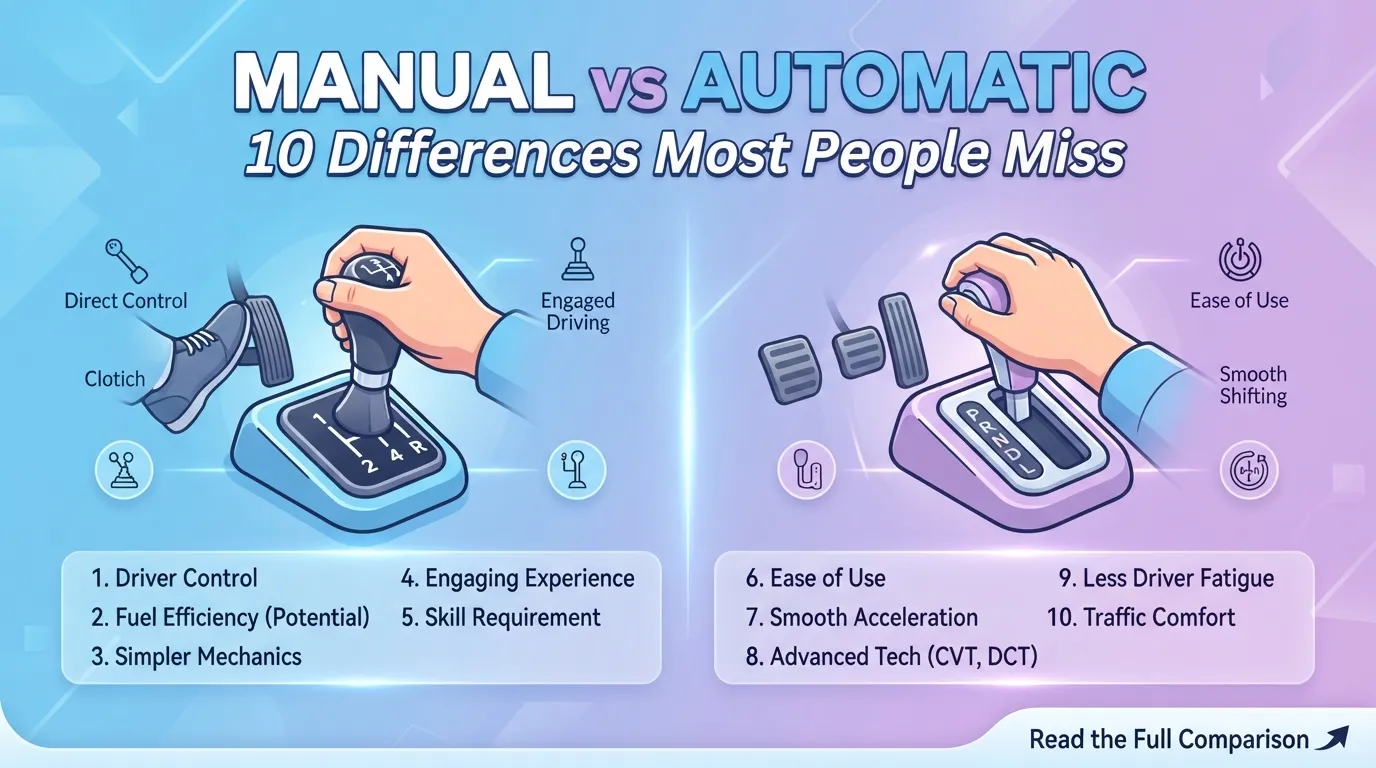
The difference between manual and automatic is simple. A manual car needs the driver to shift gears by hand using a clutch. An automatic car shifts gears on its own.
Most people think manual and automatic are just two ways to drive the same car. They are not. The gap between them changes how you drive, how much you pay, and even how tired you feel after a long trip.
Sam bought his first car last year. He picked a manual because it looked cool in movies. Two weeks later, stuck on a steep hill in traffic, his car rolled back and bumped the car behind him. He had no idea the difference between manual and automatic would matter that much.
So what really sets these two apart, and which one fits your life better?
A manual transmission uses a clutch pedal and a gear stick that the driver controls by hand. An automatic transmission uses a computer and hydraulics to change gears without any help from the driver. Once you understand the difference between manual and automatic, choosing the right car becomes much easier. This single fact shapes everything else in this guide.
Key Difference
The core difference between manual and automatic comes down to control. A manual driver decides when to shift gears using a clutch and gear stick. An automatic system decides for you, using sensors and a computer.
Keep reading, we break down all 10 differences in plain, simple terms below.
Why Is This Difference Important To Know?
Knowing the difference between manual and automatic helps before you even sign a car loan. It affects fuel costs, resale value, and how relaxed your commute feels.
New drivers often assume all cars work the same way. They do not. Picking the wrong type can mean stalling at every red light, or paying more for a transmission repair you never expected. Even experienced drivers switching countries get caught off guard, since some regions favor one type over the other.
10 Points Of Difference
1. Basic Definition And Meaning
A manual transmission is a gearbox the driver operates by hand using a clutch pedal and gear stick. An automatic transmission shifts gears by itself using internal sensors. For example, a Honda Civic with a stick shift is manual, while a Toyota Camry with a gear dial is automatic.
2. Origin And Main Components
Manual gearboxes rely on a clutch plate, flywheel, and gear stick. Automatic gearboxes use a torque converter, planetary gear sets, and a control computer. The Ford Model T used an early manual style system, while modern Teslas use automatic single speed gearboxes.
3. Process, How It Is Made Or Done
Driving manual means pressing the clutch, moving the stick, and releasing the clutch smoothly. Driving automatic means pressing the gas, and the car handles the rest. A driving school student learning manual practices this clutch timing for weeks, while an automatic student skips that step entirely.
4. Time Involved Or Duration
Learning manual usually takes longer, often several extra weeks of practice. Automatic can be learned in just a few driving lessons. Many UK driving schools report manual lessons taking twice as long as automatic ones for new learners.
5. Feel And Output Quality
Manual gives a raw, connected feel with more control over engine power. Automatic feels smooth and effortless, especially in stop and go traffic. A sports car like the Mazda MX5 feels sharper in manual, while a luxury sedan like the Lexus ES feels calmer in automatic.
6. Primary Use Cases
Manual suits performance driving, off roading, and budget conscious buyers. Automatic suits city commuting, long highway drives, and drivers who want comfort. Race car drivers at tracks often prefer manual or paddle shift systems, while daily commuters in Los Angeles traffic lean toward automatic.
7. Effect Or Impact
Manual can improve fuel efficiency slightly and gives the driver more control during icy roads. Automatic reduces driver fatigue and lowers the risk of stalling. A delivery driver in a snowy city may prefer manual for control, while a rideshare driver in a busy downtown prefers automatic for ease.
8. Degree Of Specificity Or Precision
Manual demands precise timing between clutch and gas pedal for smooth shifts. Automatic handles this precision internally, with no timing needed from the driver. A truck driver hauling heavy loads manually controls gear choice for steep hills, while an automatic SUV driver simply presses the accelerator.
9. Can They Replace Each Other?
In most modern cars, no. A manual gearbox cannot be swapped for automatic without major mechanical changes. Some cars, like certain Porsche models, offer both options from the factory, letting buyers choose either version of the same car.
10. Long Term Results And Lasting Impact
Manual transmissions often last longer with fewer expensive repairs, since they have simpler parts. Automatic transmissions can cost more to fix long term, though modern versions have improved greatly. A well maintained manual Toyota Corolla can run past 250,000 miles, while an aging automatic gearbox may need a rebuild sooner.
Nature And Behaviour
Manual feels active and demanding, rewarding attention with a sense of control. It behaves like a tool that responds only when guided carefully.
Automatic feels calm and forgiving, adjusting quietly in the background. It behaves like a quiet assistant that handles the hard part without asking for credit.
Why Do People Confuse Them?
People confuse manual and automatic partly because both cars look the same from the outside. Car ads rarely explain the mechanical difference clearly. Many buyers also assume automatic is simply the newer or better version, which is not true.
A common mistake happens when someone rents a car abroad, expects automatic, and ends up stalling repeatedly on a manual rental in an unfamiliar city.
Comparison Table
| Feature | Manual | Automatic |
| Definition | Driver controlled gear shifting | Computer controlled gear shifting |
| Origin | Clutch and gear stick system | Torque converter and computer system |
| Process | Clutch, stick, and gas coordination | Just press the gas pedal |
| Duration | Longer to learn | Faster to learn |
| Output | Raw, connected driving feel | Smooth, effortless driving feel |
| Main Use | Performance and budget driving | Comfort and city driving |
| Impact | More control, more fatigue | Less fatigue, less control |
| Interchangeable | No, needs major changes | No, needs major changes |
| Long Term Result | Often cheaper repairs | Can be pricier repairs |
| Similarity | Both move the same car forward | Both move the same car forward |
| Key Difference | Human controls gear changes | Machine controls gear changes |
📌 Save this for later, bookmark this page or share it with someone who always mixes up manual and automatic.
Which Is Better And When?
Manual is better when you want control, lower upfront cost, and enjoy engaged driving, like weekend mountain drives. Automatic is better when you want comfort, easier city commuting, and less physical effort, like daily traffic filled work commutes.
Quick Decision Guide
Choose Manual if: ☑ You enjoy hands on driving control ☑ You want a cheaper upfront price ☑ You drive mostly on open roads ☑ You want simpler long term repairs
Choose Automatic if: ☑ You drive mostly in heavy traffic ☑ You want an easier learning curve ☑ You prefer comfort over control ☑ You want smoother daily commuting
Still unsure? Drop your question in the comments, we answer every single one.
Metaphors And Similes
Manual is like a musical instrument, it rewards practice and skill. Automatic is like a reliable assistant, it works quietly without needing guidance. Choosing between them is like choosing between cooking from scratch and ordering a meal that is already made.
Connotative Meaning
Manual can feel exciting and skillful in a positive sense, like a driver mastering a winding road. It can feel exhausting in heavy traffic, a negative connotation. Neutrally, it simply means hand operated.
Automatic can feel relaxing and modern in a positive sense, like gliding through a long highway drive. It can feel disconnected or dull to enthusiasts, a negative connotation. Neutrally, it simply means self operating.
Idioms And Proverbs
“Shift gears” often means changing approach in life, borrowed directly from manual driving. “Running on autopilot” describes doing something automatically without thinking, borrowed from automatic systems. “In the driver’s seat” [coined expression] can describe someone who prefers full manual control over a situation.
FAQ Section
What is the main difference between manual and automatic?
Manual requires the driver to shift gears using a clutch, while automatic shifts gears on its own using a computer system, removing that task from the driver entirely.
Can manual be used instead of automatic?
Not directly. Swapping a manual system into an automatic car, or the reverse, needs major mechanical changes and is rarely practical for everyday drivers.
Which is better, manual or automatic?
Neither is universally better. Manual suits control and cost, while automatic suits comfort and ease, so the right choice depends entirely on your driving habits.
How long does a manual or automatic last?
Both can last well over 150,000 miles with proper maintenance. Manual gearboxes often need fewer repairs, while automatic gearboxes benefit from regular fluid changes.
Why do people mix up manual and automatic?
Both cars look identical from the outside, and marketing rarely explains internal differences clearly, so many buyers only learn the difference after driving one.
Real World Importance
Understanding the difference between manual and automatic matters when buying a car, renting one abroad, or teaching a teenager to drive. It shapes daily comfort, repair costs, and even job opportunities, since some driving jobs require manual skills.
Conclusion
The difference between manual and automatic comes down to who controls the gears, the driver or the machine. Manual offers control, lower cost, and a hands on feel, while automatic offers comfort, ease, and smoother city driving. Neither option is wrong, they simply serve different needs and driving styles.
Now that you know the difference, you will never mix them up again. Next time you shop for a car or step into a rental, you will know exactly what you are getting into.
See More: Difference Between Boss and Leader: 10 Key Differences

I’m Ayesha Sadiqah, and I’m passionate about answering one simple question: “What’s the difference?” Through clear comparison guides, I help readers understand commonly confused words, products, concepts, and everyday topics. My goal is to make complex ideas easy to understand with accurate, practical, and reader-friendly explanations.