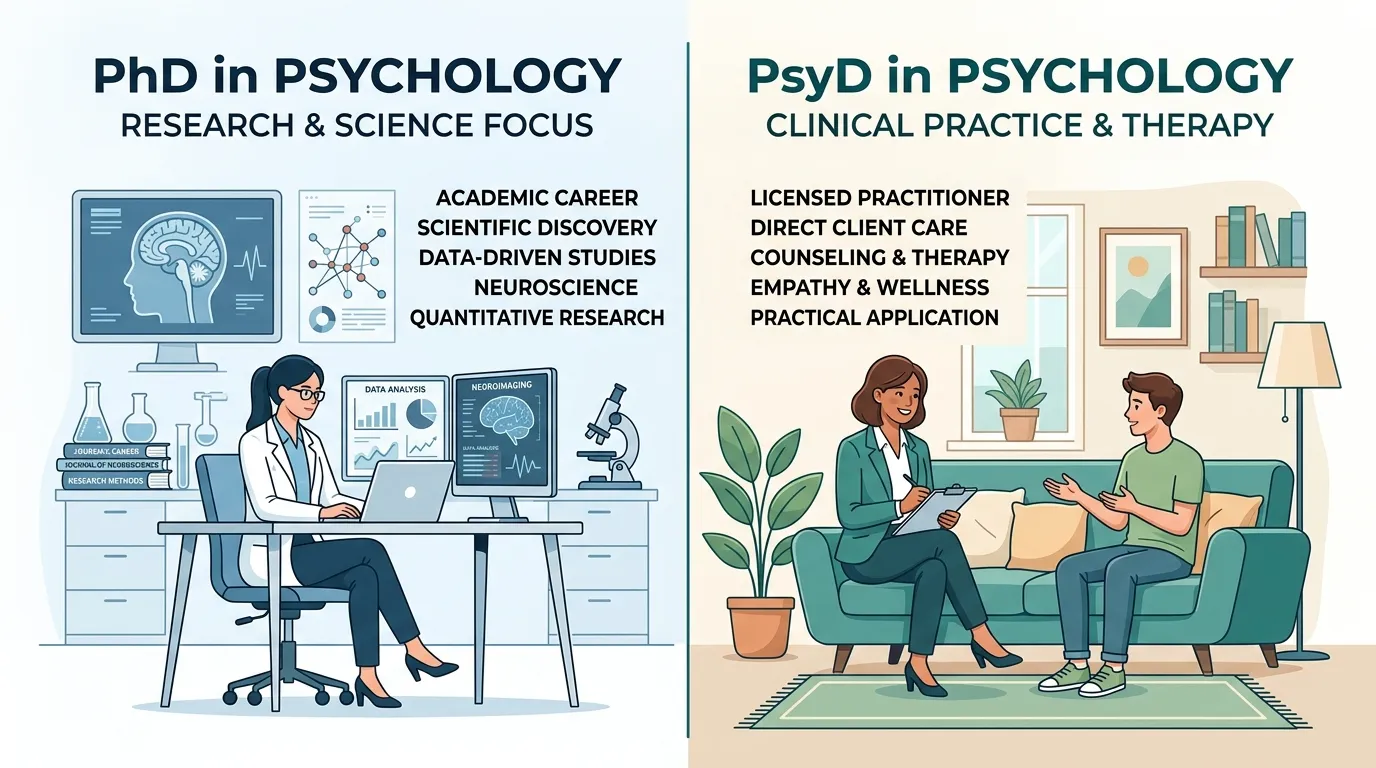
A PhD focuses on research and teaching, while a PsyD focuses on hands-on clinical practice and treating patients.
Choosing the wrong doctoral degree can cost you years of wasted time and thousands of dollars. Most people use these terms like synonyms, but they are not. My friend Sarah wanted to open her own therapy clinic right away. She picked a PhD program by mistake and spent six long years analyzing statistics in a dark campus basement instead of helping real people. Are you ready to discover the perfect path for your career goals?
Understanding the difference between PhD and PsyD tracks is vital. A PhD, or Doctor of Philosophy, trains you to find new data. A PsyD, or Doctor of Psychology, trains you to apply that data. Knowing the true difference between PhD and PsyD will save your sanity.
The Key Difference Between PhD and PsyD
The core difference is simple: a PhD makes you a producer of psychological research, while a PsyD makes you a consumer of that research who applies it directly to patients.
Keep reading, we break down all 10 differences in plain, simple terms below.
Why Is This Difference Important to Know?
Picking the right degree shapes your daily life for the next half-decade. If you want to discover why people develop habits, you need a research background. If you want to help people break bad habits in a clinic, you need practical training. Knowing the true difference between PhD and PsyD ensures your tuition money buys the exact future you actually want.
10 Points of Difference
1. Basic Definition and Meaning
A PhD is a Doctor of Philosophy. It focuses heavily on science, statistics, and generating new knowledge for the academic world. A PsyD is a Doctor of Psychology. It focuses almost entirely on clinical work, practical therapy skills, and direct patient interaction.
- PhD Example: Dr. Aris Logan writes scholarly papers about brain patterns during panic attacks.
- PsyD Example: Dr. Maya Lin sits on a couch guiding a teenager through a panic attack.
2. Origin and Core Philosophy
The PhD is an old, traditional academic degree born in research universities to advance human knowledge. The PsyD started in the 1970s from the Vail Model. This model was created because the psychology world needed more hands-on healers than university researchers.
- PhD Example: Harvard University built its PhD program around laboratory science and theory.
- PsyD Example: Rutgers University designed a PsyD track specifically to train community mental health workers.
3. The Training Process
PhD students spend their days designing lab experiments, analyzing complex data sheets, and writing a massive research thesis called a dissertation. PsyD students spend their time in clinics, interviewing real clients, learning therapy methods, and doing practical field exams.
- PhD Example: Leo Vance spends his Tuesday afternoon coding data from 500 patient surveys.
- PsyD Example: Nina Cross spends her Tuesday afternoon conducting group therapy at a local clinic.
4. Time Involved and Duration
A PhD program usually takes 5 to 7 years to complete because research studies take a long time to finish. A PsyD program is faster and typically takes 4 to 5 years since the focus is on practical hours rather than a massive laboratory project.
- PhD Example: Marcus Reed spent 7 full years finishing his research on sleep loss.
- PsyD Example: Chloe Vance graduated in 4 years and immediately started her local clinical internship.
5. Financial Cost and Funding
PhD programs are highly competitive but often offer full funding. The school pays your tuition in exchange for your teaching or research work. PsyD programs accept more students but rarely offer funding, meaning you will likely pay full tuition out of pocket.
- PhD Example: The State University gave Elena Cruz a free ride and a monthly stipend.
- PsyD Example: Dr. James Vance took out student loans to pay his private tuition fees.
6. Primary Use Cases
Use a PhD if you want a career as a university professor, a lab director, or a top-tier consultant. Use a PsyD if you want to open a private practice, work in a hospital ward, or counsel school children.
- PhD Example: Dr. Sarah Jenkins works as a full-time professor teaching cognitive science.
- PsyD Example: Dr. Robert Vance runs a thriving private family counseling center downtown.
7. Core Examination Style
PhD students must defend a massive research dissertation in front of a panel of senior scientists. PsyD students often complete a smaller research project or pass a rigorous practical exam that tests their face-to-face therapy skills.
- PhD Example: David Kim stood before a board to defend his 200-page paper on memory.
- PsyD Example: Tara West passed her exam by accurately diagnosing an actor playing a patient.
8. Acceptance Rates and Class Sizes
PhD programs keep class sizes tiny, often accepting only 5 to 10 students per year per advisor. PsyD programs have much larger cohorts, sometimes accepting 30 to 100 students in a single learning track.
- PhD Example: The clinical psychology PhD track accepted only 4 people out of 300 applicants.
- PsyD Example: The regional PsyD program welcomed a collaborative class of 45 new students.
9. Can They Replace Each Other?
Yes, both can work as licensed clinical psychologists and diagnose patients. However, a PsyD will struggle to get hired as a high-level university research professor, and a PhD might lack the sheer volume of early clinical hours.
- PhD Example: Dr. Bell successfully applied to work at the state mental health hospital.
- PsyD Example: Dr. Green was rejected for the role of Head of Laboratory Science.
10. Long-Term Results and Lasting Impact
A PhD leaves a lasting impact through published books, scientific discoveries, and generations of taught students. A PsyD leaves a legacy through the thousands of individual human lives they directly healed, comforted, and saved over a long career.
- PhD Example: Dr. White’s paper on childhood trauma is cited in textbooks worldwide.
- PsyD Example: Dr. Black helped over two thousand local patients overcome severe depression.
Nature and Behaviour
The PhD is methodical, deeply analytical, and quiet. It loves quiet libraries, spreadsheet columns, and deep intellectual debates. It behaves like a classical scientist looking at the world through a microscope.
The PsyD is energetic, highly social, and empathetic. It loves human conversation, active listening, and real-time problem-solving. It behaves like an emergency room doctor, responding quickly to the emotional needs of the person in front of them.
Why Do People Confuse Them?
People confuse them because both degrees allow you to use the title “Doctor.” Both degrees let you open a private therapy office and treat patients. Advertisements often lump them together under “psychology degrees.”
For example, Tim wanted to treat veterans with PTSD. He picked a PhD because it had “Psychology” in the title, only to realize he had to spend his first three years coding computer statistics instead of talking to soldiers.
Comparison Table
| Feature | PhD | PsyD |
| Definition | Doctor of Philosophy | Doctor of Psychology |
| Origin | Traditional research universities | 1970s Vail Model conference |
| Process | Lab experiments and data analysis | Clinical rotations and face-to-face therapy |
| Duration | 5 to 7 years | 4 to 5 years |
| Funding | Often fully funded with stipends | Seldom funded; paid via loans |
| Main Use | Research, teaching, and consulting | Private practice and clinical counseling |
| Impact | Scientific discovery and literature | Direct patient healing and recovery |
| Interchangeable? | Partially (both can do clinical therapy) | No (PsyD cannot easily run major research labs) |
| Long-term Result | Published papers and academic legacy | Transformed human lives and community health |
| Similarity | Both grant the title of licensed Doctor | Both diagnose and treat mental health conditions |
| Key Difference | Creates new psychological data | Uses existing data to heal patients |
📌 Save this for later, bookmark this page or share it with someone who always mixes up these two career tracks!
Which Is Better and When?
The PhD is better if you love science and want a free education. For example, if your dream is to discover a new treatment for autism while working at a major university, choose a PhD.
The PsyD is better if you want to skip lab work and start helping clients fast. For example, if you want to open a private marriage counseling practice within four years, choose a PsyD.
Quick Decision Guide
Choose a PhD if:
- You want your college tuition fully paid by the school.
- You love analyzing statistics and running lab experiments.
- Your dream is to teach college students as a professor.
- You want to discover new scientific theories.
Choose a PsyD if:
- You want to graduate and enter the workforce quickly.
- You dislike heavy math, statistics, and writing research papers.
- Your primary goal is face-to-face patient counseling.
- You want a higher chance of program acceptance.
Still unsure? Drop your question in the comments below, we answer every single one!
Metaphors and Similes
- PhD Metaphor: The PhD is the architect who designs the blue-sky blueprints for a brand new house.
- PsyD Metaphor: The PsyD is the master carpenter who actually swings the hammer to build the rooms.
- Comparison Simile: Comparing a PhD to a PsyD is like comparing a automotive engineer to a professional race car driver.
Connotative Meaning
PhD
- Positive: Highly prestigious, brilliant, deeply intellectual. (Example: “She is a world-class PhD researcher.”)
- Negative: Rigid, stuck in an ivory tower, detached from real life. (Example: “His PhD view lacks real-world common sense.”)
- Neutral: Academic, studious. (Example: “The university hired a new PhD for the science department.”)
PsyD
- Positive: Compassionate, practical, deeply human. (Example: “Our clinic needs a caring PsyD on staff.”)
- Negative: Expensive, non-academic, less prestigious. (Example: “He chose a costly PsyD instead of a research track.”)
- Neutral: Clinical, practitioner-focused. (Example: “The hospital job requires a PsyD or equivalent degree.”)
Idioms and Proverbs
- Get down to brass tacks: A PsyD skips the theories to get down to brass tacks with a patient.
- Back to the drawing board: A PhD loves going back to the drawing board to fix a broken scientific theory.
- An ounce of prevention is worth a pound of cure [coined expression]: The PhD seeks the ounce of prevention through study, while the PsyD applies the pound of cure in the office.
FAQ Section
Q1: What is the main difference between a PhD and a PsyD?
A PhD focuses on scientific research, statistics, and teaching. A PsyD focuses on practical clinical work, therapy techniques, and treating mental health patients directly in a clinical setting.
Q2: Can a PsyD graduate use the title of Doctor?
Yes, both graduates earn a doctoral degree. Both can legally use the prefix “Dr.” and practice as licensed clinical psychologists once they pass their state board exams.
Q3: Which degree is harder to get accepted into?
The PhD is harder to get into because classes are tiny and funded. PsyD programs accept larger classes, making entry less competitive, though tuition costs are usually much higher.
Q4: How long does it take to finish these programs?
A PhD typically takes 5 to 7 years due to the extensive research dissertation requirement. A PsyD takes 4 to 5 years because it prioritizes clinical hours over laboratory research.
Q5: Can a PhD graduate open a private therapy practice?
Yes, a PhD in clinical psychology includes enough practical training to allow graduates to pass licensing exams, open private practices, and treat clients just like a PsyD graduate.
Related Reading:
Real-World Importance
Understanding the difference between PhD and PsyD tracks helps you make smart choices in everyday life. Students can avoid massive debt by choosing the right program. Patients can find the professional best suited to their needs, and mental health clinics can recruit the ideal expert for their open roles.
Conclusion
Choosing between these paths comes down to your personal career passion. A PhD gives you the tools to discover new scientific insights through deep data analysis. A PsyD gives you the practical skills to sit with people and heal their emotional pain. Your choice will define how you spend your days, how you think, and how you change the world around you. Knowing the core difference between PhD and PsyD programs ensures you take the right step forward. You now possess the expert knowledge needed to choose your path with total confidence. Your future patients or future students are waiting for you to begin!
Explore More: Difference Between Nauseous and Nauseated: Quick Guide

I’m Ayesha Sadiqah, and I’m passionate about answering one simple question: “What’s the difference?” Through clear comparison guides, I help readers understand commonly confused words, products, concepts, and everyday topics. My goal is to make complex ideas easy to understand with accurate, practical, and reader-friendly explanations.