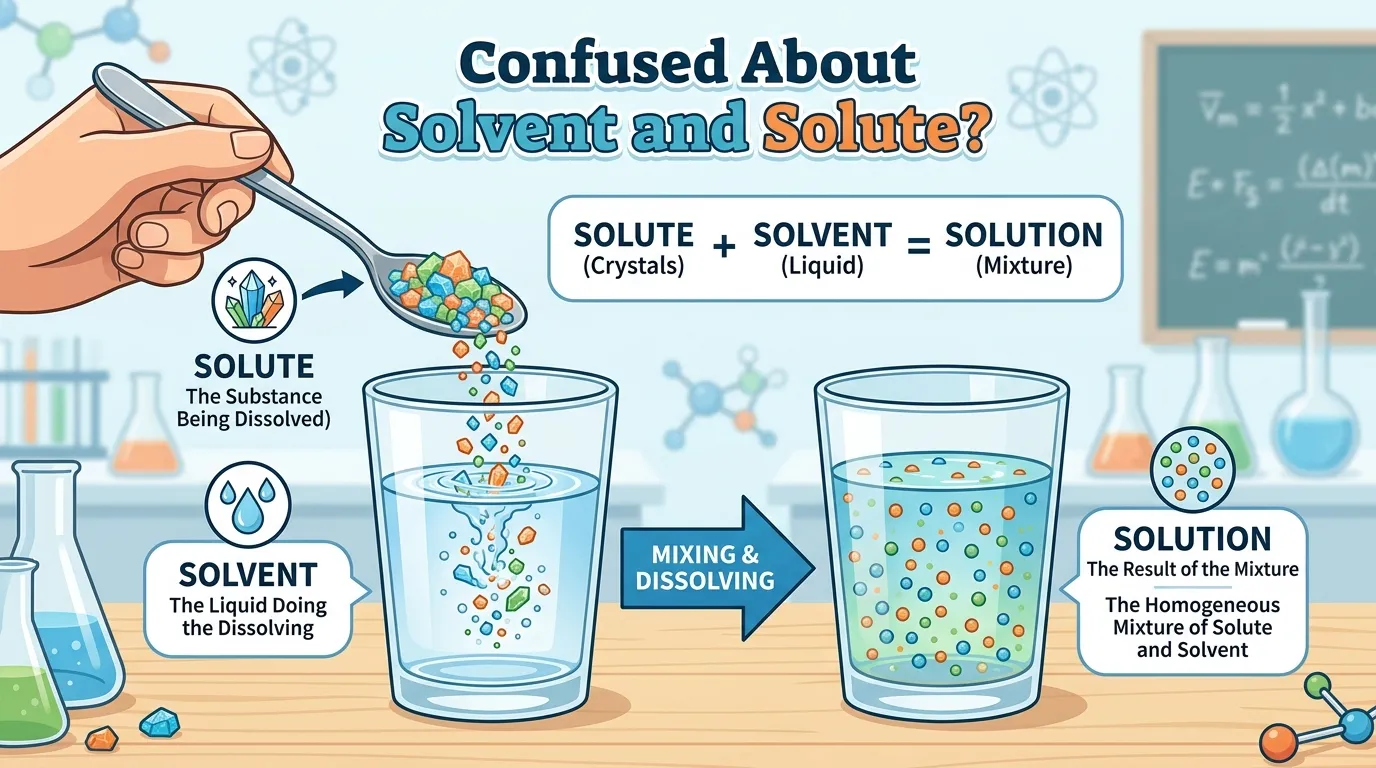
A solvent is the substance that dissolves another substance, while a solute is the substance that gets dissolved to form a solution.
Most people use solvent and solute like they mean the same thing. They don’t. The difference matters more than you might think.
I once helped a student named Emma during a science lab. She was making a saltwater solution but accidentally labeled the salt as the solvent and the water as the solute. Her experiment still worked, but her report was wrong. That small mix-up cost her points on an important test.
The difference between solvent and solute confuses many students because both work together in every solution. When you make tea, mix juice powder with water, or dissolve sugar in coffee, both are involved.
Understanding the difference between solvent and solute makes chemistry much easier. By the end of this guide, you’ll know exactly what each term means, how they work together, and when each one matters.
Key Difference

The biggest difference is simple. A solvent does the dissolving. A solute gets dissolved.
Think of water and salt. Water is the solvent because it dissolves the salt. Salt is the solute because it disappears into the water.
Keep reading, we break down all 10 differences in plain, simple terms below.
Why Is This Difference Important to Know?
Knowing the difference between solvent and solute helps you understand basic chemistry, cooking, medicine, and even cleaning products.
Students see these terms in science classes. Doctors and pharmacists use them when preparing medicines. Manufacturers use them when making paints, drinks, and household products. A clear understanding prevents mistakes and builds a strong science foundation.
10 Points of Difference
1. Basic Definition and Meaning
A solvent is the substance that dissolves another material. A solute is the substance being dissolved.
Example 1: In saltwater, water is the solvent and salt is the solute.
Example 2: In lemonade, water is the solvent and sugar is the solute.
2. Origin / Source / Main Components
Solvents are usually present in larger amounts. They often act as the base of a mixture.
Solutes are usually added to the solvent.
Example 1: Ocean water contains water as the solvent and dissolved minerals as solutes.
Example 2: Coffee contains water as the solvent and coffee compounds as solutes.
3. Process: How It Is Made or Done
The solvent surrounds and breaks apart the solute particles. The solute spreads evenly throughout the solvent.
Example 1: Sugar dissolving in tea.
Example 2: Salt dissolving in soup.
4. Time Involved / Duration
Solvents usually remain present throughout the mixing process. Solutes may dissolve quickly or slowly depending on conditions.
Example 1: Powdered drink mix dissolves within seconds.
Example 2: Rock salt may take longer to dissolve in cold water.
5. Flavor, Feel, or Output Quality
The solvent often determines the texture or consistency of the solution. The solute often changes the taste, color, or effect.
Example 1: Water gives juice its liquid form.
Example 2: Cocoa powder gives chocolate milk its flavor.
6. Primary Use Cases
Solvents help carry or dissolve substances. Solutes provide the desired ingredient or effect.
Example 1: Water carries medicine in liquid syrups.
Example 2: Active drug ingredients act as solutes in many medicines.
7. Effect or Impact
The solvent controls how well the solution forms. The solute controls what properties the solution gains.
Example 1: Water dissolves sports drink ingredients.
Example 2: Electrolytes provide the drink’s purpose.
8. Degree of Specificity or Precision
A solvent is often easier to identify because it exists in the larger amount. A solute can be one substance or many.
Example 1: Water in seawater.
Example 2: Salt, magnesium, and minerals dissolved in seawater.
9. Can They Replace Each Other?
No. Their roles are different.
A solvent cannot become a solute unless the proportions and situation change.
Example 1: Water remains the solvent in most saltwater solutions.
Example 2: Salt remains the solute in most saltwater solutions.
10. Long-Term Results / Lasting Impact
The solvent affects stability and storage. The solute affects the solution’s final purpose.
Example 1: Water helps preserve consistency in beverages.
Example 2: Sugar affects sweetness and energy content.
Nature and Behaviour
A solvent is usually the dominant substance in a solution. It acts like a carrier and allows other materials to spread evenly.
A solute is the ingredient being carried. It contributes flavor, color, medicine, minerals, or other useful properties to the solution.
Why Do People Confuse Them?

People confuse these terms because they always appear together.
Several reasons cause confusion:
- Both are parts of a solution.
- Their names sound similar.
- School examples often introduce them at the same time.
- Students focus on the mixture rather than individual roles.
A common mistake happens when someone sees saltwater and assumes salt is the solvent because it seems important. In reality, water is the solvent because it does the dissolving.
Comparison Table
| Feature | Solvent | Solute |
| Definition | Dissolves another substance | Gets dissolved |
| Origin | Usually larger amount | Usually smaller amount |
| Process | Performs dissolving | Undergoes dissolving |
| Duration | Remains throughout solution | Becomes distributed |
| Output | Determines medium | Determines properties |
| Main Use | Carrier substance | Active ingredient |
| Impact | Helps form solution | Changes solution characteristics |
| Interchangeable? | No | No |
| Long-Term Result | Supports stability | Provides function |
| Similarity | Both form a solution | Both form a solution |
| Key Difference | Does dissolving | Gets dissolved |
📌 Save this for later, bookmark this page or share it with someone who always mixes up solvent and solute.
Which Is Better and When?
Neither is better because they serve different jobs.
A solvent is more important when you need a medium to dissolve substances. For example, water acts as the solvent in sports drinks.
A solute is more important when you want a specific result. For example, sugar provides sweetness in lemonade.
Quick Decision Guide
Choose Solvent if, it:
- Dissolves another substance
- Exists in greater quantity
- Acts as the carrier
- Forms the solution base
Choose Solute if, it:
- Gets dissolved
- Exists in smaller quantity
- Provides the main effect
- Changes solution properties
Still unsure? Drop your question in the comments, we answer every single one.
Metaphors and Similes
A solvent is like a stage where everything performs.
A solute is like the actor delivering the performance.
Together, they work like a team where one provides the space and the other provides the action.
Connotative Meaning
Solvent
- Positive: Helpful carrier. Example: Water carries nutrients.
- Neutral: Base liquid. Example: Water in lemonade.
- Negative: Industrial chemicals can be harmful if misused.
Solute
- Positive: Useful ingredient. Example: Vitamins in a drink.
- Neutral: Dissolved material. Example: Salt in seawater.
- Negative: Too much sugar can reduce health benefits.
Idioms and Proverbs
While chemistry has few direct idioms, these expressions fit:
- “Mix well and succeed.” Example: The team mixed ideas well and succeeded.
- “A solution starts with the right ingredients.” Example: Every project needs the right ingredients to succeed.
- “The solvent carries the load.” Example: Good leadership carries the load during difficult times.
Frequently Asked Questions
Q1: What is the main difference between solvent and solute?
A solvent dissolves another substance. A solute is the substance that gets dissolved. Together they form a solution.
Q2: Can solvent be used instead of solute?
No. They have different roles. One dissolves while the other gets dissolved.
Q3: Which is better, solvent or solute?
Neither is better. Both are necessary for forming a solution and each serves a unique purpose.
Q4: How long does solvent or solute last?
Their duration depends on the solution. In many mixtures, both remain present until the solution changes or evaporates.
Q5: Why do people mix up solvent and solute?
They often appear together in science lessons. Their similar names also make them easy to confuse.
Related Reading
You might also like:
→ Difference Between Mixture and Solution /difference-between-mixture-and-solution
→ Homogeneous vs Heterogeneous Mixtures /homogeneous-vs-heterogeneous-mixtures
Real-World Importance
Understanding the difference between solvent and solute helps in school, cooking, healthcare, and manufacturing.
You use these concepts when making coffee, mixing sports drinks, preparing medicines, and even cleaning surfaces. Knowing which substance dissolves and which gets dissolved makes everyday science easier to understand.
Conclusion
The key idea is simple. A solvent does the dissolving, while a solute gets dissolved. Although they work together in every solution, they perform very different jobs.
Understanding the difference between solvent and solute helps you make sense of chemistry lessons, everyday mixtures, and real-world products. Once you know who does the dissolving and who gets dissolved, identifying them becomes much easier.
You’ve already learned what many students struggle to remember. Now that you know the difference, you’ll never mix them up again. Bookmark this guide and share it with anyone who needs a simple explanation.
See More: Difference Between Dysphoria and Dysmorphia: Quick Guide

I’m Ayesha Sadiqah, and I’m passionate about answering one simple question: “What’s the difference?” Through clear comparison guides, I help readers understand commonly confused words, products, concepts, and everyday topics. My goal is to make complex ideas easy to understand with accurate, practical, and reader-friendly explanations.