A boss uses authority and job title to make people work, while a leader uses trust and example to make people want to work.
Most people use “boss” and “leader” like they mean the same thing. They do not, and mixing them up can quietly wreck a team’s morale.
Here is a quick story. Farhan got promoted to manager and thought the title alone made him a leader. He started barking orders, tracking every minute of his team’s day, and taking credit for their wins. Within three months, his best employee quit, saying she never felt trusted or respected.
So what is the real difference between boss and leader, and which one actually gets better results? Let’s break it down clearly, one point at a time.
Key Difference
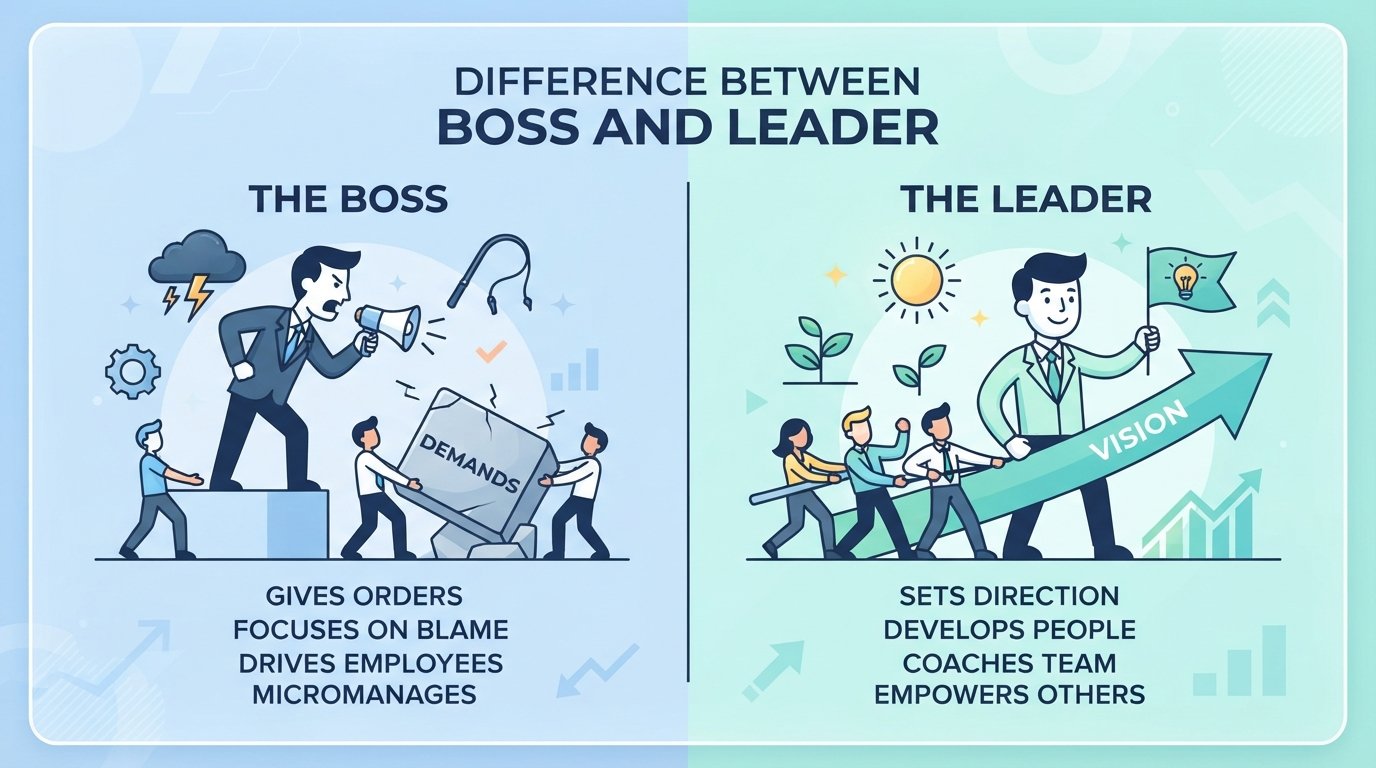
The core difference between boss and leader comes down to power versus influence. A boss controls people through position and rules. A leader guides people through trust, respect, and shared purpose. Keep reading, we break down all 10 differences in plain, simple terms below.
Why Is This Difference Important to Know?
Understanding the difference between boss and leader shapes how well a team performs, whether at a small shop or a large company. Employees under a true leader tend to stay longer, work harder, and speak up with ideas. Employees under a strict boss often disengage, hide mistakes, and count down the hours until they can leave.
A Quick Bridge Before the Details
Now that you see the core split between control and trust, let’s walk through all 10 specific differences. If you also want to understand how communication style affects a team, check out our guide on effective workplace communication.
10 Points of Difference Between Boss and Leader
1. Basic Definition and Meaning
A boss is someone assigned formal authority over a team’s tasks and schedule. A leader is someone who earns influence by guiding, motivating, and supporting others toward a shared goal. A store supervisor who only assigns shifts acts like a boss. A shift supervisor who mentors new hires and solves their problems acts like a leader.
2. Origin and Main Components
Boss authority comes from an org chart, a title, or a signed contract. Leadership influence comes from trust built through consistent actions over time. A newly hired regional manager becomes a boss the moment HR updates the system. A junior employee can become a respected leader on a project team long before getting any official title.
3. Process: How It Is Made or Done
A boss directs work by assigning tasks and checking whether they got done. A leader builds momentum by explaining the why behind the work and removing obstacles for the team. A boss might simply say, “Finish this report by five.” A leader might say, “Here is why this report matters, and here is how I can help you finish it.”
4. Time Involved and Duration
Boss authority can appear instantly with a promotion announcement or a new hire letter. Leadership respect usually takes weeks or months of consistent, trustworthy behavior to build. A new department head is called “boss” on day one. That same person might not feel like a true leader to the team until several months of proven support.
5. Feel and Output Quality
Working under a boss often feels tense, rushed, and one directional. Working under a leader often feels collaborative, supported, and two directional. A team under a controlling boss stays quiet during meetings. A team under a strong leader debates ideas openly and offers suggestions without fear.
6. Primary Use Cases
Boss style tends to show up in strict, fast paced environments like factory floors with tight safety rules. Leader style tends to show up in creative or growth focused environments like startups and design teams. A warehouse shift often needs a boss enforcing safety procedures precisely. A marketing team often thrives under a leader encouraging bold new ideas.
7. Effect or Impact
A boss style can produce short term compliance but long term resentment and turnover. A leader style tends to produce long term loyalty, innovation, and lower turnover. A call center with heavy boss style management often sees high yearly staff turnover. A tech company known for strong leadership culture often reports employees staying five or more years.
8. Degree of Specificity or Precision
“Boss” describes a formal role tied to a job title, nothing more, nothing less. “Leader” describes a broader quality that can exist with or without any official title at all. Saying “she is my boss” only tells you about reporting structure. Saying “she is a great leader” tells you something about her character and influence.
9. Can They Replace Each Other?
Not automatically, since having a boss title does not guarantee leadership skill, and being a leader does not require holding a boss title. A company can promote someone into a boss role who never develops real leadership ability. Meanwhile, a frontline employee with no formal power can still lead informally through respect and initiative.
10. Long Term Results and Lasting Impact
Teams led by bosses alone often struggle with high turnover, low morale, and stalled growth over the years. Teams guided by real leaders often see stronger retention, steady skill growth, and a lasting culture of trust. Companies known for weak leadership frequently rebuild entire departments every few years. Companies known for strong leadership often promote from within for decades.
Nature and Behaviour
A boss tends to behave like a strict referee, focused on rules, deadlines, and enforcement. The relationship feels formal, and conversations often center on tasks rather than people.
A leader tends to behave like a coach, focused on growth, encouragement, and shared wins. The relationship feels personal, and conversations often include feedback, support, and genuine listening.
Why Do People Confuse Them?
People confuse boss and leader mainly because both roles often sit at the top of an org chart, making the titles feel interchangeable. Company culture sometimes rewards control instead of trust, blurring the line further. Movies and shows often show tough bosses barking orders and call it “leadership,” reinforcing the mix up. One new manager once told his team, “I’m the boss now, so do what I say,” genuinely believing that statement made him a leader.
Comparison Table
| Feature | Boss | Leader |
| Definition | Person with formal authority over a team | Person who guides and inspires others |
| Origin | Comes from a title or job contract | Comes from earned trust and respect |
| Process | Assigns and enforces tasks | Explains purpose and removes obstacles |
| Duration | Authority begins instantly | Trust builds gradually over time |
| Output | Tense, one directional environment | Collaborative, supportive environment |
| Main Use | Strict, fast paced settings | Creative, growth focused settings |
| Impact | Short term compliance, higher turnover | Long term loyalty, lower turnover |
| Interchangeable? | Not automatically a leader | Not automatically a boss |
| Long Term Result | Frequent rebuilding of teams | Strong internal promotion culture |
| Similarity | Both can hold formal authority | Both can hold formal authority |
| Key Difference | Relies on power and control | Relies on trust and influence |
📌 Save this for later, bookmark this page or share it with someone who always mixes up boss and leader.
Which Is Better and When?
A boss style can work well in high risk, rule heavy settings, like a construction site where safety procedures must be followed exactly. A leader style works better almost everywhere else, especially where creativity, morale, and long term loyalty matter, like a software company building new products. Most successful managers actually blend both, using boss level clarity with leader level trust.
Quick Decision Guide
Choose boss style if: ☑ Safety or compliance rules must be followed exactly ☑ Tasks are highly repetitive and time sensitive ☑ Little room exists for creative decision making ☑ Quick, clear direction matters more than buy in
Choose leader style if: ☑ You want long term loyalty and lower turnover ☑ Creativity and problem solving drive results ☑ Team morale directly affects performance ☑ You want people to grow, not just comply
Still unsure? Drop your question in the comments, we answer every single one.
Metaphors and Similes
A boss is like a traffic light, directing movement through strict control. A leader is like a lighthouse, guiding people safely through their own judgment. Comparing a boss to a leader is like comparing a strict referee to a trusted coach, both shape the game, but only one builds real loyalty.
Connotative Meaning
Boss carries a slightly negative or neutral feel today. Positively, it can suggest decisiveness, like “she’s a real boss in negotiations.” Negatively, it can suggest bossy or controlling, like “he’s such a boss about tiny details.” Neutrally, it simply names a job title.
Leader carries a strongly positive feel in most contexts. Positively, it suggests trust and vision, like “she’s a natural leader.” Negatively, in rare cases it can suggest someone who avoids necessary discipline. Neutrally, it can just describe a role, like “team leader.”
Idioms and Proverbs
“Bossing people around” describes controlling behavior, as in “he’s always bossing people around instead of helping.” “Born leader” describes someone naturally skilled at guiding others, as in “everyone could tell she was a born leader by age ten.” “Leads from the front” describes someone who models the behavior they expect, as in “a good manager leads from the front, not just from an office.”
FAQ
Q1: What is the main difference between boss and leader?
The main difference between boss and leader is how they earn cooperation. A boss relies on formal authority and rules, while a leader relies on trust, respect, and shared purpose built over time.
Q2: Can a boss be used instead of a leader?
Yes, but only short term. A pure boss style can get tasks done quickly, but it usually fails to build the loyalty and creativity that a true leader inspires in a team.
Q3: Which is better, boss or leader?
Leader style generally produces better long term results, since it builds trust, loyalty, and innovation. Boss style can still help in strict, rule heavy environments where quick compliance truly matters most.
Q4: How long does it take to become a boss or a leader?
Becoming a boss can happen instantly with a promotion or new job title. Becoming a respected leader usually takes months of consistent, trustworthy actions that prove genuine care for the team.
Q5: Why do people mix up boss and leader?
Both roles often sit at the top of a team, and pop culture frequently shows tough bosses as leaders. This overlap in position and portrayal causes most of the lasting confusion.
You might also like: → How to Build Trust as a New Manager → Signs Your Workplace Culture Needs a Leadership Reset
Real World Importance
Knowing the difference between boss and leader helps at every career stage, from a first supervisor role to running an entire company. It matters when hiring managers, mentoring junior staff, or deciding how you want to be remembered by your own team. Strong leadership habits build lasting trust, higher retention, and a healthier workplace overall.
Conclusion
At the end of the day, the difference between boss and leader comes down to power versus trust. A boss directs through title and rules, while a leader guides through respect, purpose, and consistent support. Titles alone never make someone a true leader, actions over time do. Once you understand that one distinction, workplace relationships start making a lot more sense.
You clearly understand the details now, and that puts you ahead of most managers who never think about this difference at all. Next time you lead a team, you’ll know exactly which style actually earns loyalty.
See More: Difference Between Botox and Jeuveau: Quick Guide

I’m Ayesha Sadiqah, and I’m passionate about answering one simple question: “What’s the difference?” Through clear comparison guides, I help readers understand commonly confused words, products, concepts, and everyday topics. My goal is to make complex ideas easy to understand with accurate, practical, and reader-friendly explanations.