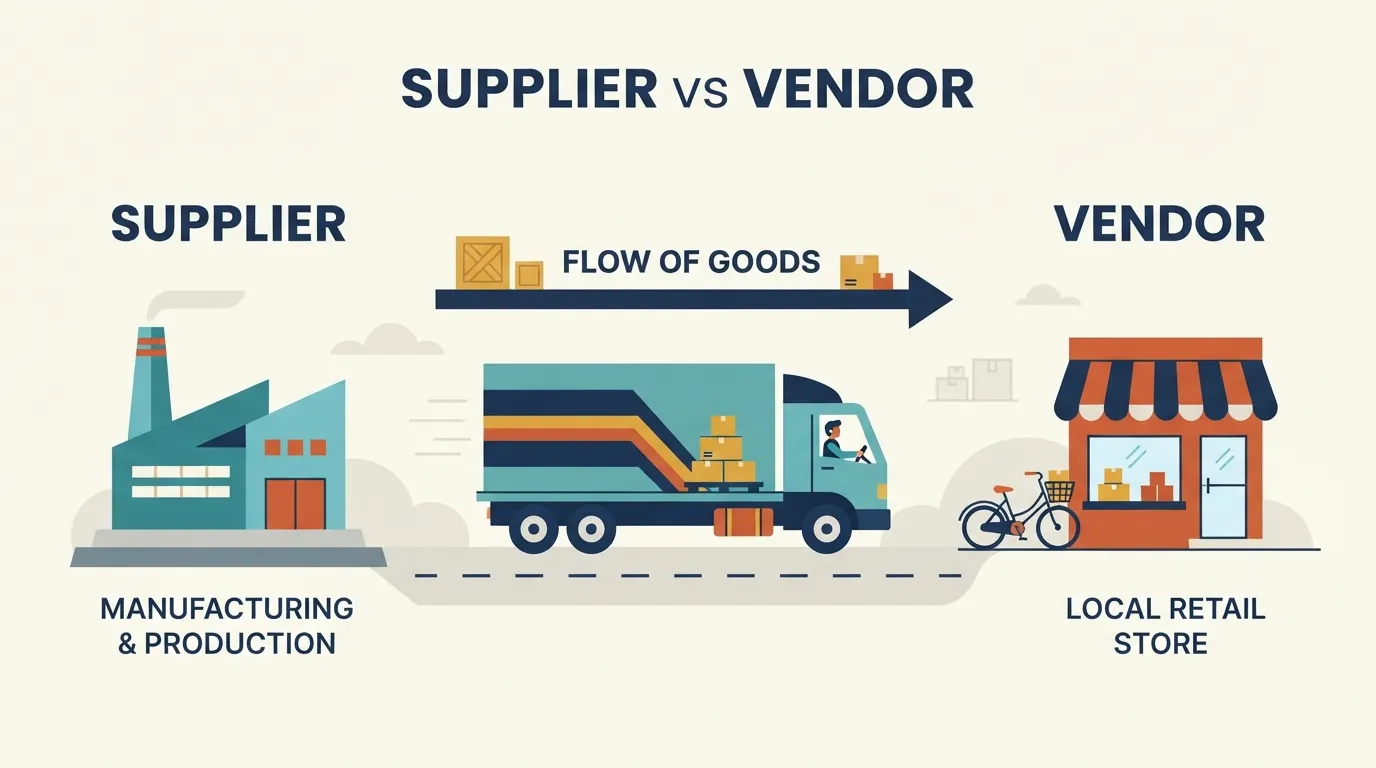
A supplier provides raw materials or goods used to make a product. A vendor sells the finished product directly to the buyer or customer.
Most people use “vendor” and “supplier” like they mean the same thing. They don’t, and the difference between vendor and supplier can shape how a business runs.
James, a new procurement assistant in Ohio, once signed a supplier contract when he actually needed a vendor agreement. The mix up delayed his company’s product launch by two full weeks, because the paperwork covered the wrong kind of business relationship entirely.
So what is the real difference between vendor and supplier, and why should you care? Let’s break it down in plain, simple English.
A supplier is a business or person that provides raw materials, parts, or resources used to create a product. A vendor is a business or person that sells a finished product or service directly to customers. Once you understand the difference between vendor and supplier, you’ll manage contracts, budgets, and partnerships with much more confidence.
Key Difference
The core difference between vendor and supplier comes down to their place in the supply chain. A supplier feeds raw materials into production. A vendor sells the finished result to the end buyer.
Keep reading, we break down all 10 differences in plain, simple terms below.
Why Is This Difference Important To Know?
Knowing the difference between vendor and supplier can save real money and time. Business owners who confuse the two often sign the wrong type of contract, leading to legal headaches and missed deadlines.
This matters for beginners starting a small shop and for experienced managers running large supply chains. Whether you’re negotiating prices or writing a purchase order, choosing the right word, and the right partner, keeps your business running smoothly.
10 Points of Difference
1. Basic Definition and Meaning
A supplier provides raw materials, parts, or ingredients used to build something. A vendor sells a finished, ready to use product or service. A company named FabricSource supplies cotton to a clothing brand. A store named UrbanThreads acts as a vendor, selling the finished shirts to shoppers.
2. Origin and Main Role
Suppliers usually sit near the start of a supply chain, close to raw materials and manufacturing. Vendors usually sit near the end, close to the final customer. A farm called GreenValley supplies wheat to a bakery. A market stall called SunnySide acts as the vendor, selling fresh bread to shoppers.
3. Process: How They Operate
A supplier works through manufacturing, sourcing, and bulk delivery processes, often behind the scenes. A vendor works through sales, marketing, and direct customer interaction. A factory named SteelWorks supplies metal parts to a car maker. A dealership named AutoPlaza acts as the vendor, selling finished cars to drivers.
4. Time Involved or Duration
Supplier relationships often last for years, built on long term contracts and steady bulk orders. Vendor relationships can be short or long, often tied to specific sales periods or events. A supplier like PaperMill signs a five year deal with a printing company. A vendor like BookNook may only work with a customer for a single purchase.
5. Output Quality and Focus
Suppliers focus heavily on consistency, quality control, and meeting production standards. Vendors focus heavily on presentation, pricing, and customer experience. A supplier named GlassCraft ensures every glass bottle meets strict size standards. A vendor named SparkleMart focuses on attractive packaging and friendly service for shoppers.
6. Primary Use Cases
Suppliers are common in manufacturing, agriculture, and industrial production. Vendors are common in retail, events, and direct to consumer sales. A supplier like CocoaFields sends cocoa beans to a chocolate factory. A vendor like SweetTreats sells the finished chocolate bars at a local fair.
7. Effect or Impact
A supplier problem, like a late shipment, can stop an entire factory from producing goods. A vendor problem, like poor customer service, can hurt sales and damage a brand’s reputation directly. A supplier named MetalWorks delaying steel halts a construction project. A vendor named QuickBuild losing customer trust hurts future sales.
8. Degree of Specificity or Precision
Suppliers usually deal with specific materials, measured in exact quantities, weights, or grades. Vendors usually deal with finished units, sold individually or in smaller batches. A supplier named CottonPure ships fabric by the ton. A vendor named StyleHub sells finished jackets one at a time to shoppers.
9. Can They Replace Each Other?
No, a vendor and a supplier serve different roles and cannot simply swap places in most businesses. A raw material supplier cannot suddenly become a retail vendor without changing its entire business model. A company like WoodSource supplies lumber to furniture makers, while a vendor like HomeStyle sells the finished furniture to families.
10. Long Term Results or Lasting Impact
Strong supplier relationships build steady, reliable production over many years, protecting a business from shortages. Strong vendor relationships build customer loyalty and brand trust over time. A supplier like GrainCo helps a bakery avoid ingredient shortages. A vendor like FreshLoaf builds a loyal customer base through consistent quality.
Nature and Behaviour
A supplier behaves like the quiet engine room of a business, steady, consistent, and focused on production behind the scenes. It thrives on reliability, bulk orders, and long term trust.
A vendor behaves like the friendly storefront of a business, visible, persuasive, and focused on the final sale. It thrives on presentation, pricing, and direct customer connection.
Why Do People Confuse Them?
People confuse vendor and supplier because both words describe someone who provides goods or services to a business. Both appear in contracts, invoices, and supply chain conversations, often without clear definitions. Many businesses also use the terms loosely in everyday conversation.
A common real life mistake happens when a small business owner calls their raw material provider a vendor, then struggles when writing a supplier specific contract that doesn’t match the relationship at all.
Comparison Table
| Feature | Supplier | Vendor |
| Definition | Provides raw materials or parts | Sells finished goods or services |
| Origin | Early stage, near production | Later stage, near the customer |
| Process | Sourcing, manufacturing, bulk delivery | Sales, marketing, direct transactions |
| Duration | Often long term contracts | Can be short or long term |
| Output | Raw or bulk materials | Finished, ready to use products |
| Main Use | Manufacturing, agriculture | Retail, events, direct sales |
| Impact | Affects production directly | Affects customer experience directly |
| Interchangeable? | No | No |
| Long Term Result | Reliable production supply | Strong customer loyalty |
| Similarity | Both provide value to a business | Both provide value to a business |
| Key Difference | Feeds production | Sells to the final buyer |
📌 Save this for later. Bookmark this page or share it with someone who always mixes up vendor and supplier.
Which Is Better and When?
A supplier is better when a business needs raw materials or bulk parts for manufacturing, like a furniture maker needing steady wood shipments. A strong supplier keeps production running without delays or shortages.
A vendor is better when a business needs to sell a finished product directly to customers, like a food truck selling meals at a festival. Neither role is better overall. Each fits a different stage of the supply chain.
Quick Decision Guide
Choose Supplier if: ☑ You need raw materials or bulk parts ☑ You focus on manufacturing or production ☑ You want long term, steady contracts ☑ Quality control is your top priority
Choose Vendor if: ☑ You sell finished products to customers ☑ You focus on marketing and presentation ☑ You need flexible, shorter agreements ☑ Customer experience is your top priority
Still unsure? Drop your question in the comments, we answer every single one.
Metaphors and Similes
A supplier is like the roots of a tree, unseen but essential for growth. A vendor is like the fruit on the branches, visible and ready to be picked by customers. Comparing them is like comparing a farmer growing crops to a market seller offering the harvest to shoppers.
Connotative Meaning
Supplier can feel positive, like dependable partnership; negative, like a hidden bottleneck when shipments run late; or neutral, like plain business terminology. “Trusted supplier” sounds reassuring, while “unreliable supplier” sounds risky.
Vendor can feel positive, like a friendly local seller; negative, like a pushy salesperson; or neutral, like a standard business term. “Local vendor” sounds warm, while “aggressive vendor” sounds off putting.
Idioms and Proverbs
“Behind every product is a story” often describes a supplier’s hidden role, as in, “Behind every product is a story, and the supplier writes the first chapter.” “The customer is king” reflects a vendor’s focus, as in, “The vendor always remembers the customer is king.” A coined expression, “chain link trust,” fits supplier reliability, as in, “Every strong business rests on chain link trust between supplier and buyer.” [coined expression]
FAQ Section
Q1: What is the main difference between vendor and supplier? A supplier provides raw materials or parts used in production. A vendor sells the finished product or service directly to customers or businesses ready to use it.
Q2: Can a vendor be used instead of a supplier? No. A vendor sells finished goods, while a supplier provides raw materials. Using the wrong term in contracts can cause confusion, delays, or legal issues.
Q3: Which is better, vendor or supplier? Neither is better overall. Suppliers matter most for manufacturing and production. Vendors matter most for direct sales and customer relationships in retail or service businesses.
Q4: How long does a vendor or supplier relationship last? Supplier relationships often last for years through steady contracts. Vendor relationships can be short term, tied to a single sale, or long term, depending on the business.
Q5: Why do people mix up vendor and supplier? Both terms describe businesses that provide goods or services. They appear in similar contracts and conversations, so people often use them loosely without checking exact roles.
You might also like: → How to Choose the Right Supplier for Your Business, /choosing-a-supplier-guide → Vendor Contracts Explained for Small Business Owners, /vendor-contracts-guide
Real World Importance
Understanding the difference between vendor and supplier helps business owners write clear contracts, manage budgets, and build stronger partnerships. It matters in manufacturing, retail, event planning, and everyday purchasing decisions across nearly every industry.
Conclusion
The difference between vendor and supplier comes down to their place in the supply chain. A supplier provides raw materials or parts used to build a product. A vendor sells the finished product directly to the customer. This simple distinction shapes contracts, budgets, and business relationships every day.
Now that you know the difference, you’ll never mix them up again. You’ve got this.
See More: Concurrent vs Consecutive: 10 Differences Most People Miss

I’m Ayesha Sadiqah, and I’m passionate about answering one simple question: “What’s the difference?” Through clear comparison guides, I help readers understand commonly confused words, products, concepts, and everyday topics. My goal is to make complex ideas easy to understand with accurate, practical, and reader-friendly explanations.