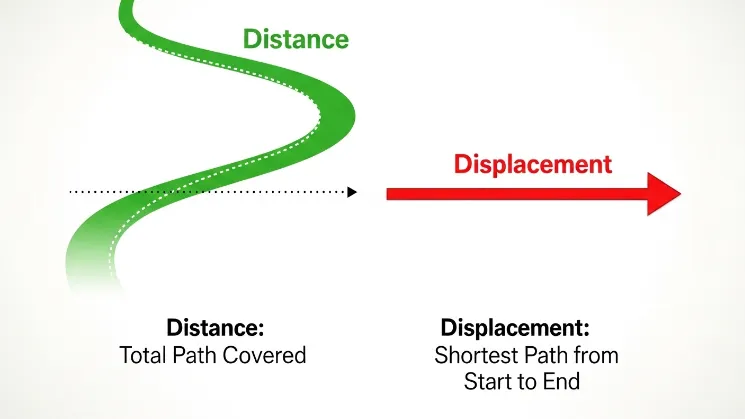
The difference between displacement and distance is that distance measures total path length, while displacement measures shortest straight-line change in position.
When a student walks from home to school, takes a longer route, and returns by another road, two different measurements come into play—distance and displacement. At first, they seem similar because both describe motion, but in physics, they are fundamentally different.
The difference between displacement and distance becomes clear when you analyze direction and path. Distance only cares about how much ground is covered, regardless of direction. Displacement, on the other hand, focuses on how far the object is from its starting point in a straight line. This is why two people traveling the same route can have the same distance but different displacement depending on their start and end positions. Understanding the difference between displacement and distance is essential in physics, navigation, engineering, and real-life motion analysis.
KEY DIFFERENCE OVERVIEW
The main difference between displacement and distance is:
- Distance is scalar (only magnitude, no direction)
- Displacement is vector (magnitude + direction)
Distance measures total travel, while displacement measures net change in position.
IMPORTANCE OF UNDERSTANDING THE DIFFERENCE
Knowing the difference between displacement and distance is important because:
- It helps solve physics motion problems accurately
- It explains real-world navigation and GPS systems
- It improves understanding of speed vs velocity
- It avoids confusion in scientific calculations
For example, a runner completing a circular track may travel 400 meters (distance), but have zero displacement if they end at the starting point.
PRONUNCIATION SECTION
Distance
- US: /ˈdɪs.təns/
- UK: /ˈdɪs.təns/
- Phonetic: DIS-tuhns
Displacement
- US: /dɪsˈpleɪs.mənt/
- UK: /dɪsˈpleɪs.mənt/
- Phonetic: dis-PLAYS-ment
Key Differences Between Displacement and Distance
1. Meaning Difference
Distance is the total length of the path traveled. Displacement is the shortest straight-line distance between start and end points.
Example: Walking around a park vs straight line from start to finish.
2. Nature Difference
Distance is scalar, while displacement is vector.
Example: Distance = 10 km, displacement = 5 km north.
3. Direction Difference
Distance has no direction, displacement always includes direction.
Example: 100 meters (distance) vs 100 meters east (displacement).
4. Path Dependency Difference
Distance depends on actual path taken, displacement depends only on start and end points.
Example: Curved road increases distance but not displacement.
5. Value Difference
Distance is always positive or zero, displacement can be positive, negative, or zero.
Example: Round trip gives distance > 0 but displacement = 0.
6. Formula Difference
Distance = total path length
Displacement = final position − initial position
Example: Physics motion calculations use both differently.
7. Representation Difference
Distance is represented as a number only; displacement is shown with arrow notation.
Example: 20 km vs 20 km → east.
8. Real-Life Context Difference
Distance is used in travel, fitness, and navigation. Displacement is used in physics and engineering.
Example: Step counter vs motion analysis.
9. Measurement Difference
Distance is measured using odometers or tracking tools. Displacement is calculated using coordinates.
Example: Car mileage vs GPS position change.
10. Common Mistake Difference
People often assume both are the same because they describe motion.
Example: Thinking 5 km walk always means 5 km displacement (not true if route is curved).
INDIVIDUAL ANALYSIS
Nature of Distance
Distance is the total length covered during motion without considering direction. It increases regardless of how the object moves. It is always a non-negative scalar quantity used in everyday life and basic physics.
Nature of Displacement
Displacement is the shortest straight-line change in position from the initial point to the final point. It considers direction and can be zero even if distance is large, making it a vector quantity used in advanced motion analysis.
CONFUSION REASON
The difference between displacement and distance is confusing because:
- Both measure motion
- Both use similar units (meters, kilometers)
- In simple movement, they may appear similar
- People ignore direction in daily life
However, physics clearly separates them based on path and direction.
COMPARISON TABLE
| Feature | Distance | Displacement |
| Definition | Total path length | Shortest straight-line change |
| Type | Scalar | Vector |
| Direction | No | Yes |
| Path dependence | Yes | No |
| Value | Always positive | Can be positive, negative, or zero |
| Example | 10 km walk | 6 km east |
| Similarity | Both measure motion | Both measure motion |
| Key difference | Total travel | Net position change |
WHICH IS MORE USEFUL?
Distance is more useful when:
- Measuring travel length
- Fitness tracking (running, walking)
- Road mapping
Displacement is more useful when:
- Solving physics problems
- Understanding motion direction
- GPS and coordinate systems
Both are important depending on context.
LANGUAGE & LITERARY USE
Metaphors
- Distance = “journey of effort”
- Displacement = “true change in position”
Connotative Meaning
- Distance → effort, travel, path
- Displacement → direction, change, precision
IDIOMS / PROVERBS
No direct idioms, but related idea:
- “It’s not the journey, it’s the destination” → relates to displacement concept
LITERATURE USE
- Used in physics textbooks (motion and kinematics chapters)
- Essential in engineering mechanics studies
- Featured in competitive exam science sections
MOVIE / CULTURE REFERENCES
- The Martian indirectly uses displacement concepts in space navigation calculations
- Space and physics documentaries often explain distance vs displacement in astronaut travel scenarios
FAQ SECTION
1. What is the main difference between displacement and distance?
Distance is total path covered, while displacement is shortest straight-line change in position.
2. Can distance and displacement be equal?
Yes, only when motion is in a straight line.
3. Can displacement be zero?
Yes, if the starting and ending points are the same.
4. Why is displacement a vector?
Because it includes both magnitude and direction.
5. Is distance always positive?
Yes, distance is always positive or zero.
6. Which is larger, distance or displacement?
Distance is usually greater than or equal to displacement.
7. Where is displacement used?
It is used in physics, engineering, and navigation systems.
8. Why are distance and displacement different?
Because distance ignores direction while displacement includes it.
REAL-WORLD IMPORTANCE
The difference between displacement and distance is important in sports tracking, navigation systems, engineering design, and physics calculations. Fitness apps track distance, while GPS systems calculate displacement for accurate positioning. Understanding both helps in interpreting motion correctly in real-world situations.
FINAL SUMMARY
The difference between displacement and distance is that distance measures the total path traveled without considering direction, while displacement measures the shortest straight-line change from start to end with direction included. Both describe motion but serve different purposes in physics and real-life applications.
CONCLUSION
Understanding the difference between displacement and distance is essential in physics and everyday life. Distance tells us how much ground an object has covered, regardless of direction, while displacement tells us how far the object is from its starting point in a straight line with direction included.
Although they may seem similar, they behave very differently in real situations. A person walking in a circle may cover a large distance but have zero displacement. This distinction is important in science, engineering, navigation, and motion analysis. Once this difference is clear, solving motion-related problems becomes much easier and more accurate. Both concepts work together to fully describe how objects move in space.

I’m Ethan Caldwell, a language enthusiast who enjoys simplifying confusing English word pairs for everyday readers. At Hubdifference.com, I write clear and practical comparisons that help users choose the right word with confidence. My goal is to remove confusion and make English learning simple, useful, and accessible. I believe the right words create better communication.