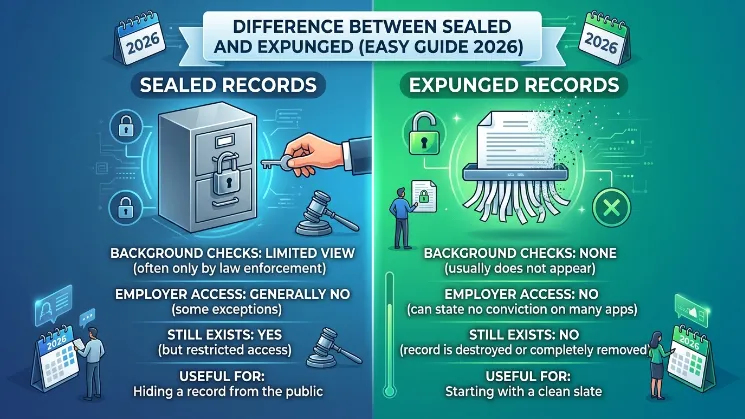
A sealed record is hidden from public view but still exists, while an expunged record is legally erased as if it never happened.
When people deal with legal issues, job applications, or background checks, they often come across the terms sealed and expunged records. This creates confusion because both seem to hide criminal records, but they are not the same.
Many users search for the difference between sealed and expunged to understand what employers can see, what courts keep, and what disappears completely. The confusion is common because both terms involve “removing” records from public access.
In reality, one option only hides your record, while the other can completely erase it under certain laws. Understanding this difference is important for jobs, immigration, education, and legal rights.
Quick Difference
A sealed record is still stored by the court but hidden from the public, while an expunged record is destroyed or erased and treated as if it never existed.
👉 Example:
- Sealed: Employer cannot see your record
- Expunged: Record does not legally exist in most cases
Why This Difference Matters
- Jobs & Careers: Employers run background checks
- Education: Schools may check criminal history
- Immigration: Records can affect visa applications
- Legal rights: Determines what stays in your history
- Privacy: Impacts how much information is hidden or erased
A small legal difference can have a big impact on your future opportunities.
Detailed Comparison Between Both
1. Definition
A sealed record is hidden from public access but still exists in court systems.
An expunged record is legally removed or erased.
👉 Example: Sealed records may still be visible to courts.
2. Visibility
Sealed records are invisible to employers and public databases.
Expunged records are generally treated as if they never existed.
👉 Example: Background checks won’t show either in most cases.
3. Legal Status
Sealed records still legally exist but are restricted.
Expunged records are destroyed or removed under law.
👉 Example: Expungement clears legal history in many jurisdictions.
4. Accessibility
Sealed records can be accessed by courts or law enforcement.
Expunged records are usually inaccessible to everyone.
👉 Example: Police may still view sealed records.
5. Purpose
Sealing is used to protect privacy while keeping records.
Expungement is used to give a fresh legal start.
👉 Example: Minor offenses may be sealed instead of erased.
6. Background Checks
Sealed records do not appear in most job checks.
Expunged records do not appear at all in standard checks.
👉 Example: Employers see nothing in expunged cases.
7. Permanence
Sealed records can sometimes be reopened by court order.
Expunged records are permanently removed (in most cases).
👉 Example: Expunged records are rarely restored.
8. Eligibility
Not all cases qualify for expungement.
Sealing is often more widely available.
👉 Example: Juvenile records are often sealed.
9. Impact on Future Rights
Sealed records may still affect certain legal situations.
Expunged records usually have no legal impact.
👉 Example: Expungement may restore some rights.
10. Real-World Application
Sealing helps maintain privacy without full deletion.
Expungement helps people rebuild life with a clean slate.
👉 Example: Job seekers benefit more from expungement.
Nature / Usage Context
- Sealed records: Used when courts want to protect privacy but retain information.
- Expunged records: Used when the law allows full removal of past offenses.
Both are legal tools, but they serve different purposes in the justice system.
Why People Get Confused
- Both involve “hiding” criminal records
- Legal language sounds similar
- Media often uses terms incorrectly
- Different laws in different countries/states
- Assumption that both mean “erased”
Comparison Table
| Feature | Sealed Record | Expunged Record |
|---|---|---|
| Meaning | Hidden but still exists | Fully erased or deleted |
| Visibility | Not public | Not visible anywhere |
| Legal status | Still exists in court files | Treated as non-existent |
| Access | Courts/law enforcement may access | Generally inaccessible |
| Purpose | Privacy protection | Fresh legal start |
| Example | Juvenile sealed case | Expunged misdemeanor |
Which One Should You Choose?
You usually do not “choose” between sealed and expunged—courts decide based on eligibility and law.
However, in general:
- Sealing is used when records must stay but remain private
- Expungement is preferred when full legal clearance is allowed
If you qualify for expungement, it is often the stronger option because it removes the record completely.
Easy Understanding (Metaphor Section)
Think of it like this:
- Sealed record: A locked box stored in a basement—no one can see it, but it still exists.
- Expunged record: The box is destroyed—nothing remains at all.
Connotation / Tone
- Sealed: Controlled, restricted, partially hidden
👉 Example: “Your record is sealed for privacy.” - Expunged: Clean, complete removal
👉 Example: “Your record has been expunged.”
Idioms / Expressions
There are no common idioms using these legal terms. They are strictly legal vocabulary.
FAQs
1. What is the difference between sealed and expunged records?
Sealed records are hidden but still exist; expunged records are erased.
2. Can employers see sealed or expunged records?
Usually no, but sealed records may be accessible in rare legal cases.
3. Which is better, sealed or expunged?
Expunged is generally better because it removes the record completely.
4. Do expunged records really disappear?
Yes, in most legal systems they are treated as if they never existed.
5. Can a sealed record be unsealed?
Yes, courts can sometimes unseal records under specific conditions.
Practical Use in Daily Life
Understanding this difference helps in:
- Job applications: Knowing what employers can see
- Legal decisions: Choosing petitions correctly
- Immigration: Avoiding legal complications
- Personal planning: Understanding your rights
Final Thoughts
Sealed and expunged records both protect privacy, but they are not the same. One hides information, while the other removes it completely from legal existence.
Conclusion
The difference between sealed and expunged records is important in law and everyday life. A sealed record is still stored in the system but kept private from public access. An expunged record, however, is legally erased and treated as if it never happened in most situations.
Knowing this difference helps you understand background checks, legal rights, and future opportunities more clearly. If you ever deal with court records, always check which option applies to your case so you can make informed decisions about your future.

I’m Sophia Turner, a content writer who loves making English simple and easy to understand. At Hubdifference.com, I write clear comparisons of commonly confused words, spelling variations, and everyday language differences. I focus on practical examples so readers can quickly learn and use the right words. My aim is to help learners write with clarity, confidence, and accuracy.