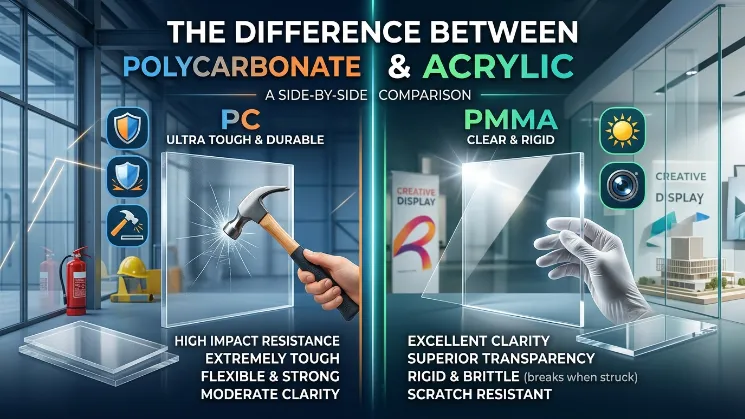
Polycarbonate is far stronger and impact-resistant than acrylic, while acrylic is clearer and more scratch-resistant but more brittle.
If you’ve ever walked into a hardware store trying to choose between plastic sheets for a project like a greenhouse cover, safety shield, or display panel you’ve probably heard two common names: polycarbonate and acrylic. At first glance, they look almost identical. Both are transparent, lightweight, and often used instead of glass. This is where confusion begins.
Many people searching for the difference between polycarbonate and acrylic assume they are interchangeable, but in reality, their properties behave very differently under pressure, heat, and impact. One might shatter under stress while the other bends without breaking.
Understanding the difference between polycarbonate and acrylic is essential whether you are working on construction, DIY crafts, or industrial applications. This confusion is very common because both materials serve similar purposes but perform differently in real-life conditions.
KEY DIFFERENCE OVERVIEW
Polycarbonate is known for extreme impact resistance and flexibility, while acrylic is known for optical clarity and scratch resistance.
Although both are transparent thermoplastics, polycarbonate is more durable and flexible, whereas acrylic is more rigid and glass-like in appearance.
IMPORTANCE OF DIFFERENCE
Understanding the difference between polycarbonate and acrylic is important because choosing the wrong material can lead to failure in safety, durability, and cost efficiency.
- In construction, wrong selection may cause breakage or safety hazards
- In manufacturing, it affects product lifespan and performance
- In DIY projects, it impacts appearance and strength
- In safety applications, polycarbonate is often required for protection
For example, using acrylic instead of polycarbonate in a protective shield can lead to cracking under impact. On the other hand, using polycarbonate where high clarity is needed might reduce visual sharpness.
PRONUNCIATION SECTION
Polycarbonate
- US: /ˌpɑː.liˈkɑːr.bə.neɪt/
- UK: /ˌpɒl.iˈkɑː.bə.neɪt/
- Phonetic: pol-ee-KAR-buh-nayt
Acrylic
- US: /əˈkrɪl.ɪk/
- UK: /əˈkrɪl.ɪk/
- Phonetic: uh-KRIL-ik
KEY DIFFERENCES BETWEEN POLYCARBONATE AND ACRYLIC
1. Meaning Difference
Polycarbonate is a tough, impact-resistant plastic used in safety equipment. Acrylic is a transparent plastic known for glass-like clarity.
Example: Bulletproof shields use polycarbonate; display cases often use acrylic.
2. Usage Difference
Polycarbonate is used where strength is needed; acrylic is used where clarity matters.
Example: Machine guards (polycarbonate) vs photo frames (acrylic).
3. Structure/Form Difference
Polycarbonate has flexible molecular structure; acrylic is rigid and brittle.
Example: Polycarbonate bends under force, acrylic may crack.
4. Function Difference
Polycarbonate absorbs impact energy; acrylic resists scratches.
Example: Safety goggles (polycarbonate) vs signage boards (acrylic).
5. Context Difference
Polycarbonate is used in industrial and safety environments; acrylic is used in decorative and visual applications.
Example: Airport shields vs retail display windows.
6. Emotional/Usage Tone Difference
Polycarbonate feels “industrial and protective,” acrylic feels “clean and aesthetic.”
Example: Security barriers vs luxury display panels.
7. Cultural Difference
Polycarbonate is associated with safety engineering; acrylic is associated with design and creativity.
Example: Construction industry vs art installations.
8. Technical Difference
Polycarbonate withstands higher impact and heat; acrylic offers better light transmission.
Example: Polycarbonate roofing in storms vs acrylic aquariums.
9. Common Usage Mistake
People often replace acrylic with polycarbonate thinking both are equal in appearance.
Example: Using acrylic outdoors may lead to cracking over time.
10. Substitution Difference
Polycarbonate can replace acrylic in most cases; acrylic cannot replace polycarbonate in high-impact uses.
Example: Polycarbonate can replace glass windows; acrylic cannot replace safety shields.
INDIVIDUAL ANALYSIS
Nature of Polycarbonate
Polycarbonate is a strong, flexible, and highly impact-resistant thermoplastic. It is designed for durability under stress and extreme conditions. It does not easily shatter, making it ideal for protective applications.
Nature of Acrylic
Acrylic is a rigid, transparent plastic that resembles glass. It is lightweight and offers excellent optical clarity but is more prone to cracking under heavy impact. It is widely used for aesthetic and display purposes.
CONFUSION REASON
People confuse polycarbonate and acrylic because both are:
- transparent
- lightweight
- glass alternatives
- used in similar industries
However, their internal structure and performance are very different. The confusion also comes from visual similarity, as both look almost identical when installed in sheets.
COMPARISON TABLE
| Feature | Polycarbonate | Acrylic |
|---|---|---|
| Definition | Impact-resistant plastic | Clear, glass-like plastic |
| Usage | Safety, industrial use | Displays, decoration |
| Context | Heavy-duty environments | Visual and design use |
| Examples | Helmets, shields | Frames, signage |
| Similarity | Transparent plastic | Transparent plastic |
| Key Difference | Strong & flexible | Clear but brittle |
WHICH IS BETTER & WHEN?
- Polycarbonate is better when strength matters
- Safety shields
- Machine guards
- Outdoor roofing
- Security windows
- Acrylic is better when appearance matters
- Display cases
- Signboards
- Aquariums
- Decorative panels
Neither is universally “better”—it depends entirely on usage.
LANGUAGE & LITERARY USE
Metaphors & Similes
- Polycarbonate is often compared to “invisible armor” due to its strength
- Acrylic is compared to “crystal glass” because of its clarity
Connotative Meaning
- Polycarbonate → protection, strength, reliability
- Acrylic → beauty, clarity, elegance
IDIOMS / PROVERBS
No direct idioms exist for these materials, but in technical language:
- “Tough as polycarbonate” (informal usage in engineering circles)
LITERATURE USE
- Commonly referenced in engineering and material science textbooks
- Used in industrial design manuals (modern publications, 2000s–present)
- No major literary works specifically feature these materials metaphorically in classic literature
MOVIE / CULTURE REFERENCES
- Polycarbonate is widely used in film production for stunt safety shields
- Acrylic is used in modern museum displays and exhibition design
- Example: Transparent acrylic barriers in public spaces became widely visible during global health safety installations (2020s)
FAQ SECTION
1. What is the main difference between polycarbonate and acrylic?
Polycarbonate is stronger and impact-resistant, while acrylic is clearer and more scratch-resistant but brittle.
2. Which is more durable?
Polycarbonate is significantly more durable than acrylic.
3. Which is cheaper?
Acrylic is generally cheaper than polycarbonate.
4. Can acrylic replace polycarbonate?
No, acrylic cannot replace polycarbonate in high-impact applications.
5. Which is clearer?
Acrylic has better optical clarity than polycarbonate.
6. Which is better for outdoor use?
Polycarbonate is better for outdoor use due to weather resistance.
7. Does acrylic break easily?
Yes, acrylic is more prone to cracking under stress.
8. Is polycarbonate scratch-resistant?
No, acrylic is more scratch-resistant than polycarbonate.
REAL-WORLD IMPORTANCE
In daily life, both materials are everywhere from smartphone screens to protective barriers and decorative displays. Polycarbonate ensures safety in helmets, shields, and industrial tools, while acrylic enhances beauty in home décor, signage, and aquariums. Choosing correctly ensures safety, durability, and cost efficiency in real-world applications.
FINAL SUMMARY
Polycarbonate and acrylic may look similar, but their performance is very different. Polycarbonate is strong, flexible, and impact-resistant, making it ideal for safety applications. Acrylic is clear, rigid, and visually appealing, making it perfect for decorative and display purposes. Understanding this difference helps avoid costly mistakes and ensures proper material selection based on need.
CONCLUSION
The difference between polycarbonate and acrylic is mainly based on strength, clarity, and usage purpose. While both materials are transparent and lightweight, polycarbonate is designed for durability and impact resistance, making it suitable for safety and industrial applications. Acrylic, on the other hand, offers superior clarity and a glass-like appearance, making it ideal for visual and decorative uses.
Confusion arises because both materials look similar and are often used in overlapping industries. However, their performance under stress is very different. Choosing between them depends entirely on the application whether you need strength or aesthetics. Understanding the difference between polycarbonate and acrylic ensures better decision-making in construction, design, and everyday use.

I’m Nathan Brooks, an independent writer passionate about vocabulary clarity and usage differences. On Hubdifference.com, I create easy-to-understand comparisons covering American and British English variations. I focus on simple language, practical tips, and reader-friendly explanations. Helping people write with clarity and confidence is what drives my work.