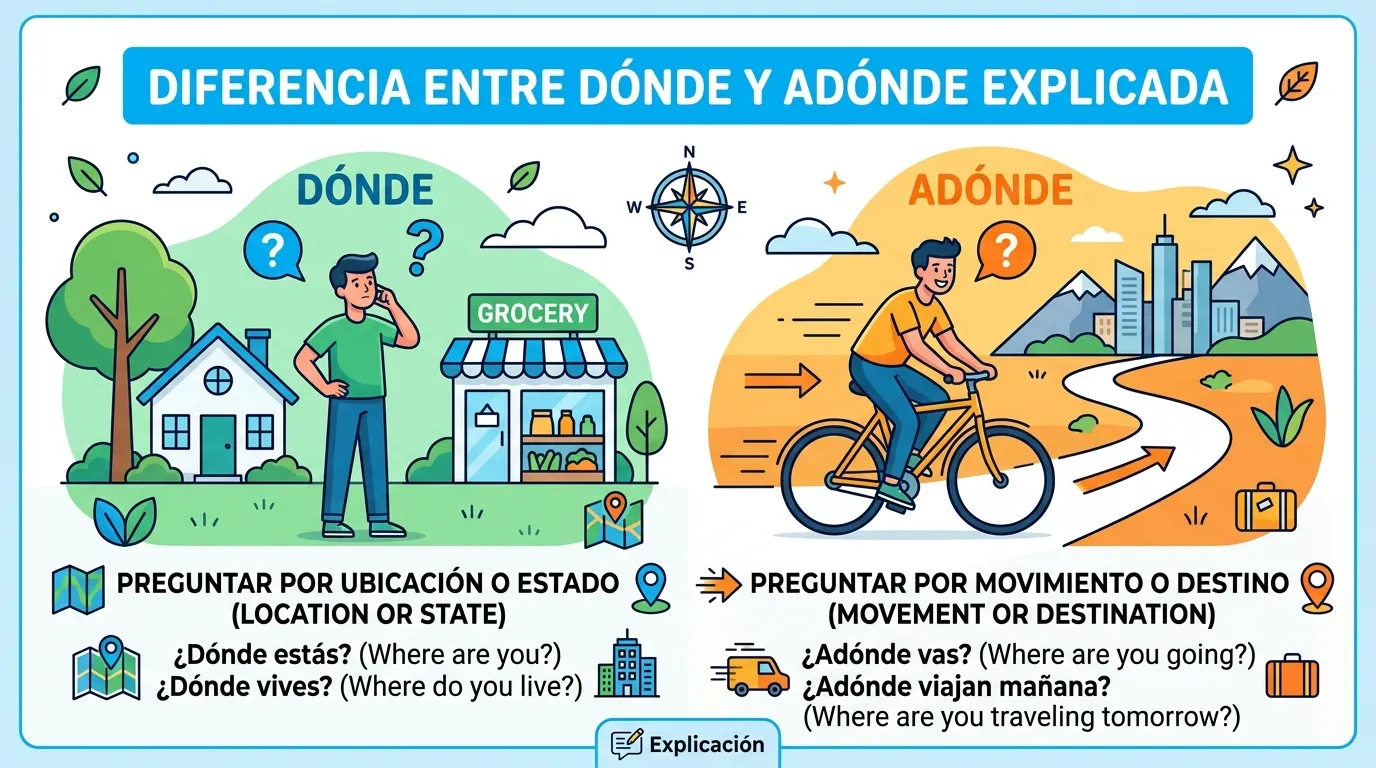
Donde shows a location, while adonde shows movement toward a destination.
Sofia was learning Spanish before a trip to Mexico City. One day, she asked a friend, “¿Dónde vas?” when she meant “Where are you going?” Her friend smiled and explained that adónde was the better choice because the question involved movement. Sofia realized that two similar words could change the meaning of a sentence.
Many Spanish learners face the same confusion. Donde relates to a place or location. Adonde relates to movement toward a place. Think of them like a map and a road. One shows where something is, while the other shows where someone is headed. Understanding the difference between donde and adonde can make your Spanish sound much more natural. The distinction is simple once you see it in action.
The Key Difference
Donde refers to a location or place. Adonde refers to movement toward a destination.
If no movement is involved, use donde. If someone or something is going somewhere, use adonde.
Why Does This Difference Matter?
Knowing the difference between donde and adonde helps you build correct Spanish sentences. Native speakers often notice the difference because each word answers a different kind of question.
If you mix them up, people will usually still understand you, but the sentence may sound unnatural. Learning when to use each word makes conversations, writing, and language exams much easier to handle.
A small change in wording can make a big difference in meaning, so let’s look at the details that separate these two common Spanish terms.
10 Differences Between Donde and Adonde
1. Basic Definition
Donde means “where” and points to a location. Adonde means “to where” or “where to” and points to a destination.
Example 1: ¿Dónde está Madrid? (Where is Madrid?)
Example 2: ¿Adónde vas mañana? (Where are you going tomorrow?)
2. Origin or Source
Both words come from Spanish location expressions. Donde developed as a word for place. Adonde combines the idea of place with direction or movement.
Example 1: La casa donde vivo. (The house where I live.)
Example 2: El lugar adonde viajamos. (The place where we traveled to.)
3. How It Is Made or Done
Donde is used when talking about a fixed position. Adonde is used when a verb involves movement toward a location.
Example 1: El parque donde juego. (The park where I play.)
Example 2: La ciudad adonde llegamos. (The city we arrived at.)
4. Variety or Range
Donde appears in questions, statements, and descriptions about places. Adonde appears in questions and statements involving travel, motion, or direction.
Example 1: ¿Dónde estudias? (Where do you study?)
Example 2: ¿Adónde corren los niños? (Where are the children running to?)
5. Flavor, Feel, or Output Quality
Donde feels stable because it describes a location. Adonde feels active because it describes movement toward a place.
Example 1: El restaurante donde cenamos. (The restaurant where we ate dinner.)
Example 2: El pueblo adonde nos mudamos. (The town we moved to.)
6. Primary Use Cases
Donde is commonly used when identifying where something exists. Adonde is commonly used when discussing travel, arrival, or direction.
Example 1: ¿Dónde está la biblioteca? (Where is the library?)
Example 2: ¿Adónde viajas este verano? (Where are you traveling this summer?)
7. Effect or Impact
Donde helps listeners identify a location. Adonde helps listeners understand a destination or direction.
Example 1: La oficina donde trabajo. (The office where I work.)
Example 2: El país adonde emigraron. (The country they emigrated to.)
8. Specificity and Precision
Donde is broader because it can describe almost any place. Adonde is more specific because it requires movement toward that place.
Example 1: El lugar donde nació. (The place where he was born.)
Example 2: El lugar adonde fue. (The place where he went.)
9. Can They Replace Each Other?
Sometimes people use donde in casual speech where adonde would be more precise. However, they are not always interchangeable because movement changes the meaning.
Example 1: ¿Dónde está tu escuela? is correct for location.
Example 2: ¿Adónde vas después? is correct for destination.
10. Long-Term Result
Using donde correctly helps you describe places naturally. Using adonde correctly helps you express movement clearly. Together, they improve Spanish fluency and accuracy.
Example 1: Students using donde properly write clearer descriptions.
Example 2: Students using adonde properly give clearer directions.
Nature and Character
Donde has a calm and descriptive character. It focuses on where people, objects, or places are located. It often appears in conversations about position, geography, and everyday situations.
Adonde has a more dynamic character. It focuses on direction and travel. It often appears in conversations about journeys, plans, movement, and destinations.
Why Do People Mix Them Up?
Many learners notice that both words relate to places. In everyday speech, some native speakers use donde even when movement exists. English also uses “where” in both situations, which makes the distinction less obvious for English speakers.
A common mistake happens when a student asks “¿Dónde vas?” in a grammar exercise where “¿Adónde vas?” is expected.
Comparison Table
| Feature | Donde | Adonde |
|---|---|---|
| Definition | Refers to location | Refers to destination |
| Origin | Place-related expression | Direction-related expression |
| Process / How Made | Describes position | Describes movement |
| Variety / Duration | Used in many location contexts | Used in movement contexts |
| Output / Quality | Gives place information | Gives direction information |
| Main Use | Identifying locations | Identifying destinations |
| Impact | Clarifies where something is | Clarifies where something goes |
| Grammar Rule | Works with fixed locations | Works with motion verbs |
| Interchangeable? | Sometimes informally | More precise for movement |
| Long-Term Result | Better location descriptions | Better direction descriptions |
| Key Similarity | Both relate to places | Both relate to places |
| Key Difference | Static location | Movement toward location |
Which Is Better and When?
Donde is the better choice when discussing a place that already exists or remains fixed. For example, use it when asking where a museum or school is located.
Adonde is the better choice when discussing movement toward a destination. For example, use it when asking where someone is traveling for vacation. Neither word is better in every situation.
Quick Decision Checklist
Choose Donde if:
☑ Talking about a location
☑ No movement is involved
☑ Describing where something is
☑ Asking about a place
Choose Adonde if:
☑ Movement is happening
☑ A destination is involved
☑ Asking where someone is going
☑ Using motion verbs
Metaphors and Similes
Donde is a pin on a map showing a fixed spot.
Adonde is an arrow pointing toward a destination.
Together, they work like a map and a travel route, helping you understand both place and direction.
[used in: intro]
Connotative Meaning
Donde often feels descriptive and steady. For example, a teacher may use it when explaining where a city is located. It can sound vague if the exact place is unclear. In a neutral sense, it simply identifies location.
Adonde often feels active and purposeful. For example, travelers use it when discussing destinations. It may sound more formal in some situations. In a neutral sense, it identifies direction toward a place.
Idioms and Expressions
“Know where you stand” matches the idea behind donde. Example: She knows where she stands in the project.
“Head in the right direction” matches adonde. Example: The team is heading in the right direction.
[coined expression] “Follow the arrow.” Example: When choosing adonde, follow the arrow toward movement.
Frequently Asked Questions
Q1: What is the main difference between donde and adonde?
The main difference is movement. Donde describes where something is located, while adonde describes where someone or something is going. The verb in the sentence usually helps you choose correctly.
Q2: Can donde be used instead of adonde?
In casual conversation, some speakers do this. However, adonde is grammatically more precise when movement toward a destination is involved, which is why language learners should know the distinction.
Q3: Which one is better — donde or adonde?
Neither is better overall. Donde works best for locations, while adonde works best for destinations. The correct choice depends on whether movement is present in the sentence.
Q4: Can donde and adonde be used in the same sentence?
Yes. One word can identify a place, while the other can identify movement toward a place. This happens when a sentence discusses both location and direction together.
Q5: Why do people mix up donde and adonde?
People confuse them because both refer to places. English often uses “where” for both meanings, and everyday Spanish speech sometimes blurs the distinction, making it harder for learners to notice.
Real-World Importance
Understanding the difference between donde and adonde helps when speaking Spanish, writing essays, following directions, and traveling in Spanish-speaking countries. It is especially useful in classrooms, language exams, and conversations about movement. Choosing the correct word makes your Spanish sound more natural and accurate.
Conclusion
Remember Sofia from the beginning? She now knows why asking about a destination often requires adonde instead of donde. That small lesson made her Spanish sound much more natural.
The difference between donde and adonde comes down to location versus movement. Donde points to where something is. Adonde points to where someone or something is going. One describes a place, while the other describes a direction. Learning this distinction helps you ask clearer questions, understand native speakers more easily, and communicate with greater confidence.
Keep practicing, and these two Spanish words will soon feel completely natural.

I’m Sophia Turner, a content writer who loves making English simple and easy to understand. At Hubdifference.com, I write clear comparisons of commonly confused words, spelling variations, and everyday language differences. I focus on practical examples so readers can quickly learn and use the right words. My aim is to help learners write with clarity, confidence, and accuracy.