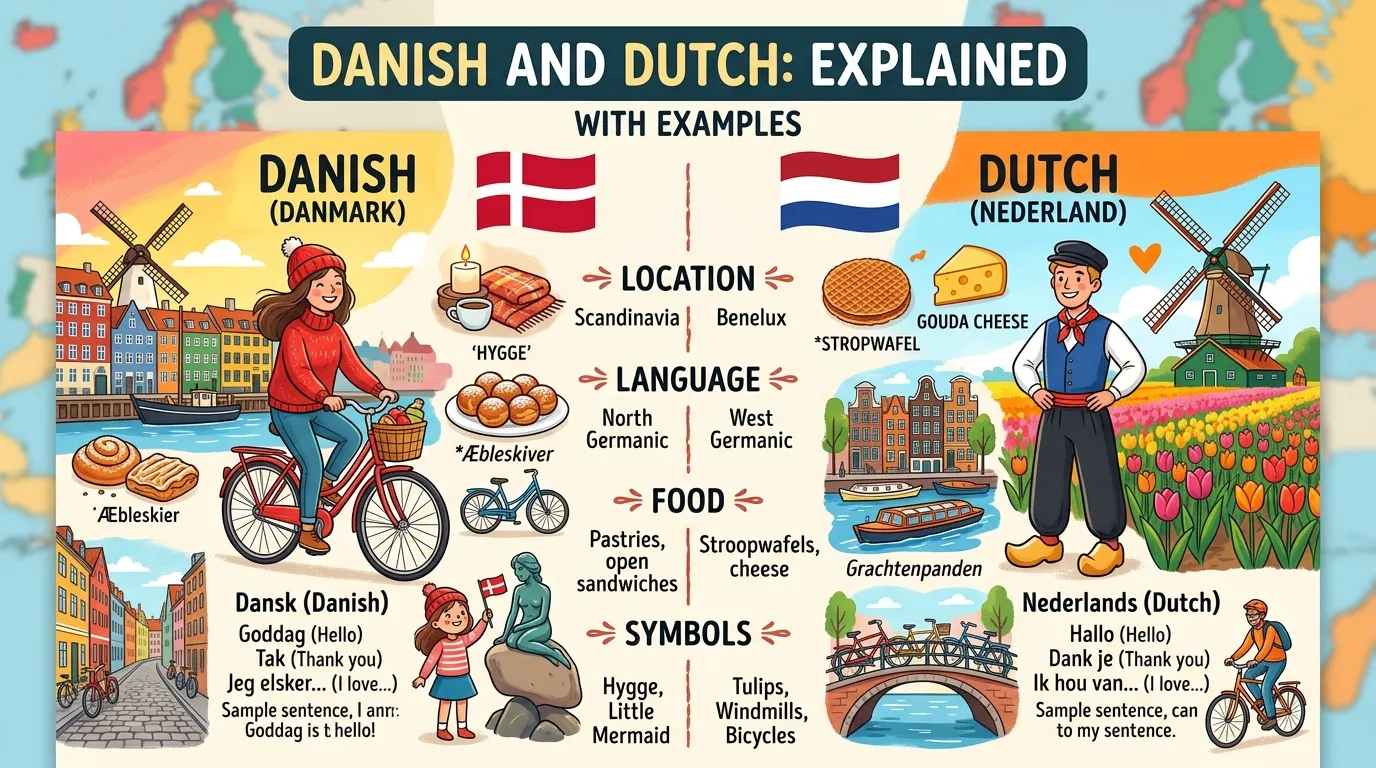
Danish relates to Denmark and its people or language, while Dutch relates to the Netherlands and its people or language.
Jake was planning a trip across Europe. While booking hotels, he told a friend that people in Denmark spoke Dutch. His friend quickly corrected him. Jake realized he had mixed up two different countries, languages, and cultures.
Many people make the same mistake because the names sound somewhat similar. Danish refers to Denmark, its people, and its language. Dutch refers to the Netherlands, its people, and its language. Think of them like two neighboring houses on the same street. They may be close to each other, but they belong to different families. Understanding the difference between Danish and Dutch can help you avoid confusion when talking about Europe, languages, or travel.
The Key Difference
Danish belongs to Denmark. Dutch belongs to the Netherlands.
The people, language, culture, and national identity connected to each term are different, even though both countries are located in Northern Europe.
Why Does This Difference Matter?
Knowing the difference between Danish and Dutch helps you communicate more accurately. If you confuse the two, you might refer to the wrong language, nationality, or country.
This matters when traveling, studying geography, learning languages, or discussing European culture. Calling a Danish person Dutch or a Dutch person Danish may create confusion and sometimes even embarrassment. Using the correct term shows respect and understanding.
These two terms are often mixed up, so let’s compare them point by point to make the distinction clear and easy to remember.
10 Differences Between Danish and Dutch
1. Basic Definition
Danish refers to something connected with Denmark. Dutch refers to something connected with the Netherlands. Both terms can describe people, language, and culture.
Example 1: A person from Denmark is Danish.
Example 2: A person from the Netherlands is Dutch.
2. Origin or Source
Danish comes from Denmark, a Scandinavian country in Northern Europe. Dutch comes from the Netherlands, a country located west of Germany.
Example 1: Copenhagen is associated with Danish culture.
Example 2: Amsterdam is associated with Dutch culture.
3. How It Is Made or Done
The Danish language developed from the North Germanic language family. The Dutch language developed from the West Germanic language family.
Example 1: Danish shares roots with Norwegian and Swedish.
Example 2: Dutch shares roots with German and English.
4. Variety or Range
Danish culture includes traditions, foods, and customs unique to Denmark. Dutch culture includes traditions, foods, and customs unique to the Netherlands.
Example 1: Danish culture celebrates hygge, a feeling of comfort and coziness.
Example 2: Dutch culture is known for bicycles and canal cities.
5. Flavor, Feel, or Output Quality
Danish often sounds softer and more flowing to language learners. Dutch often sounds stronger and more guttural because of certain throat sounds.
Example 1: Danish pronunciation can seem smooth.
Example 2: Dutch pronunciation may sound closer to German.
6. Primary Use Cases
Danish is used mainly in Denmark and by Danish-speaking communities. Dutch is used mainly in the Netherlands and parts of Belgium.
Example 1: Danish is spoken in Copenhagen.
Example 2: Dutch is spoken in Amsterdam.
7. Effect or Impact
Learning Danish helps people communicate in Denmark and understand Scandinavian culture. Learning Dutch helps people communicate in the Netherlands and understand Dutch-speaking communities.
Example 1: A student moving to Denmark may learn Danish.
Example 2: A worker relocating to the Netherlands may learn Dutch.
8. Specificity and Precision
Danish specifically refers to Denmark-related identity. Dutch specifically refers to Netherlands-related identity. Using the wrong term changes the meaning completely.
Example 1: Danish pastries come from Danish traditions.
Example 2: Dutch cheese comes from Dutch traditions.
9. Can They Replace Each Other?
No. These terms cannot replace each other because they refer to different countries, languages, and national identities.
Example 1: A Danish citizen is not Dutch.
Example 2: A Dutch speaker is not necessarily Danish.
10. Long-Term Result
Understanding the distinction helps people discuss geography, culture, and language correctly. It also improves communication when traveling or studying Europe.
Example 1: Students perform better in geography discussions.
Example 2: Travelers communicate more accurately abroad.
Nature and Character
Danish has a Scandinavian character. It is often associated with simplicity, balance, design, and cozy living. Many people connect it with Denmark’s traditions and way of life.
Dutch has a practical and international character. It is often associated with trade, innovation, canals, and strong connections to global commerce. Many people connect it with the Netherlands’ rich cultural history.
Why Do People Mix Them Up?
Many English speakers know both countries are in Europe but are less familiar with their differences. The words appear in similar contexts involving nationality and language. Some people also learn about the countries at the same time in school.
A common mistake happens when a traveler says Dutch while talking about Denmark or Danish while talking about the Netherlands.
Comparison Table
| Feature | Danish | Dutch |
|---|---|---|
| Definition | Related to Denmark | Related to the Netherlands |
| Origin | Denmark | Netherlands |
| Process / How Made | North Germanic language roots | West Germanic language roots |
| Variety / Duration | Danish cultural traditions | Dutch cultural traditions |
| Output / Quality | Softer pronunciation style | More guttural pronunciation style |
| Main Use | Communication in Denmark | Communication in the Netherlands |
| Impact | Connects people with Danish culture | Connects people with Dutch culture |
| Grammar Rule | Language of Denmark | Language of the Netherlands |
| Interchangeable? | No | No |
| Long-Term Result | Better understanding of Denmark | Better understanding of the Netherlands |
| Key Similarity | Both are European identities and languages | Both are European identities and languages |
| Key Difference | Connected to Denmark | Connected to the Netherlands |
Which Is Better and When?
Danish is the better choice when discussing Denmark, its people, or its language. For example, if you are moving to Copenhagen, learning Danish is useful.
Dutch is the better choice when discussing the Netherlands, its people, or its language. For example, if you are planning to work in Amsterdam, learning Dutch makes sense. Neither term is better overall because each belongs to a different country.
Quick Decision Checklist
Choose Danish if:
☑ Talking about Denmark
☑ Referring to Copenhagen
☑ Discussing Danish culture
☑ Mentioning the Danish language
Choose Dutch if:
☑ Talking about the Netherlands
☑ Referring to Amsterdam
☑ Discussing Dutch culture
☑ Mentioning the Dutch language
Metaphors and Similes
Danish is a key that unlocks the door to Denmark.
Dutch is a bridge leading into the Netherlands.
Together, they are like two neighboring flags flying over different countries, each representing its own identity.
[used in: intro]
Connotative Meaning
Danish often carries positive ideas of Scandinavian design, comfort, and tradition. For example, people may associate Danish furniture with elegance. Sometimes it may simply refer to nationality without any added meaning. In a neutral sense, it identifies a connection to Denmark.
Dutch often brings thoughts of canals, bicycles, and international trade. For example, people may associate Dutch cities with innovation. Sometimes it simply refers to nationality. In a neutral sense, it identifies a connection to the Netherlands.
Idioms and Expressions
“Flying the Danish flag” can describe proudly representing Denmark. Example: The athlete was flying the Danish flag during the competition.
“Going Dutch” is a real expression. Example: The friends decided to go Dutch and split the restaurant bill.
[coined expression] “Crossing the canal bridge.” Example: Learning Dutch felt like crossing the canal bridge into a new culture.
Frequently Asked Questions
Q1: What is the main difference between Danish and Dutch?
The main difference is the country they belong to. Danish relates to Denmark, while Dutch relates to the Netherlands. This affects the language, nationality, and culture connected with each term.
Q2: Can Danish be used instead of Dutch?
No. The terms refer to different countries and identities. Using one instead of the other creates a factual mistake and may confuse listeners.
Q3: Which one is better — Danish or Dutch?
Neither is better. Danish is useful if your focus is Denmark. Dutch is useful if your focus is the Netherlands. The right choice depends on your goals and interests.
Q4: Which one should a beginner start with?
A beginner should start with the one most relevant to their needs. Someone planning to live in Denmark should learn Danish, while someone moving to the Netherlands should learn Dutch.
Q5: Why do people mix up Danish and Dutch?
People often mix them up because both terms refer to European nationalities and languages. Many learners encounter them around the same time and may not yet know the differences between the two countries.
Real-World Importance
Understanding the difference between Danish and Dutch helps when traveling, learning languages, reading news, studying geography, and communicating with people from Europe. It matters when discussing nationalities, booking international trips, or learning about European cultures. Using the correct term helps conversations stay accurate and respectful.
Conclusion
Remember Jake from the beginning? He now knows that Denmark and the Netherlands are different countries with different languages and cultures. That simple lesson saved him from making the same mistake again.
The difference between Danish and Dutch is straightforward once you know their origins. Danish belongs to Denmark, while Dutch belongs to the Netherlands. They differ in language roots, cultural traditions, pronunciation, and national identity.
Although both are European and share some regional connections, they represent distinct countries and histories. Knowing the distinction makes travel, learning, and everyday conversations much easier.
Keep exploring languages and cultures, and these differences will soon become second nature.

I’m Ethan Caldwell, a language enthusiast who enjoys simplifying confusing English word pairs for everyday readers. At Hubdifference.com, I write clear and practical comparisons that help users choose the right word with confidence. My goal is to remove confusion and make English learning simple, useful, and accessible. I believe the right words create better communication.