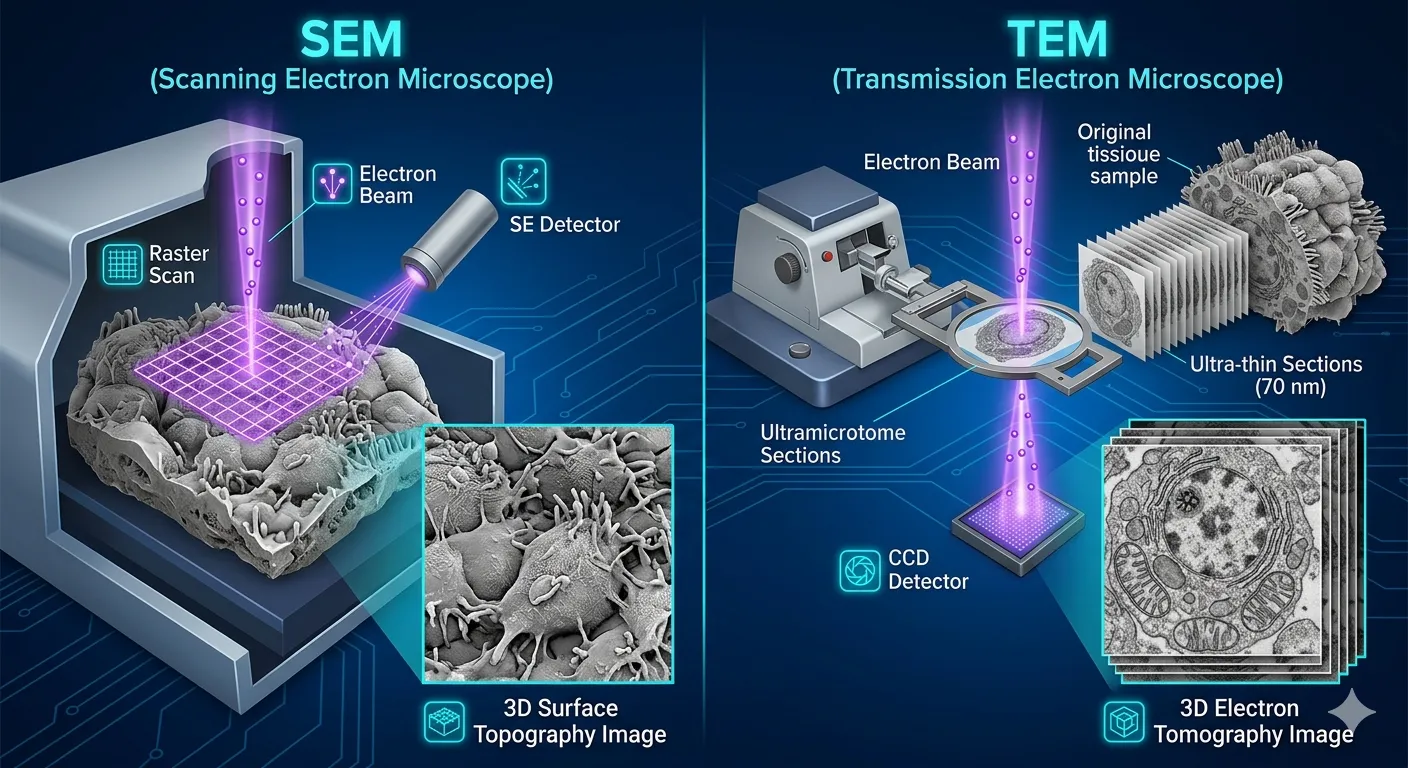
The difference between SEM and TEM is that SEM shows surface details of a sample, while TEM reveals internal structures using electrons that pass through the specimen.
Most people think the difference between SEM and TEM is small. They are not. They work in totally different ways. And mixing them up can lead to wrong results in science labs and research work.
Dr. Ayesha once used SEM images instead of TEM data during a biology report. Her results looked correct on the surface but missed deep cell details. That small mistake changed her entire conclusion.
SEM (Scanning Electron Microscope) shows surface textures. TEM (Transmission Electron Microscope) shows inside structures. The difference between SEM and TEM matters in science, medicine, and material testing.
So what really sets them apart in simple terms?
Key Difference
The main difference between SEM and TEM is simple: SEM scans the surface of a sample to create a 3D-like image, while TEM sends electrons through the sample to show internal details in high resolution. Keep reading — we break down all 10 differences in plain, simple terms below.
Why Is This Difference Important to Know?
Understanding the difference between SEM and TEM is important in science, healthcare, and engineering. It helps researchers choose the right tool for accurate results. SEM is used for surface study, while TEM is used for deep internal analysis. A wrong choice can lead to incorrect data, failed experiments, or poor material testing outcomes. That’s why professionals must clearly understand both tools before use.
Linking Hook
If you also want to understand how imaging tools work in science, check out our guide: Microscopy Basics Explained (internal link: /microscopy-basics). Now let’s break down the 10 clear differences between SEM and TEM.
10 Points of Difference
1. Basic Definition and Meaning
SEM is a microscope that scans a sample’s surface using electrons. TEM sends electrons through the sample to see inside. The difference between SEM and TEM starts with how they interact with the sample structure.
Example: Studying a butterfly wing surface uses SEM. Studying virus structure uses TEM.
2. Origin / Source / Main Components
SEM uses a focused electron beam and detectors for surface signals. TEM uses electron transmission, lenses, and thin samples. Both use electrons but in different paths, showing the core difference between SEM and TEM in structure.
Example: SEM in metallurgy labs. TEM in medical virology labs.
3. Process How It Works
SEM scans the surface line by line, creating 3D-like images. TEM passes electrons through ultra-thin slices to form flat, detailed images. This process difference defines the difference between SEM and TEM clearly.
Example: SEM for metal cracks. TEM for cell organelles.
4. Time Involved / Duration
SEM imaging is usually faster because sample prep is simple. TEM takes more time due to thin slicing and alignment. This makes the difference between SEM and TEM important in urgent research.
Example: SEM used in quick quality checks. TEM used in detailed lab studies.
5. Image Quality and Output
SEM produces detailed surface texture with depth. TEM produces extremely high-resolution internal images. This difference in output is a major part of the difference between SEM and TEM.
Example: SEM shows dust on materials. TEM shows virus inside cells.
6. Primary Use Cases
SEM is used for surface inspection and material testing. TEM is used for studying internal structures like cells and nanoparticles. This practical use is a key difference between SEM and TEM.
Example: SEM in electronics industry. TEM in biomedical research.
7. Effect or Impact
SEM helps understand surface damage or wear. TEM helps discover hidden internal structures. The difference between SEM and TEM affects how scientists interpret results.
Example: SEM checks car paint damage. TEM studies DNA structures.
8. Degree of Specificity or Precision
TEM offers higher resolution and precision than SEM. SEM gives broader surface details. This precision gap is an important difference between SEM and TEM.
Example: TEM used for virus identification. SEM used for surface roughness studies.
9. Can They Replace Each Other?
No, SEM and TEM cannot replace each other. Each serves a unique purpose. This inability to substitute is a strong difference between SEM and TEM.
Example: SEM cannot show internal cell structure. TEM cannot show full 3D surface texture.
10. Long-Term Results / Impact
SEM results are ideal for long-term material analysis of surfaces. TEM results help in scientific discovery at atomic levels. This long-term value shows the final difference between SEM and TEM.
Example: SEM in construction material testing. TEM in advanced medical research.
Nature and Behaviour
SEM behaves like a surface scanner. It feels like zooming over a landscape and seeing hills, cracks, and textures. It gives a wide but shallow view. TEM behaves like a deep explorer. It goes inside the sample and reveals hidden structures. It is more detailed but harder to prepare. Both are powerful, but their behavior depends on how electrons interact with matter.
Why Do People Confuse Them?
People confuse SEM and TEM because both use electron beams and similar lab setups. Their names also sound alike. Another reason is that both produce high-quality scientific images. Beginners often see images without knowing the method behind them. A common mistake happens in schools when students label SEM images as TEM results during biology assignments, leading to incorrect understanding of microscopic structures.
Comparison Table
| Feature | SEM | TEM |
| Definition | Surface imaging microscope | Internal structure microscope |
| Origin | Electron scanning method | Electron transmission method |
| Process | Scans surface | Passes through sample |
| Duration | Faster | Slower |
| Output | 3D surface image | 2D internal image |
| Main Use | Surface study | Internal study |
| Impact | Surface analysis | Deep analysis |
| Interchangeable? | No | No |
| Long-term Result | Material testing | Scientific discovery |
| Similarity | Uses electrons | Uses electrons |
| Key Difference | Surface view | Internal view |
📌 Save this for later — bookmark this page or share it with someone who always mixes up SEM and TEM.
Which Is Better and When?
SEM is better when you need surface details, like cracks, textures, or coatings. For example, engineers use SEM to check metal wear. TEM is better when you need internal details, like viruses or cell structures. For example, scientists use TEM to study DNA or bacteria. Neither is “better” overall — the difference between SEM and TEM decides which one fits the task.
Quick Decision Guide
Choose SEM if:
☑ You study surface features
☑ You need 3D-like images
☑ You want faster results
☑ You analyze materials externally
Choose TEM if:
☑ You study internal structure
☑ You need very high resolution
☑ You work in biology or nanotech
☑ You require deep imaging
Still unsure? Drop your question in the comments — we answer every single one.
Metaphors and Similes
SEM is like flying over a city and seeing rooftops and roads. TEM is like going underground and seeing pipes and tunnels. SEM and TEM together are like two eyes — one sees outside, the other sees inside.
Connotative Meaning
SEM feels practical, fast, and surface-focused. Positively, it is efficient; negatively, it lacks depth; neutrally, it is a standard imaging tool. TEM feels advanced, precise, and complex. Positively, it reveals hidden truth; negatively, it is time-consuming; neutrally, it is a research-grade microscope. Together, they represent two levels of understanding: visible surface vs hidden structure.
Idioms and Proverbs
- “Looks can be deceiving” — SEM shows surface, not depth.
- “Go deeper than the surface” — TEM reveals internal truth.
- [coined expression] “See the skin or see the soul” — used to compare SEM vs TEM in teaching labs.
Example: In class, the teacher said, “Use TEM because looks can be deceiving.”
FAQ Section
Q1: What is the main difference between SEM and TEM?
SEM shows surface images, while TEM shows internal structures using electron transmission.
Q2: Can SEM be used instead of TEM?
No, both serve different purposes and cannot replace each other in scientific studies.
Q3: Which is better — SEM or TEM?
Neither is better. SEM is for surfaces, TEM is for internal details depending on need.
Q4: How long does SEM or TEM analysis take?
SEM is faster, while TEM takes longer due to complex sample preparation.
Q5: Why do people mix up SEM and TEM?
They look similar in name and both use electron microscopy, causing confusion.
You might also like:
→ Electron Microscopy Basics — /electron-microscopy-basics
→ Types of Microscopes Explained — /types-of-microscopes
Real-World Importance
Knowing the difference between SEM and TEM helps in labs, hospitals, and engineering industries. SEM helps inspect materials like metals and electronics. TEM helps study viruses, cells, and nanoparticles. Choosing the right tool improves accuracy, saves time, and avoids wrong scientific conclusions in real-world applications.
Conclusion
The difference between SEM and TEM comes down to surface vs internal viewing. SEM focuses on external texture using scanning electrons, while TEM goes deeper to show internal structures with high precision. Both are essential in science, but they serve very different roles. SEM is faster and surface-based, while TEM is detailed and internal-focused.
Understanding this difference helps avoid mistakes in research and improves decision-making in labs and industries. You now clearly know when and why each microscope is used. Now that you know the difference, you’ll never mix them up again.
Read More:
Difference Between Lossy and Lossless: 10 Differences

I’m Rubab, an SEO content writer specializing in high-quality comparison articles that simplify complex topics and highlight key differences with clarity and accuracy. My content combines in-depth research, proven SEO strategies, and a reader-first approach to deliver valuable insights across language, technology, health, food, and lifestyle topics.
🔍📈 Turning complex comparisons into clear, search-friendly content that informs, engages, and ranks. ✨🏆