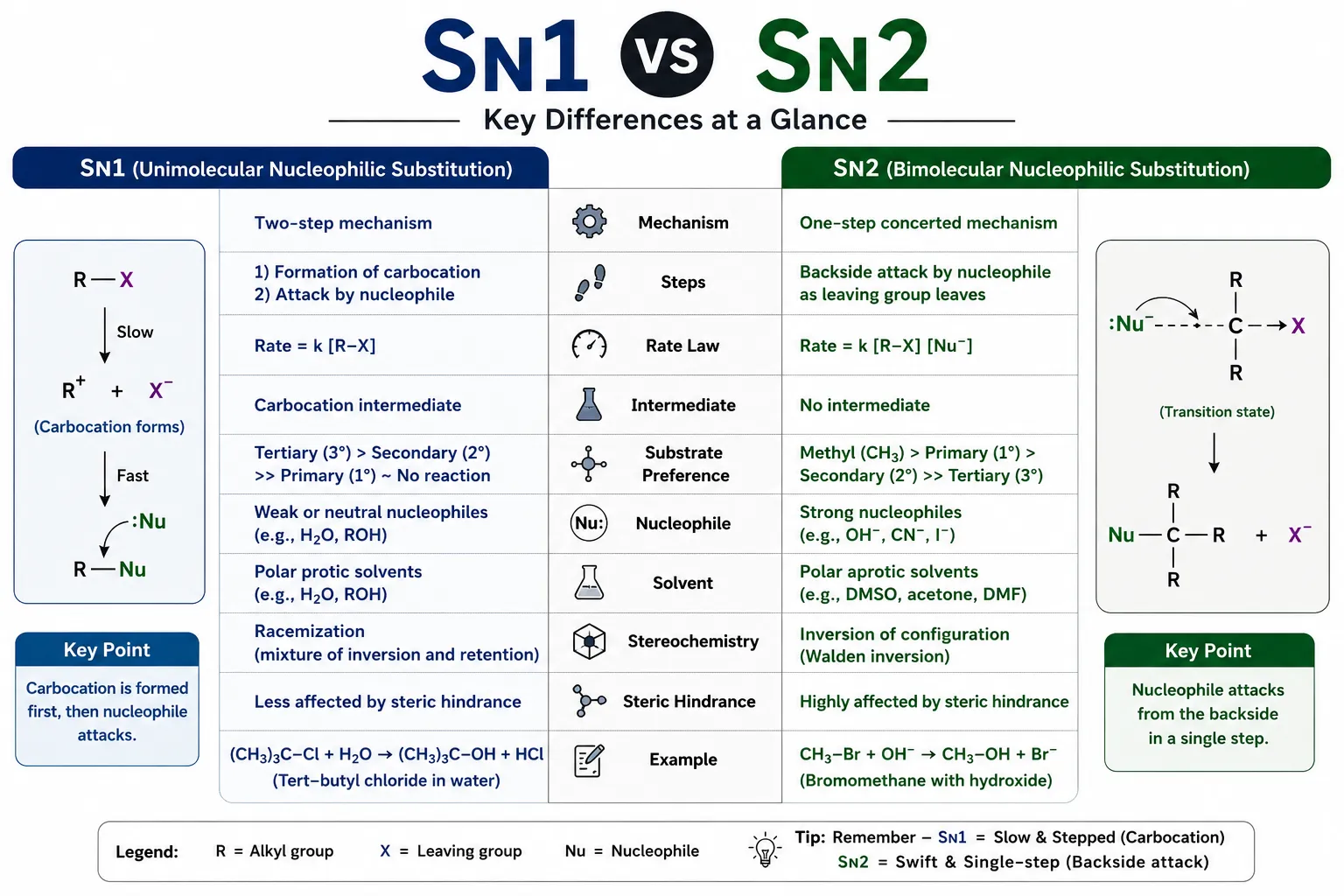
SN1 and SN2 are both substitution reactions, but SN1 happens in two steps through a carbocation intermediate, while SN2 happens in one step with a direct attack by the nucleophile.
Most chemistry students use SN1 and SN2 like they mean the same thing. They don’t, and the difference actually matters. A small mistake can turn an easy exam question into a wrong answer.
A student named Sara learned this the hard way during a chemistry lab. She saw a substitution reaction and quickly labeled it SN2. Later, she discovered the reaction followed an SN1 pathway because a carbocation formed first. That single mistake cost her several marks.
If you’ve ever felt confused by the difference between SN1 and SN2, you’re not alone. Understanding the difference between SN1 and SN2 helps you predict reaction speed, products, and mechanisms. In this guide, we’ll break down the difference between SN1 and SN2 in simple language so you’ll never mix them up again.
Key Difference
The biggest difference is how the reaction happens. SN1 reactions occur in two separate steps and form a carbocation intermediate. SN2 reactions occur in one single step with no intermediate.
Keep reading, we break down all 10 differences in plain, simple terms below.
Why Is This Difference Important to Know?
Knowing the difference between SN1 and SN2 helps students solve chemistry problems faster and more accurately. It also helps scientists predict reaction outcomes in laboratories and industries. Whether you’re preparing for exams, studying organic chemistry, or working with reaction mechanisms, understanding these two pathways can save time and prevent costly mistakes.
10 Points of Difference
1. Basic Definition and Meaning
SN1 stands for “Substitution Nucleophilic Unimolecular.” The reaction rate depends on one molecule. SN2 stands for “Substitution Nucleophilic Bimolecular.” The reaction rate depends on two reacting species.
Example 1: Tert-butyl chloride commonly reacts through SN1.
Example 2: Methyl bromide commonly reacts through SN2.
2. Origin / Source / Main Components
SN1 reactions require a substrate that can form a stable carbocation. Tertiary carbon compounds work best. SN2 reactions prefer less crowded substrates such as methyl and primary compounds because the nucleophile needs room to attack.
Example 1: Tert-butyl bromide favors SN1.
Example 2: Ethyl bromide favors SN2.
3. Process: How It Is Made or Done
SN1 occurs in two steps. First, the leaving group departs and creates a carbocation. Then the nucleophile attacks. SN2 happens in one concerted step where bond breaking and bond making occur at the same time.
Example 1: Hydrolysis of tert-butyl chloride follows SN1.
Example 2: Hydroxide attacking methyl chloride follows SN2.
4. Time Involved / Duration
SN1 reactions spend time forming a carbocation intermediate. This extra step can slow the process. SN2 reactions happen in one direct step, often making them faster when conditions are favorable.
Example 1: Tert-butyl chloride in water may react gradually through SN1.
Example 2: Sodium iodide reacting with methyl bromide often proceeds quickly through SN2.
5. Flavor, Feel, or Output Quality
In chemistry, “output quality” means the product formed. SN1 can create mixtures because the carbocation is flat and can be attacked from different sides. SN2 gives a more predictable product because the attack occurs from one side.
Example 1: Tert-butyl alcohol formation through SN1 may involve rearrangements.
Example 2: Bromide replacing a group on ethyl chloride through SN2 gives a specific product.
6. Primary Use Cases
SN1 reactions work best when the substrate is tertiary and the solvent is polar protic, such as water or alcohol. SN2 reactions are preferred for methyl and primary substrates with strong nucleophiles in polar aprotic solvents. Choosing the right mechanism helps chemists predict the correct product.
Example 1: Tert-butyl chloride reacting in water usually follows SN1.
Example 2: Sodium cyanide reacting with ethyl bromide usually follows SN2.
7. Effect or Impact
SN1 reactions can produce racemic mixtures because the carbocation can be attacked from either side. SN2 reactions cause inversion of configuration, often called the “backside attack.” This difference is important in making medicines and other chemicals where the product’s shape matters.
Example 1: Solvolysis of tert-butyl bromide may form a racemic mixture through SN1.
Example 2: Bromide replacing a leaving group on a chiral alkyl halide gives inversion through SN2.
8. Degree of Specificity or Precision
SN1 is less predictable because carbocations can rearrange into more stable forms before the nucleophile attacks. SN2 is more precise because the nucleophile attacks directly without forming an intermediate. This makes SN2 easier to predict in many reactions.
Example 1: A secondary carbocation may rearrange during an SN1 reaction.
Example 2: Methyl iodide reacts directly with hydroxide through SN2 without rearrangement.
9. Can They Replace Each Other?
SN1 and SN2 cannot always replace each other. The reaction depends on the substrate, nucleophile, solvent, and reaction conditions. Trying to force the wrong mechanism often gives poor yields or no reaction at all.
Example 1: Tert-butyl bromide rarely reacts through SN2 because of steric hindrance.
Example 2: Methyl chloride almost always reacts through SN2 instead of SN1.
10. Long-Term Results / Lasting Impact
Learning SN1 and SN2 helps students understand many other organic chemistry reactions. These mechanisms also guide chemists when designing new drugs, plastics, and industrial chemicals. Once you understand them, many reaction mechanisms become much easier to recognize.
Example 1: Pharmaceutical researchers use substitution mechanisms when designing new medicines.
Example 2: University chemistry students rely on SN1 and SN2 concepts throughout organic chemistry courses.
Nature and Behaviour
SN1: SN1 is patient and stepwise. It first forms a carbocation and then allows the nucleophile to attack. It works best when the intermediate is stable.
SN2: SN2 is direct and efficient. Everything happens in one smooth step. The nucleophile attacks from the back while the leaving group leaves at the same time.
Why Do People Confuse Them?
People often confuse SN1 and SN2 because both are substitution reactions and both replace one group with another. Textbooks also teach them together, making the names sound similar. Students sometimes focus only on the products and forget to study the reaction mechanism.
For example, Alex saw a substitution reaction on an exam and immediately chose SN2. He missed the fact that a stable tertiary carbocation formed first, meaning the correct answer was SN1.
Comparison Table
| Feature | SN1 | SN2 |
| Definition | Two-step substitution reaction | One-step substitution reaction |
| Origin | Stable carbocation intermediate | Direct nucleophilic attack |
| Process | Two separate steps | Single concerted step |
| Duration | Usually slower due to intermediate | Often faster under suitable conditions |
| Output | May form racemic mixtures | Gives inversion of configuration |
| Main Use | Tertiary substrates | Methyl and primary substrates |
| Impact | Carbocation rearrangement possible | No carbocation rearrangement |
| Interchangeable? | No | No |
| Long-term Result | Helps explain complex mechanisms | Helps predict direct substitutions |
| Similarity | Both are nucleophilic substitution reactions | Both replace a leaving group |
| Key Difference | Two-step mechanism with carbocation | One-step mechanism with backside attack |
📌 Pro Tip: Save this for later, bookmark this page or share it with someone who always mixes up SN1 and SN2.
Which Is Better and When?
SN1 is better when the substrate is tertiary and can form a stable carbocation. For example, tert-butyl chloride reacts well in water through the SN1 pathway.
SN2 is better when the substrate is methyl or primary and a strong nucleophile is available. For example, methyl bromide reacts efficiently with hydroxide ions through SN2.
Quick Decision Guide
Choose SN1 if:
☑ The substrate is tertiary.
☑ A stable carbocation can form.
☑ The solvent is polar protic.
☑ Rearrangement is possible.
Choose SN2 if:
☑ The substrate is methyl or primary.
☑ A strong nucleophile is present.
☑ The solvent is polar aprotic.
☑ You expect inversion of configuration.
Still unsure? Drop your question in the comments, we answer every single one.
Metaphors and Similes
Think of SN1 as a traveler who stops at a hotel before reaching the final destination. The hotel is the carbocation intermediate.
Think of SN2 as a nonstop express train that goes straight to its destination.
SN1 and SN2 are like taking a connecting flight versus a direct flight. Both get you there, but they follow different paths.
Connotative Meaning
SN1
- Positive: Flexible because it works well with stable tertiary substrates.
Example: “The chemist chose SN1 for the tertiary alkyl halide.” - Negative: Less predictable because carbocation rearrangements may occur.
Example: “The SN1 reaction produced an unexpected product.” - Neutral: A common substitution mechanism taught in organic chemistry.
Example: “Today’s lecture covered the SN1 mechanism.”
SN2
- Positive: Fast and precise because it happens in one step.
Example: “SN2 gave the expected product with high accuracy.” - Negative: Sensitive to steric hindrance, so bulky substrates react poorly.
Example: “The crowded molecule prevented an SN2 reaction.” - Neutral: Another important nucleophilic substitution mechanism.
Example: “Students compared SN2 with SN1 in class.”
Idioms and Proverbs
- “One step at a time.” SN1 follows this idea because it completes the reaction in separate stages.
- “Straight to the point.” SN2 fits this expression because it reaches the product in one direct step.
- [Coined expression] “Know the substrate before choosing the pathway.” A chemistry student first checked the substrate before deciding whether the reaction was SN1 or SN2.
Frequently Asked Questions (FAQs)
1. What is the main difference between SN1 and SN2?
The main difference is the reaction mechanism. SN1 happens in two steps and forms a carbocation intermediate. SN2 happens in one single step with a direct nucleophilic attack and no intermediate.
2. Can SN1 be used instead of SN2?
Not usually. The correct mechanism depends on the substrate, nucleophile, solvent, and reaction conditions. Using the wrong mechanism often leads to incorrect predictions or poor reaction yields.
3. Which is better, SN1 or SN2?
Neither is always better. SN1 is best for tertiary substrates that form stable carbocations. SN2 is better for methyl and primary substrates because they allow easy backside attack by the nucleophile.
4. How long do SN1 and SN2 reactions last?
The reaction time depends on temperature, solvent, substrate, and nucleophile. In general, SN2 reactions are often faster because they occur in one step, while SN1 reactions require time to form a carbocation.
5. Why do people mix up SN1 and SN2?
People confuse them because both are nucleophilic substitution reactions and often appear together in textbooks. Their similar names also make them easy to confuse, especially for beginners learning organic chemistry.
Related Reading
You might also like:
- → Difference Between SN1 and E1 — /difference-between-sn1-and-e1
- → Difference Between SN2 and E2 — /difference-between-sn2-and-e2
Real-World Importance
Understanding the difference between SN1 and SN2 helps students answer exam questions correctly and understand organic reaction mechanisms. It also helps researchers develop medicines, create new materials, and improve industrial chemical processes. Knowing the correct mechanism saves time and leads to better scientific decisions.
Conclusion
The difference between SN1 and SN2 comes down to how the substitution reaction takes place. SN1 is a two-step mechanism that forms a carbocation intermediate, while SN2 is a one-step reaction with a direct backside attack. They also differ in reaction rate, substrate preference, stereochemistry, solvents, and the possibility of rearrangement.
Now that you know these key differences, you’ll find it much easier to identify the correct reaction mechanism. Whether you’re preparing for an exam, working in a chemistry lab, or simply trying to understand organic chemistry, this knowledge will help you solve reaction problems with greater confidence. You’ll never have to mix up SN1 and SN2 again.
Explore More: FICO vs VantageScore: 10 Differences Most People Miss

I’m Ayesha Sadiqah, and I’m passionate about answering one simple question: “What’s the difference?” Through clear comparison guides, I help readers understand commonly confused words, products, concepts, and everyday topics. My goal is to make complex ideas easy to understand with accurate, practical, and reader-friendly explanations.