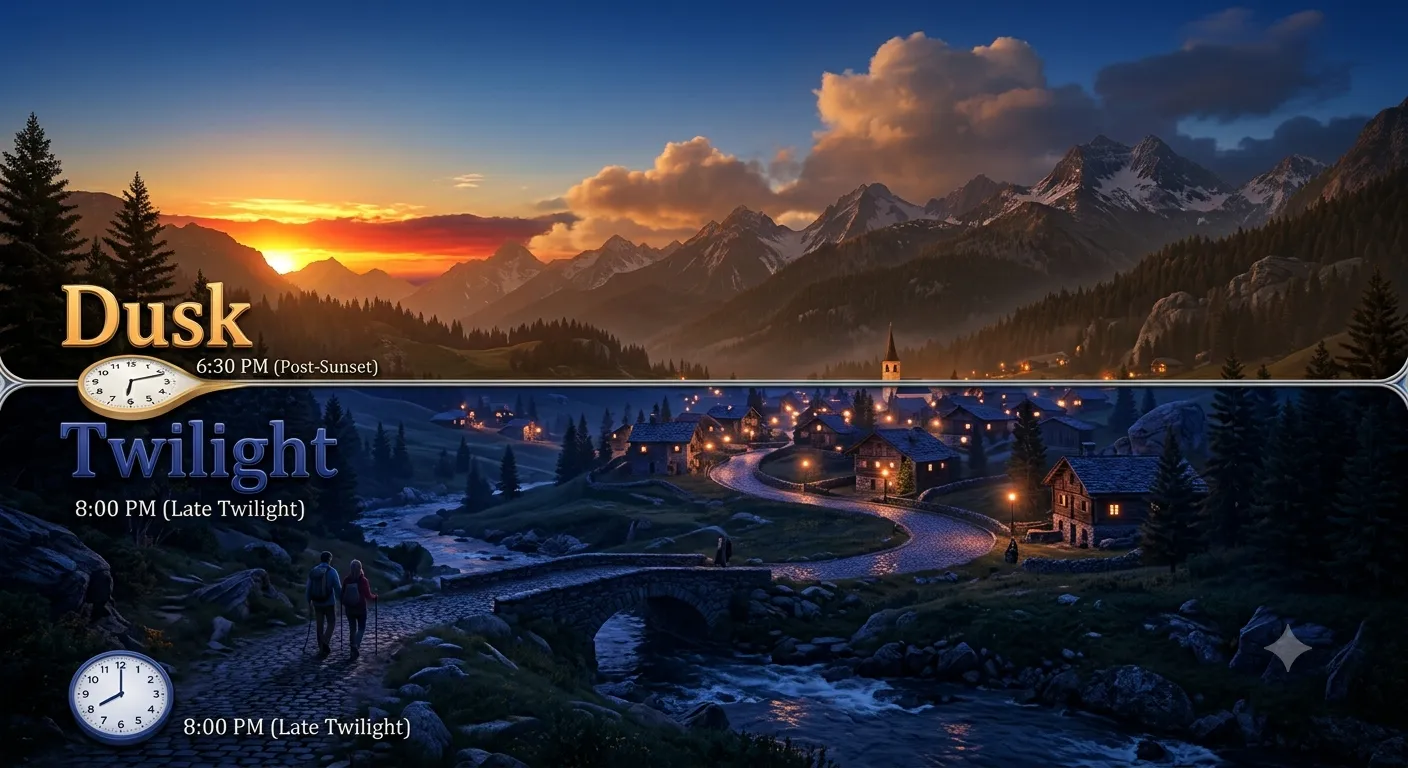
Dusk is the time when daylight is almost gone and night is about to begin. Twilight is the period of soft light before sunrise or after sunset, and dusk is actually one part of twilight.
A few years ago, I was taking photos during a beautiful evening walk. I posted one online and called it a “dusk photo.” Within minutes, someone commented, “That’s twilight, not dusk.”
At first, I thought they were the same thing.
Many people do.
The terms dusk and twilight are often used as if they mean exactly the same thing. Both happen around sunset. Both involve fading light. Both create stunning skies. Yet they are not identical.
This confusion is one reason so many people search for the difference between dusk and twilight. Whether you’re a student, writer, photographer, traveler, or simply curious, understanding the distinction can help you use these words correctly.
The good news is that the difference is much simpler than most explanations make it seem.
In this guide, you’ll learn what dusk and twilight really mean, how they relate to each other, when each occurs, common mistakes people make, and how to use both terms confidently in everyday conversation and writing.
Let’s clear up the confusion once and for all.
Difference Between Dusk and Twilight Quick Answer
Twilight is the period of partial light that occurs before sunrise and after sunset.
Dusk is the darkest stage of evening twilight. It happens just before night begins.
Simple Example
- After the sun sets, you still see light in the sky. That period is twilight.
- When the remaining light is almost gone and darkness is about to take over, that moment is dusk.
Think of it this way:
Twilight is the whole event. Dusk is the final stage of that event.
The Origin and Background of Dusk and Twilight
Understanding where these words come from helps explain why people mix them up.
Origin of Twilight
The word twilight comes from Old English words meaning “half-light” or “two lights.”
It describes a time when daylight and darkness exist together.
Because twilight occurs both before sunrise and after sunset, it refers to a broader period rather than a specific moment.
Origin of Dusk
The word dusk comes from older Germanic roots connected to darkness and shadow.
Unlike twilight, dusk refers only to the evening.
It marks the transition from the last visible light into night.
Why the Confusion Exists
People often confuse the terms because:
- Both happen around sunset.
- Both involve reduced sunlight.
- Both create colorful skies.
- Many movies, books, and social media posts use them interchangeably.
Technically, however, they are not the same thing.
Difference Between Dusk and Twilight Explained
The easiest way to understand the difference is through a comparison.
| Term | Meaning | When to Use | Region/Context |
| Twilight | Period of partial light before sunrise or after sunset | Referring to the entire transition period | Scientific and everyday use |
| Dusk | The darkest stage of evening twilight before night | Referring to the approach of night | Everyday language and astronomy |
| Dawn | The beginning of morning twilight | Referring to sunrise transition | Everyday and scientific use |
| Night | Full darkness after twilight ends | Referring to complete darkness | Universal use |
Twilight Explained
Twilight begins immediately after sunset.
The sun is below the horizon, but its light still reaches the atmosphere.
This creates the soft glow you see in the sky.
Scientists divide twilight into three stages:
- Civil Twilight
- Nautical Twilight
- Astronomical Twilight
Dusk occurs at the end of astronomical twilight.
Dusk Explained
Dusk is not a long period.
It is a specific point near the end of evening twilight.
At dusk:
- Most natural light has disappeared.
- Bright stars become visible.
- Night is about to begin.
In simple terms:
Every dusk is twilight, but not every twilight is dusk.
Which One Should You Use?
Choosing between dusk and twilight depends on what you want to describe.
For Students
Use twilight when discussing astronomy or science.
It is more precise and covers the entire period after sunset.
For Writers and Storytellers
Use dusk when you want to create mood.
Example:
“The village fell silent at dusk.”
This creates a stronger image than simply saying twilight.
For Photographers
Use twilight when referring to the broader lighting period.
Use dusk when describing the final minutes before darkness.
For General Everyday Use
- Use twilight for the whole period after sunset.
- Use dusk for the moment when night is approaching.
Best Neutral Choice
If you’re unsure, twilight is usually the safer and more accurate term.
Common Mistakes With Dusk and Twilight
Many people make the same errors.
Here are the most common ones.
| Mistake | Correction |
| Calling all evening light “dusk” | Use twilight for the full period after sunset |
| Using dusk before sunrise | Use dawn or morning twilight instead |
| Saying dusk lasts for hours | Dusk is a brief stage near nightfall |
| Treating dusk and twilight as identical | Dusk is part of twilight |
| Using twilight only in the evening | Twilight also occurs before sunrise |
Why These Mistakes Happen
The sky changes gradually.
There is no sharp line between daylight, twilight, dusk, and night.
Because of this, people often blur the meanings.
Difference Between Dusk and Twilight in Real-World Examples
Here are examples of how each term appears in real situations.
Professional Email
“The outdoor event will begin during twilight and continue into the evening.”
News Headline
“Drivers urged to use headlights at dusk as visibility decreases.”
Social Media Post
“The colors during twilight tonight were absolutely amazing!”
Formal Report
“Wildlife activity increased significantly at dusk, shortly before darkness.”
Travel Guide
“Visitors often gather during twilight to watch the sunset over the mountains.”
Photography Description
“This image was captured at dusk, just before nightfall.”
Difference Between Dusk and Twilight Data, Trends & Usage
Interest in the difference between dusk and twilight continues to grow.
Who Searches for This Topic?
Common audiences include:
- Students
- Writers
- Photographers
- Nature enthusiasts
- Travelers
- Astronomy learners
Search Intent
Primary intent:
Informational
People want a quick and clear explanation.
Regions With Strong Interest
Searches often come from:
- United States
- United Kingdom
- Canada
- Australia
- India
Why It Matters Today
Photography, social media, astronomy apps, and outdoor activities have increased interest in sunset-related terms.
People want to describe these moments accurately.
As a result, searches about dusk, twilight, dawn, sunset, and nightfall continue to remain popular.
Standalone Comparison Table
| Term/Variant | Meaning | Region/Context | Best Used When |
| Twilight | Partial light before sunrise or after sunset | Scientific and general use | Describing the full transition period |
| Dusk | End of evening twilight before night | Everyday language | Describing approaching darkness |
| Dawn | Beginning of morning twilight | Everyday and scientific use | Describing approaching sunrise |
| Sunset | Moment the sun drops below the horizon | Universal | Referring to the sun’s disappearance |
| Nightfall | Arrival of night | Literary and everyday use | Emphasizing darkness |
Frequently Asked Questions
Q: What does the difference between dusk and twilight mean?
A: Twilight is the period of fading light after sunset or before sunrise. Dusk is the final stage of evening twilight before night begins.
Q: How do you use dusk correctly?
A: Use dusk when referring to the time just before darkness. It describes the end of evening twilight.
Q: Dusk vs twilight — what’s the difference?
A: Twilight is the broader period of partial light. Dusk is one specific point near the end of evening twilight.
Q: Is twilight before or after sunset?
A: Twilight can occur both before sunrise and after sunset. It refers to the transition between day and night.
Q: Is dusk acceptable in formal writing?
A: Yes. Dusk is widely accepted in formal, academic, journalistic, and professional writing.
Q: Where do the words dusk and twilight come from?
A: Twilight comes from Old English words related to half-light. Dusk comes from older Germanic roots connected to darkness.
Q: Can dusk be used for the morning?
A: No. Dusk only refers to the evening. For morning transitions, use dawn or morning twilight.
Conclusion
Understanding the difference between dusk and twilight is easier once you know their relationship.
Remember these key points:
- Twilight is the entire period of partial light before sunrise or after sunset.
- Dusk is the final stage of evening twilight.
- Every dusk is part of twilight, but twilight includes much more than dusk.
- Twilight can happen in the morning and evening, while dusk only occurs in the evening.
If you’re describing the whole period of fading light, choose twilight. If you’re talking about the moment when darkness is almost here, choose dusk.
Using the correct term makes your writing clearer, your descriptions more accurate, and your understanding of natural light much stronger.
Now you know exactly how to use dusk and twilight. Bookmark this guide so you never second-guess these terms again, and share it with anyone who has ever wondered whether dusk and twilight are actually the same thing.
Read More:
Difference Between Dysphoria and Dysmorphia: Quick Guide

I’m Rubab, an SEO content writer specializing in high-quality comparison articles that simplify complex topics and highlight key differences with clarity and accuracy. My content combines in-depth research, proven SEO strategies, and a reader-first approach to deliver valuable insights across language, technology, health, food, and lifestyle topics.
🔍📈 Turning complex comparisons into clear, search-friendly content that informs, engages, and ranks. ✨🏆