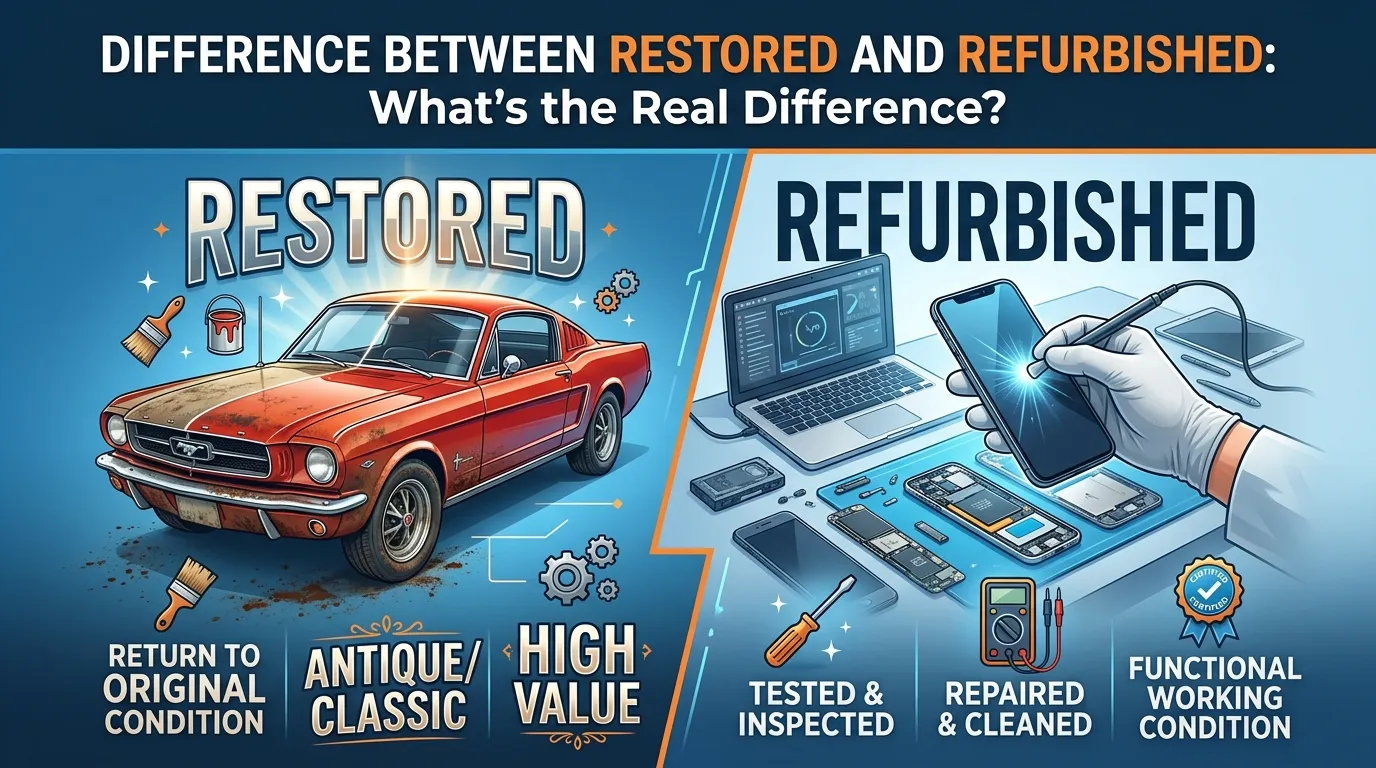
Restored means returned as closely as possible to its original condition, while refurbished means repaired, tested, and improved so it works properly again.
Most people use restored and refurbished like they mean the same thing. They don’t and the difference can affect what you buy, how much you pay, and what quality you receive.
A few months ago, Daniel wanted to buy a used vintage camera from an online marketplace. He saw two listings. One said “restored,” and the other said “refurbished.” Thinking they were identical, he chose the cheaper option. When the camera arrived, he realized it worked well but no longer looked like the original model.
That’s why understanding the difference between restored and refurbished matters. In this guide, you’ll learn the difference between restored and refurbished, what each term means, and how to choose the right option for your needs. If you’ve ever wondered about the difference between restored and refurbished, you’re in the right place.
Key Difference
The biggest difference is the goal of the work. Restored items are brought back as close as possible to their original appearance and condition. Refurbished items are repaired and updated mainly to improve functionality and performance.
Keep reading we break down all 10 differences in plain, simple terms below.
Why Is This Difference Important to Know?
Knowing the difference between restored and refurbished helps you make smarter buying decisions. Whether you’re purchasing electronics, furniture, cars, or antiques, understanding these terms can save money and prevent disappointment. It also helps sellers describe products accurately and buyers set realistic expectations about quality, appearance, and value.
Before We Compare the Details
The terms often appear on product listings, auction sites, and repair shops. Understanding them can help you avoid costly mistakes. If you also want to understand used product conditions, check out our guide: Difference Between Used and Pre-Owned.
10 Points of Difference
1. Basic Definition and Meaning
Restored means an item has been returned as closely as possible to its original state. Refurbished means an item has been repaired, tested, and improved to work properly again.
Example 1: A 1967 Ford Mustang restored to its original factory look.
Example 2: An Apple MacBook refurbished with a new battery and tested components.
2. Origin / Source / Main Components
Restoration often involves older, historic, vintage, or collectible items. Refurbishment commonly applies to electronics, appliances, and everyday products.
Example 1: A restored Rolex watch from the 1970s.
Example 2: A refurbished Dell laptop sold by a certified retailer.
3. Process : How It Is Done
Restoration focuses on preserving original parts whenever possible. Refurbishment focuses on fixing defects and replacing damaged components to improve performance.
Example 1: A restored antique desk with original woodwork preserved.
Example 2: A refurbished Samsung smartphone with a new screen installed.
4. Time Involved
Restoration usually takes longer because specialists carefully recreate or preserve original features. Refurbishment is often faster because the goal is functionality rather than historical accuracy.
Example 1: Restoring a classic Chevrolet Corvette may take months.
Example 2: Refurbishing a Lenovo laptop may take a few days.
5. Quality of Final Output
A restored item often looks very close to the original version. A refurbished item may look different but should perform well.
Example 1: A restored antique clock that matches its original design.
Example 2: A refurbished iPhone with replacement parts and updated software.
6. Primary Use Cases
Restoration is popular for collectibles, antiques, and historical objects. Refurbishment is common for electronics, appliances, and office equipment.
Example 1: Restored vintage furniture displayed in a museum.
Example 2: Refurbished office printers used in businesses.
7. Effect or Impact
Restoration often increases historical or collector value. Refurbishment increases usability and affordability.
Example 1: A restored classic motorcycle becoming more valuable to collectors.
Example 2: A refurbished gaming console becoming affordable for students.
8. Degree of Specificity or Precision
Restoration requires close attention to original details and materials. Refurbishment focuses more on meeting performance standards.
Example 1: A restored painting using period-correct materials.
Example 2: A refurbished tablet passing quality tests before resale.
9. Can They Replace Each Other?
Sometimes the terms overlap, but they are not always interchangeable. An item can be refurbished without being restored.
Example 1: A restored vintage radio retaining its original appearance.
Example 2: A refurbished radio working perfectly but using modern replacement parts.
10. Long-Term Results
Restored items often maintain historical authenticity for years. Refurbished items usually provide reliable everyday performance over time.
Example 1: A restored antique cabinet displayed for decades.
Example 2: A refurbished HP laptop used daily for work and study.
Nature and Behaviour
A restored item values authenticity. It aims to preserve history, original materials, and original appearance as much as possible.
A refurbished item values functionality. It focuses on making the product reliable, safe, and efficient for modern use.
Why Do People Confuse Them?
People confuse these terms because both involve repairing and improving an item. Online sellers also use them inconsistently. In many cases, the item looks better after either process.
For example, someone buying a “restored” smartphone may expect original parts, while the seller actually means the phone was refurbished with replacement components.
Comparison Table
| Feature | Restored | Refurbished |
|---|---|---|
| Definition | Returned close to original condition | Repaired and tested for proper function |
| Origin | Antiques, classics, collectibles | Electronics, appliances, devices |
| Process | Preserve original features | Repair and replace faulty parts |
| Duration | Often longer | Usually shorter |
| Output | Original appearance prioritized | Functionality prioritized |
| Main Use | Historical and collectible items | Everyday practical items |
| Impact | Increases authenticity and value | Improves usability |
| Interchangeable? | Not always | Not always |
| Long-term Result | Preserves originality | Provides reliable performance |
| Similarity | Both involve repair and improvement | Both involve repair and improvement |
| Key Difference | Focus on originality | Focus on functionality |
📌 Save this for later bookmark this page or share it with someone who always mixes up restored and refurbished.
Which Is Better and When?
Restored is better when originality matters. Collectors of vintage cars, antique furniture, and historical items usually prefer restoration because authenticity adds value.
Refurbished is better when you want reliable performance at a lower price. For example, a refurbished laptop or smartphone can provide excellent value without the cost of a brand-new product.
Quick Decision Guide
Choose Restored if:
☑ Original appearance matters most
☑ You collect vintage items
☑ Historical value is important
☑ Authenticity affects resale value
Choose Refurbished if:
☑ You want lower costs
☑ Performance matters most
☑ Modern replacement parts are acceptable
☑ Everyday use is your goal
Still unsure? Drop your question in the comments , we answer every single one.
Metaphors and Similes
A restored item is a time machine that brings the past back to life.
A refurbished item is a second chance that makes something useful again.
Restored and refurbished are like two roads leading to improvement, but each road follows a different destination.
Connotative Meaning
Restored often has a positive meaning because it suggests care, preservation, and authenticity. Example: “The restored cathedral attracted visitors.” It can have a neutral meaning when simply describing repairs. A negative meaning may appear if restoration changes history too much.
Refurbished often has a positive meaning because it suggests value and savings. Example: “She bought a refurbished laptop and saved money.” It can be neutral in product descriptions. Some people view it negatively if they assume refurbished means lower quality.
Idioms and Proverbs
“Good as new” is often used for refurbished products. Example: “After repairs, the laptop was good as new.”
“Turn back the clock” fits restoration. Example: “The team turned back the clock on the old theater.”
[Coined Expression] “Bring the past to polish.” Example: “The museum restored the carriage to bring the past to polish.”
FAQ
1. What is the main difference between restored and refurbished?
Restored focuses on returning an item to its original appearance and condition. Refurbished focuses on repairing and improving functionality so the item works properly again.
2. Can restored be used instead of refurbished?
Not always. Restoration emphasizes originality, while refurbishment emphasizes performance. The correct term depends on the work performed on the item.
3. Which is better : restored or refurbished?
Neither is always better. Restored is best for collectibles and historical items. Refurbished is best for practical everyday products where performance matters more than originality.
4. How long does restored or refurbished last?
Both can last many years when done correctly. The lifespan depends on the quality of workmanship, materials used, maintenance, and how often the item is used.
5. Why do people mix up restored and refurbished?
People often see both terms used for repaired items. Because both improve condition, many assume they mean the same thing even though their goals are different.
Related Reading
You might also like:
→ Difference Between Used and Pre-Owned /difference-between-used-and-pre-owned
→ Difference Between Renewed and Refurbished /difference-between-renewed-and-refurbished
Real-World Importance
Understanding these terms helps when buying electronics, antique furniture, classic cars, or collectibles. It allows you to compare value, avoid misleading listings, and choose the option that matches your needs. A buyer looking for authenticity may prefer restored items, while someone focused on savings may choose refurbished products.
Conclusion
The difference between restored and refurbished comes down to purpose. Restoration aims to return something to its original condition and preserve authenticity. Refurbishment focuses on fixing, testing, and improving functionality. Both processes add value, but they serve different goals.
When originality and historical accuracy matter, restoration is usually the better choice. When reliability and affordability matter most, refurbishment often wins. Now that you know the difference, you’ll never mix them up again. The next time you see these labels, you’ll understand exactly what they mean and make a more confident decision.

I’m Sophia Turner, a content writer who loves making English simple and easy to understand. At Hubdifference.com, I write clear comparisons of commonly confused words, spelling variations, and everyday language differences. I focus on practical examples so readers can quickly learn and use the right words. My aim is to help learners write with clarity, confidence, and accuracy.